As the global automotive industry undergoes its most significant transformation since the invention of the assembly line, the Motor City is once again at the center of the shift. However, the move from internal combustion engines (ICE) to electric vehicles (EVs) requires more than just retooling factories; it requires a massive retooling of human capital. Detroit EV workforce training has become the focal point for city officials, automakers, and educational institutions aiming to secure Michigan’s status as the hub of American mobility.
With major commitments from General Motors, Ford, and Stellantis to electrify their fleets by 2030 and 2035, the demand for workers skilled in battery technology, software engineering, and high-voltage systems is outpacing supply. Local and state entities are now racing to bridge this skills gap, launching comprehensive programs designed to upskill current autoworkers and prepare the next generation for the electric future.
The Urgency of the Electric Shift
The transition to electrification is not merely a trend; it is an industrial mandate. According to data from the Michigan Economic Development Corporation (MEDC), the state has secured billions in EV and battery manufacturing investments over the last two years. Yet, these investments are contingent on the availability of a qualified workforce.
Traditional automotive manufacturing roles are evolving. While mechanical assembly remains important, the modern assembly line worker increasingly needs to interact with robotics and understand electrical safety protocols that were previously unnecessary for standard engine production. Furthermore, the industry faces a sharp need for software developers and electrical engineers, roles that compete directly with the tech sector.
“The challenge isn’t just about creating new jobs, but transforming existing ones,” said a representative from the Workforce Intelligence Network for Southeast Michigan during a recent roundtable. “We have a deep legacy of manufacturing talent in Detroit, but that talent needs to be updated with digital and electrical competencies to remain relevant.”
State and Local Training Initiatives
To address these needs, several major initiatives have launched, positioning Detroit EV workforce training as a top priority for economic development.
The EV Jobs Academy
One of the most significant efforts is the EV Jobs Academy, a legitimate employer-led collaborative convened by the overarching goal of identifying specific skill needs. Supported by a grant from the State of Michigan, this collaborative brings together over 100 stakeholders, including automakers and educational institutions. The goal is to standardize training curriculums so that a certificate earned at a community college in Detroit is recognized by every major employer in the state.
Community College Partnerships
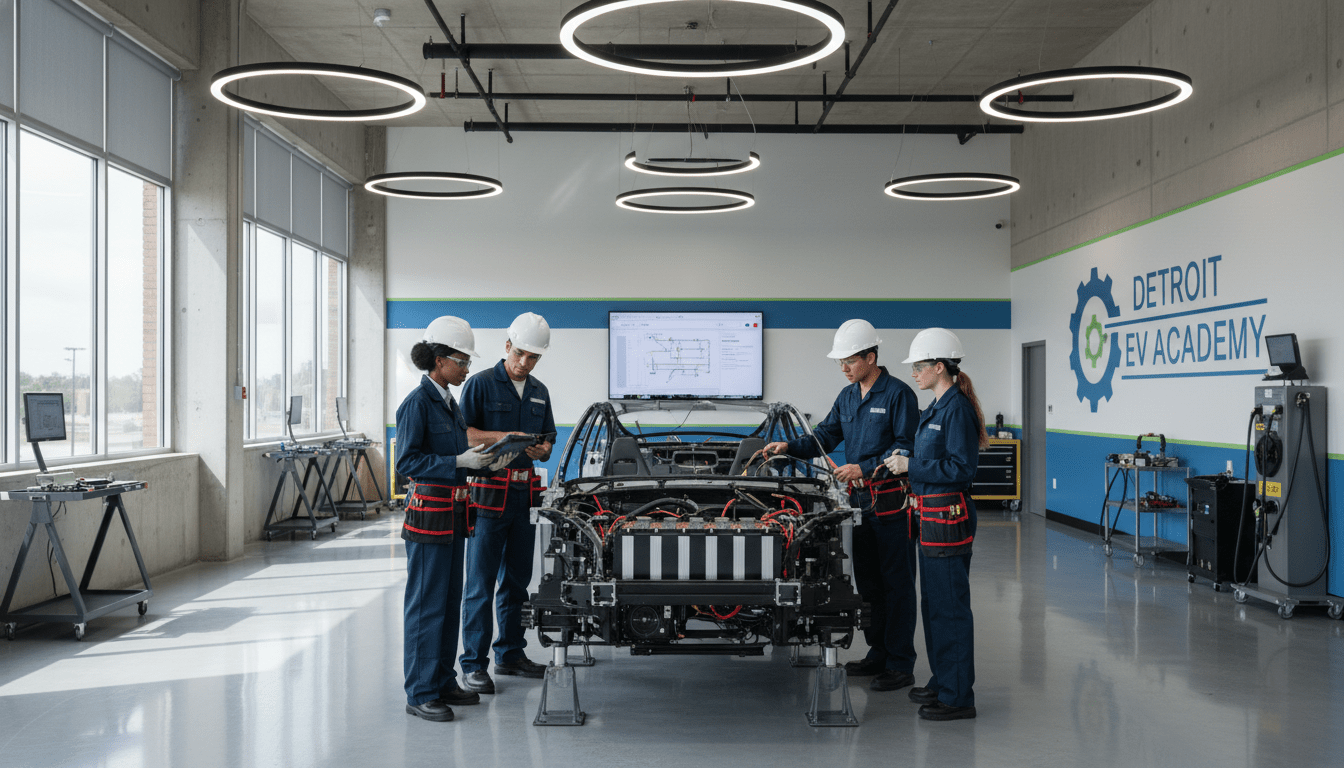
Wayne County Community College District (WCCCD) and Henry Ford College are instrumental in this ecosystem. These institutions have begun rolling out specialized certification programs focused on mechatronics, battery chemistry, and electric vehicle safety standards.
For example, new curriculum modules focus specifically on high-voltage safety—a critical requirement for anyone working on EV battery packs. These programs are designed to be accessible, often taking weeks rather than years to complete, allowing mid-career workers to pivot quickly without taking significant time out of the workforce.
You can read more about local Detroit business development updates on our dedicated economy page, where we track how these educational shifts impact local hiring trends.
Impact on Detroit Residents
For the residents of Detroit, this industrial pivot presents both a challenge and a significant opportunity. Historically, technological shifts have sometimes left urban populations behind. However, the current strategy emphasizes equity and local access.
Detroit at Work, the city’s employment agency, has been actively recruiting residents for these training pathways. The organization emphasizes that many of these new roles do not require four-year degrees but do require specialized technical certifications. By removing barriers to entry—such as offering paid training or stipends—the city aims to ensure that the economic windfall of the EV transition benefits Detroit neighborhoods directly.
“We are seeing a concerted effort to ensure that the people building the cars of the future are actually from the communities where these factories are located,” noted a spokesperson for a local workforce development non-profit. This localization strategy is crucial for the city’s broader economic recovery.
The Role of the Big Three
The private sector is heavily involved in the Detroit EV workforce training ecosystem. Ford Motor Company, for instance, has invested heavily in its BlueOval City projects and is mirroring those training standards locally in Michigan. General Motors has similarly partnered with community colleges to create the “automotive technician of the future.”
These corporations are providing equipment, curriculum guidance, and in some cases, direct apprenticeships. This direct pipeline from classroom to factory floor is intended to reduce the friction often found in workforce development, where training sometimes lags behind current industry practices.
For more on how the automakers are influencing the local landscape, check our coverage on General Motors’ recent investments in Detroit.
Looking Ahead: The 2030 Horizon
The push for a skilled EV workforce is a race against time. Federal incentives provided by the Inflation Reduction Act have accelerated the timeline for domestic battery production. Detroit must produce thousands of qualified workers within the next five years to meet production targets.
The success of these training programs will likely determine whether Detroit remains the undisputed capital of the automotive world or if production gravitates toward southern states that are also aggressively courting EV manufacturing.
Currently, the data suggests cautious optimism. Enrollment in technical trade programs in Southeast Michigan has ticked upward, and the collaboration between competitors—automakers working together on training standards—signals the severity of the need. For Detroiters, the message is clear: the jobs are coming, and the training to get them is now available.