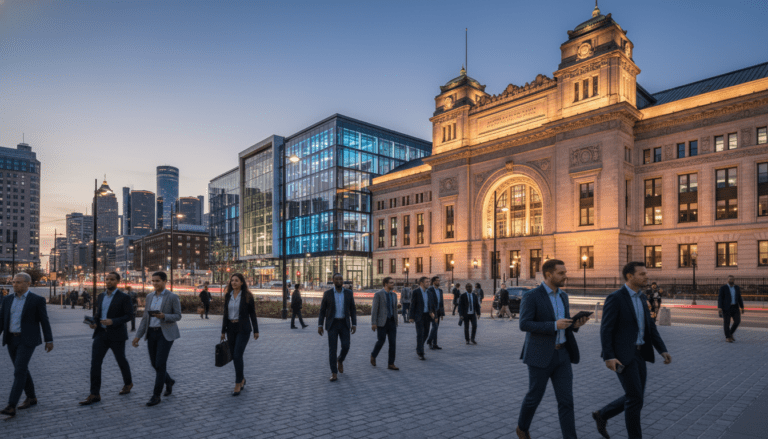
The narrative of Detroit as solely the world’s automotive capital is rapidly evolving, giving way to a more diverse and resilient economic identity. Driven by a surge in venture capital, government support, and the opening of major innovation hubs, the Detroit startup ecosystem has positioned itself as a top emerging cluster for technology and mobility innovation globally.
While the automotive industry remains the city’s backbone, the integration of software, artificial intelligence, and clean energy has blurred the lines between traditional manufacturing and high-tech startups. According to the 2024 Global Startup Ecosystem Report (GSER) by Startup Genome, Detroit has ranked as the number one emerging ecosystem globally, a testament to the region’s ability to leverage its engineering heritage for modern application.
“What we are seeing is a convergence of hardware and software,” said a representative from the Michigan Economic Development Corporation (MEDC). “Detroit is no longer just building cars; it is building the platforms that cars run on, the energy systems that power them, and the financial technologies that facilitate commerce.”
Anchoring Innovation: Michigan Central and Corktown
Central to the growth of the local tech scene is the revitalization of Corktown, anchored by Ford Motor Company’s Michigan Central innovation district. The campus, which includes the meticulously restored Michigan Central Station and the adjacent Book Depository (now Newlab), serves as a physical gravity well for the Detroit startup ecosystem.
Newlab alone is home to nearly 100 startups focused on mobility, energy, and materials science. Unlike traditional co-working spaces, this facility offers heavy machinery and testing grounds, allowing founders to prototype physical products on-site. This “hard tech” focus differentiates Detroit from software-centric hubs like Silicon Valley.
Local urban planners note that the concentration of startups in Corktown is creating a ripple effect. Coffee shops, residential developments, and service providers are springing up to support the influx of engineers and entrepreneurs, fundamentally altering the economic landscape of the neighborhood.
Venture Capital and Funding Trends
Data from EntryPoint, a nonprofit research institution that tracks the local economy, indicates that while national venture capital trends have cooled, Michigan—and Detroit specifically—has shown resilience. In their most recent Detroit Entrepreneurial Ecosystem Report, analysts highlighted that Detroit-based companies have attracted hundreds of millions in venture capital over the last two years, outperforming many peer cities in the Midwest.
Key players like Detroit Venture Partners (DVP) and ID Ventures are active in seeding early-stage companies. However, a funding gap remains for growth-stage companies (Series B and beyond), often forcing successful startups to look to the coasts for larger capital infusions. Addressing this capital continuum remains a primary focus for regional economic development leaders.
Impact on Detroit Residents
For long-time Detroiters, the tech boom brings both promise and caution. The expansion of the Detroit startup ecosystem is not just about corporate valuation; it is about workforce development and inclusive growth. Organizations like TechTown Detroit and Black Tech Saturdays are working aggressively to ensure that the wealth generated by this sector remains accessible to Detroit residents.
“The goal is to prevent a digital divide where the tech sector operates in a silo, separate from the neighborhoods,” said a program director at a local workforce development non-profit. “We are seeing more boot camps and apprenticeship programs designed to transition workers from legacy manufacturing roles into high-growth tech positions.”
Furthermore, the rise of minority-led startups is a critical metric for the city. Detroit has one of the highest concentrations of Black-founded startups in the country. Support networks have emerged to provide non-dilutive capital and mentorship to underrepresented founders, aiming to correct historical disparities in access to business credit.
Mobility, Fintech, and Beyond
While mobility remains the crown jewel, the ecosystem is diversifying. Fintech (financial technology) is a rapidly growing sector, bolstered by the presence of Rocket Mortgage and other large lenders who are spinning out proprietary technologies and funding smaller ventures. Additionally, green energy initiatives are gaining traction as state mandates for renewable energy drive demand for cleantech solutions.
A recent report from the University of Michigan’s economic forecast suggests that the diversification of the startup landscape provides a buffer against the cyclical nature of the automotive industry. When auto sales dip, software and service-based startups can often maintain stability, smoothing out the region’s macroeconomic peaks and valleys.
Challenges and Future Outlook
Despite the optimism, the Detroit startup ecosystem faces hurdles. Talent retention remains a critical challenge. While Detroit’s cost of living is attractive compared to San Francisco or New York, the city must compete fiercely to keep graduates from the University of Michigan and Michigan State University from leaving the state.
Transit infrastructure is another pain point cited by founders. A fragmented regional transit system makes it difficult for employees without cars to access innovation hubs like Newlab or the Detroit Smart Parking Lab. City officials have acknowledged this, citing recent grant applications for improved transit corridors as a necessary step to support the business community.
Looking ahead to 2025 and beyond, the trajectory appears positive. With the North American International Auto Show increasingly pivoting toward “AutoMobili-D” and tech showcases, the world continues to look to Detroit for the future of movement. As legacy automakers transition to mobility service providers, the symbiosis between corporations and startups will likely deepen, cementing Detroit’s status not just as the Motor City, but as a premier innovation hub.