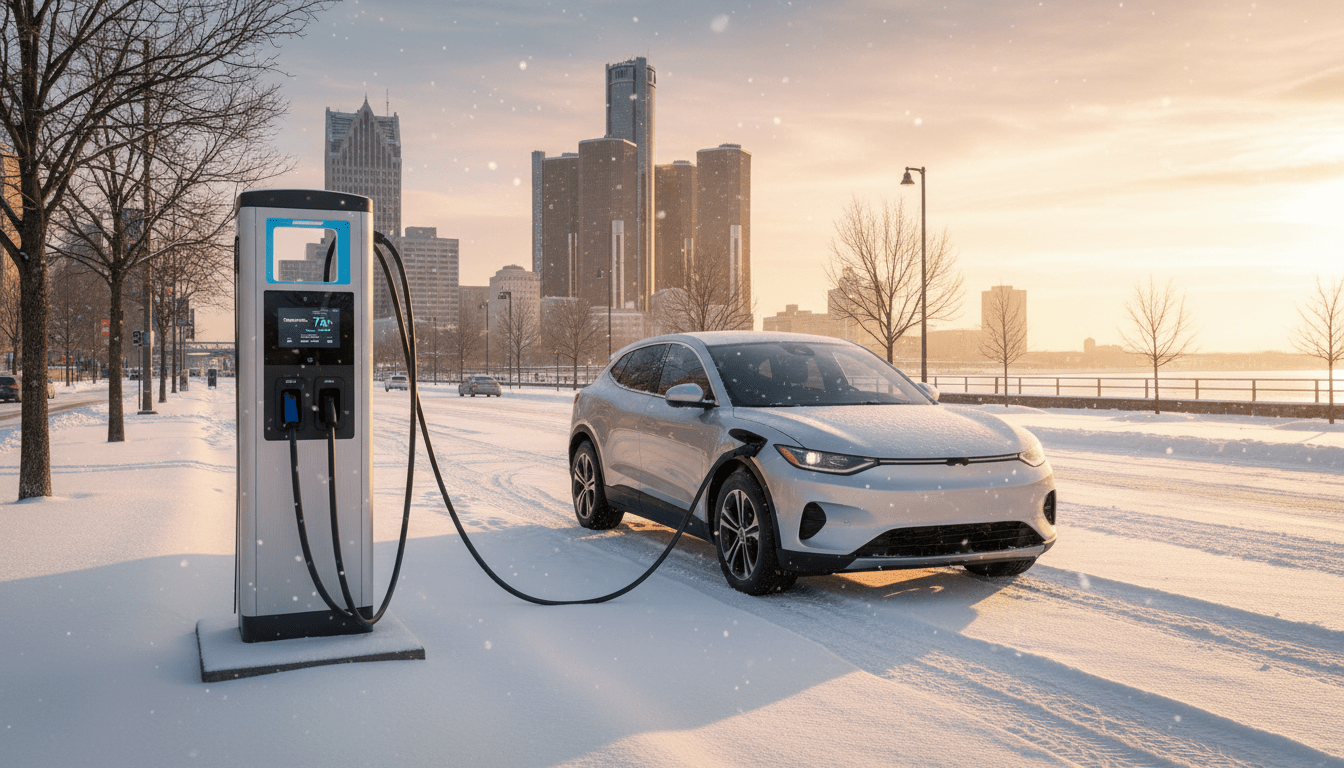
Detroit, widely known for over a century as the world’s Motor City, is aggressively pivoting to secure its future as the global leader in modern mobility. In a significant move to support this transition, city officials and state partners have announced a comprehensive expansion of Detroit EV charging stations designed to bridge infrastructure gaps and support the growing number of electric vehicle owners across the metro area.
The initiative, supported by a mix of federal grants via the Bipartisan Infrastructure Law and private investment from stakeholders like DTE Energy, aims to install hundreds of new charging ports throughout the city by 2026. This infrastructure push is a critical component of the Michigan Future Mobility Plan, which sets a goal for the state to support 2 million electric vehicles on its roads by 2030.
Expanding Detroit EV Charging Stations for a Greener Future
According to data from the Michigan Department of Environment, Great Lakes, and Energy (EGLE), lack of reliable public charging infrastructure remains the primary barrier to EV adoption for residents in urban centers. While suburban areas have seen a steady increase in home-based charging solutions, Detroit residents living in multi-unit dwellings or homes without private driveways face significant hurdles.
To address this, the new expansion plan prioritizes public access. “The goal is to ensure that a resident in any Detroit neighborhood is never more than a few miles from a fast, reliable charger,” stated a representative from the City of Detroit’s Office of Mobility Innovation. “We are moving beyond just highway corridors to place infrastructure where people actually live and work.”
The rollout will focus heavily on Level 3 DC Fast Chargers, which can charge most modern EVs to 80 percent battery capacity in 20 to 30 minutes. This technology is viewed as essential for urban drivers who cannot rely on overnight trickle charging.
Federal Funding and Strategic Partnerships
The expansion is largely fueled by the National Electric Vehicle Infrastructure (NEVI) Formula Program. Michigan is slated to receive approximately $110 million over five years to build out this network. While the initial phase focused on alternative fuel corridors along I-75 and I-94, the upcoming phase, expected to break ground later this year, targets community-based charging solutions.
DTE Energy has also ramped up its involvement through its Charging Forward program. The utility provider creates incentives for local business owners to host chargers, effectively subsidizing the costly electrical upgrades required to install high-voltage equipment. By partnering with local businesses in the Detroit auto sector, the program aims to create a dense network of charging points at grocery stores, parking garages, and community centers.
Impact on Detroit Residents and Local Economy
For Detroiters, this infrastructure project promises more than just convenience; it represents a potential economic boost. The installation and maintenance of these stations require a skilled workforce, and local trade unions are gearing up to train electricians specifically for EV infrastructure jobs.
“We are looking at a long-term shift in the automotive job market,” said a spokesperson for the International Brotherhood of Electrical Workers (IBEW) Local 58. “These are high-tech jobs that are staying right here in the city.”
Furthermore, increasing the availability of Detroit EV charging stations is expected to drive traffic to local businesses. Studies cited by the U.S. Department of Transportation suggest that retail locations with EV charging capabilities see increased dwell time and higher spending from customers while their vehicles charge.
However, equity remains a central concern. Community advocates have long pointed out that early EV infrastructure was concentrated in affluent areas like Downtown and Midtown. The city’s new strategic plan explicitly targets historically underserved neighborhoods to prevent the creation of “charging deserts.”
Addressing ‘Range Anxiety’ in the Winter
One of the specific challenges facing Detroit drivers is the impact of cold weather on battery performance. Lithium-ion batteries can lose significant range in freezing temperatures, making the density of the charging network even more critical during Michigan winters.
To combat this, the new stations are being equipped with weather-hardened technology designed to operate reliably in sub-zero temperatures. “Reliability is just as important as availability,” noted a project manager from the Michigan Department of Transportation (MDOT). “A charger that is offline due to frost is useless. We are holding vendors to strict uptime requirements to ensure Detroiters aren’t left stranded.”
Future Outlook: The Road Ahead
As the automotive industry continues its seismic shift toward electrification, Detroit’s ability to adapt its infrastructure is being watched globally. General Motors and Ford, both headquartered in the metro area, have staked their futures on electric lineups, increasing the pressure on local governments to lead by example.
The city is also exploring innovative pilot programs, such as inductive charging roads—wireless charging embedded in the pavement—near Michigan Central Station in Corktown. While these futuristic technologies are still in the testing phase, the immediate focus remains on the rapid deployment of standard plug-in stations.
For residents interested in learning more about how these changes affect their neighborhoods, Detroit Local Living & Info offers resources on zoning changes and upcoming community meetings regarding infrastructure developments.
With shovels ready to hit the ground for this next phase of development, Detroit is taking concrete steps to ensure its infrastructure matches its legacy. The expansion of the charging network is not just about cars; it is about modernizing the city’s grid and ensuring equitable access to the next generation of transportation.