For decades, the narrative of the Midwest economy has been inextricably linked to heavy manufacturing and the automotive assembly line. However, a significant transformation is underway in Michigan’s largest city. The Detroit startup ecosystem is rapidly evolving, moving beyond its industrial roots to foster innovation in mobility, financial technology, and green energy. This shift is not only diversifying the local economy but is also positioning Detroit as a central anchor for economic stability across the wider Midwest region.
According to recent data from the Michigan Venture Capital Association (MVCA), the state has seen a resilient upward trend in venture capital investment, with Detroit serving as the primary hub for this activity. While coastal tech hubs face saturation and skyrocketing costs, Detroit is emerging as a pragmatic alternative, attracting entrepreneurs who value the city’s engineering heritage and relatively lower cost of living.
The Diversification of the Detroit Startup Ecosystem
While the automotive industry remains the bedrock of Michigan’s economy, the definition of “mobility” is expanding. Startups are no longer just building car parts; they are developing the software, sensors, and artificial intelligence that power autonomous vehicles. This evolution is evident in districts like Detroit’s automotive heritage sectors, which are being retrofitted for high-tech innovation.
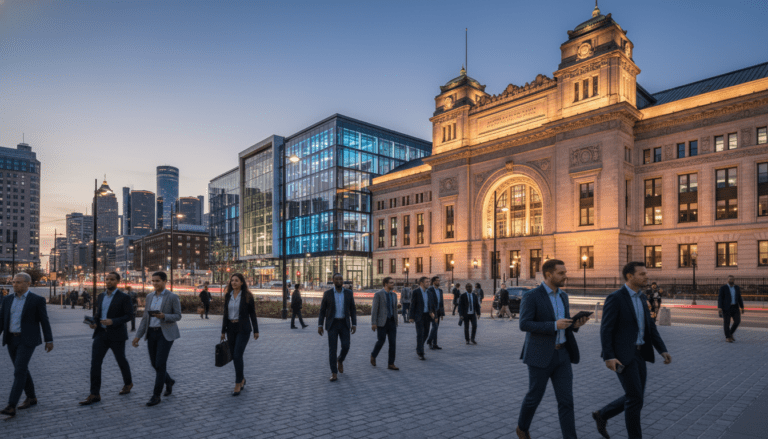
Michigan Central, the innovation district anchored by Ford’s restoration of the historic train station, serves as a prime example. It acts as a magnet for mobility startups looking to test technologies in real-world environments. “The infrastructure available here for hardware and mobility startups is unmatched globally,” said a representative from Newlab at Michigan Central during a recent press briefing. “Detroit provides the physical space and the manufacturing expertise that software-only hubs cannot offer.”
Beyond mobility, the fintech sector is gaining traction. Following the success of unicorns like StockX, a new wave of digital finance and cybersecurity firms is taking root downtown. This diversification is crucial for the Midwest economy, offering a buffer against the cyclical nature of the manufacturing industry.
Impact on Detroit Residents and the Local Workforce
The rise of the Detroit startup ecosystem has tangible implications for local residents, primarily in the form of job creation and workforce development. Unlike traditional manufacturing roles, which have seen a decline due to automation and offshoring, startup-led growth focuses on specialized technical skills.
However, this shift presents both opportunities and challenges. Data from the Detroit Regional Chamber indicates a growing demand for computer science and engineering professionals. To bridge the gap, local organizations are stepping up. TechTown Detroit, an entrepreneurship hub, has been instrumental in supporting small business owners and tech founders alike, ensuring that the benefits of this economic shift are not limited to transplant workers.
For the average Detroit resident, the growth of startups translates to a revitalized engagement with the city’s commercial corridors. New businesses require office space, catering, legal services, and maintenance, creating a multiplier effect that supports the broader local service economy. Furthermore, as startups mature, they contribute to the tax base, funding essential city services.
Attracting Capital to the Midwest
Historically, venture capital has been concentrated in Silicon Valley, New York, and Boston. However, the “Rise of the Rest” philosophy—championed by investors like Steve Case—is finding fertile ground in Detroit. Institutional investors are beginning to view the Midwest not as a “flyover country” but as an undervalued market with high potential returns.
According to the 2024 Annual Research Report by the Michigan Venture Capital Association, there are currently over 160 venture-backed companies in the state, a significant portion of which are headquartered in Metro Detroit. The report highlights that for every dollar invested in a Michigan startup, there is a significant return in local economic activity.
“We are seeing a maturity in the market,” noted a senior analyst from EntryPoint, a nonprofit research institution. “Five years ago, the conversation was about getting startups to launch here. Today, the conversation is about Series B and Series C funding rounds—getting them to scale here.”
Talent Retention: Stopping the Brain Drain
A critical component of the Midwest economy is talent retention. For years, graduates from the University of Michigan and Michigan State University migrated to the coasts for tech jobs. The robust Detroit startup ecosystem is reversing this trend.
By offering competitive salaries and the opportunity to work on cutting-edge problems—such as the electrification of transport and sustainable energy—Detroit companies are keeping talent in-state. The lower cost of living compared to San Francisco or Austin allows these workers to achieve a higher quality of life, which in turn fuels the local housing market.
Challenges and Future Outlook
Despite the optimism, significant hurdles remain. Access to early-stage capital for minority founders remains a critical issue. While Detroit is a majority-Black city, the demographic makeup of startup founders does not yet fully reflect the population. Initiatives like the Detroit Development Fund are working to address this disparity, but systemic gaps persist.
Additionally, the region must improve its public transportation infrastructure to support a dense, connected innovation hub. Connectivity between neighborhoods and business districts is vital for an inclusive economy.
Looking ahead to 2025 and beyond, the trajectory suggests that Detroit will continue to solidify its role as the Midwest’s innovation capital. As the line between traditional manufacturing and high-tech blurs, Detroit’s unique combination of industrial muscle and digital agility places it in a formidable position.
For the Midwest economy, Detroit’s success is a bellwether. It demonstrates that with targeted investment, public-private partnerships, and a leverage of historical strengths, rust-belt cities can successfully pivot into the economy of the future.