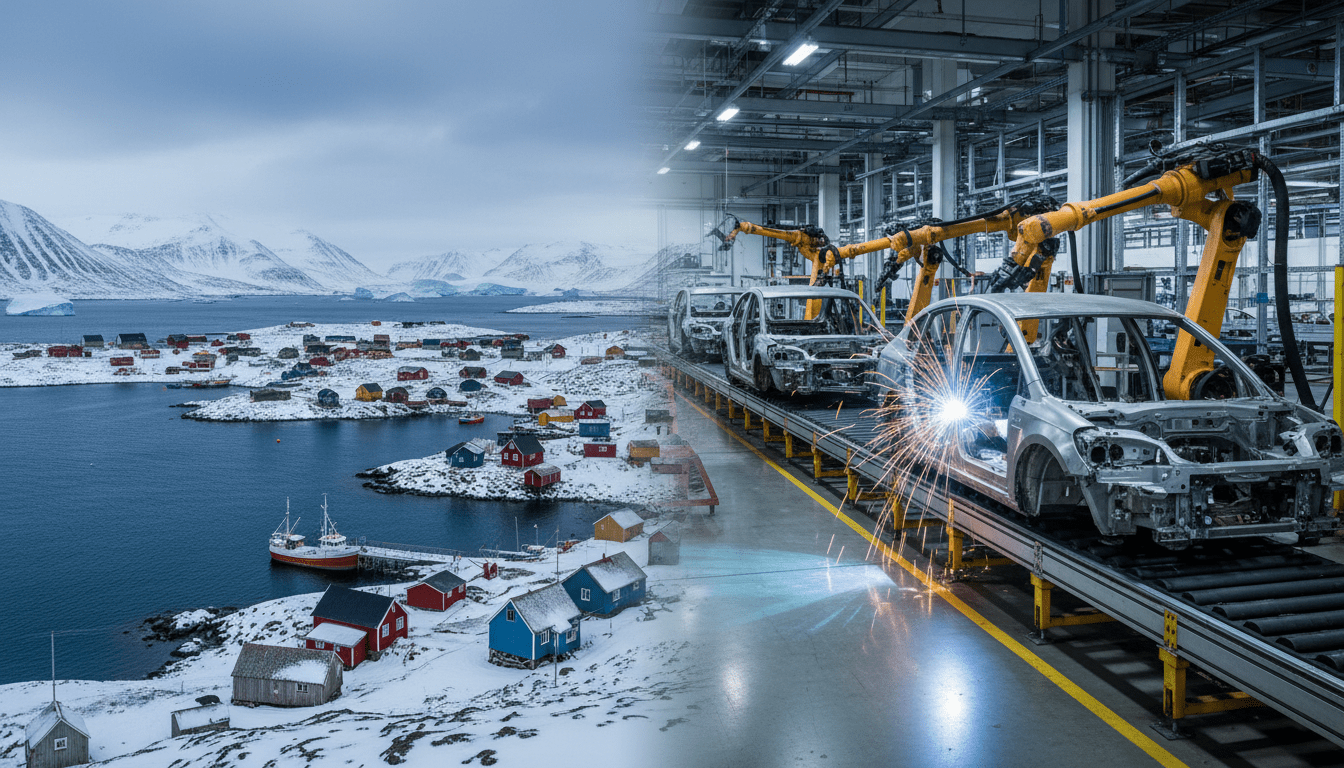
DETROIT — Following recent comments by President-elect Donald Trump reiterating his interest in the United States purchasing Greenland, officials and residents of the semi-autonomous Arctic island have voiced strong opposition. While the geopolitical headline has stirred controversy in Copenhagen and Nuuk, the situation is being closely monitored by economic analysts in Detroit, where the automotive industry’s transition to electric vehicles (EVs) relies heavily on the very resources Greenland possesses in abundance: rare earth minerals.
Trump, who first floated the idea of buying Greenland during his first term in 2019, has reportedly revived the discussion as he prepares to return to the White House. The suggestion has been met with incredulity and rejection from Danish and Greenlandic leadership, yet it highlights a critical strategic scramble for resources that directly impacts Detroit’s manufacturing future.
Greenland’s Stance: “We Are Not for Sale”
The reaction from Greenland has been swift and unequivocal. Local lawmakers and citizens have expressed concern that their home is being treated as a commodity rather than a sovereign nation with its own culture and government. In Nuuk, the capital, sentiment remains consistent with the rejection issued in 2019.
“We are open for business, but we are not for sale,” remains the prevailing message from the island’s leadership. Greenland, an autonomous territory within the Kingdom of Denmark, handles its own domestic affairs while Denmark manages defense and foreign policy. The suggestion of a purchase strikes a nerve regarding colonial history and sovereignty.
According to reports from international news agencies, Danish politicians have dismissed the idea as absurd. However, the persistence of the topic suggests that the incoming U.S. administration views the Arctic island as a strategic imperative, both for military positioning and resource acquisition.
The Detroit Connection: The Race for Rare Earths
While the diplomatic row plays out in the Arctic, the implications ripple down to the factory floors of Southeast Michigan. Greenland is home to some of the world’s largest undeveloped deposits of rare earth elements (REEs)—minerals such as neodymium, praseodymium, and dysprosium that are essential for the production of permanent magnets used in EV motors.
Currently, the supply chain for these critical minerals is dominated by China. For Detroit automakers like General Motors and Ford, which are investing billions into Detroit’s EV manufacturing expansion, diversifying the supply chain is a top priority. Dependence on Chinese exports poses a significant risk to the stability of the U.S. auto industry.
“The interest in Greenland isn’t just about land; it is about the periodic table,” said industry analyst Mark Stevenson. “For Detroit to successfully transition to an all-electric future, secure access to rare earth minerals is non-negotiable. Greenland represents a potential alternative to Chinese dominance, regardless of whether it is a territory or a purchased asset.”
Impact on Detroit Residents and Jobs
For the average Detroiter, high-level geopolitical maneuvering might seem distant, but the outcome of these resource wars has a direct effect on local employment. The stability of the local auto industry supply chain determines production schedules, factory tooling, and job security.
If the U.S. were to gain greater influence over Greenland’s mining sector—whether through diplomacy or the highly unlikely scenario of a purchase—it could streamline the flow of raw materials to battery plants in Michigan. Conversely, a diplomatic fallout between the U.S., Denmark, and Greenland could stall potential mining partnerships, keeping Detroit automakers reliant on volatile foreign markets.
According to the U.S. Geological Survey (USGS), Greenland holds estimated reserves of rare earth minerals that could sustain global consumption for years. Unlocking these resources is seen as a key step in bringing down the cost of electric vehicles, making them more affordable for Detroit consumers and more profitable for local manufacturers.
Historical Context and Strategic Value
This is not the first time the United States has shown interest in the island. In 1946, President Harry S. Truman offered to buy Greenland from Denmark for $100 million in gold, citing its strategic location for defense. The U.S. already operates Thule Air Base (now Pituffik Space Base) on the island, a critical asset for missile warning and space surveillance.
The renewed interest, however, is driven as much by economics as it is by defense. As the Arctic ice melts due to climate change, shipping routes and mining sites are becoming more accessible. This has attracted attention not just from the U.S., but also from China, which has previously attempted to invest in Greenland’s airport infrastructure and mining projects.
What Happens Next?
Legal and political experts agree that a direct purchase of Greenland is virtually impossible under international law without the consent of both the Danish government and the people of Greenland. The 1953 Danish constitution and the 2009 Act on Greenland Self-Government grant the islanders recognized rights that preclude a simple real estate transaction.
However, the rhetoric signals a more aggressive U.S. policy in the Arctic. For Detroit, this means the federal government is likely to push harder for mining rights and trade deals involving the island’s resources. As the auto industry continues its massive pivot to electrification, the political status of this icy island 2,500 miles away will remain a surprising but significant factor in the Motor City’s economic forecast.