In the quiet hum of the assembly lines at the Jefferson North Assembly Plant and the bustling cafes of Hamtramck, a global transformation is making itself felt. While the concepts of "the dictator, the imperialist, and the new world order" may sound like the title of a political science textbook, these geopolitical forces are actively rewriting the economic and social contract of Detroit. As the world moves away from the unfettered globalization of the past thirty years toward a fractured landscape of competing power blocs, Detroit—a city deeply integrated into the global supply chain and home to some of the nation’s most diverse diaspora communities—finds itself on the front lines of this new reality.
The era of predictable global trade is fading, replaced by what experts are calling a "New World Order" defined by supply chain sovereignty, re-industrialization, and heightened political tension. For the Motor City, this shift presents a complex paradox: it is simultaneously a source of deep anxiety for immigrant families fearing for relatives abroad and a potential economic catalyst driving manufacturing jobs back to Michigan.
The Economic Impact: Reshoring in the Face of Instability
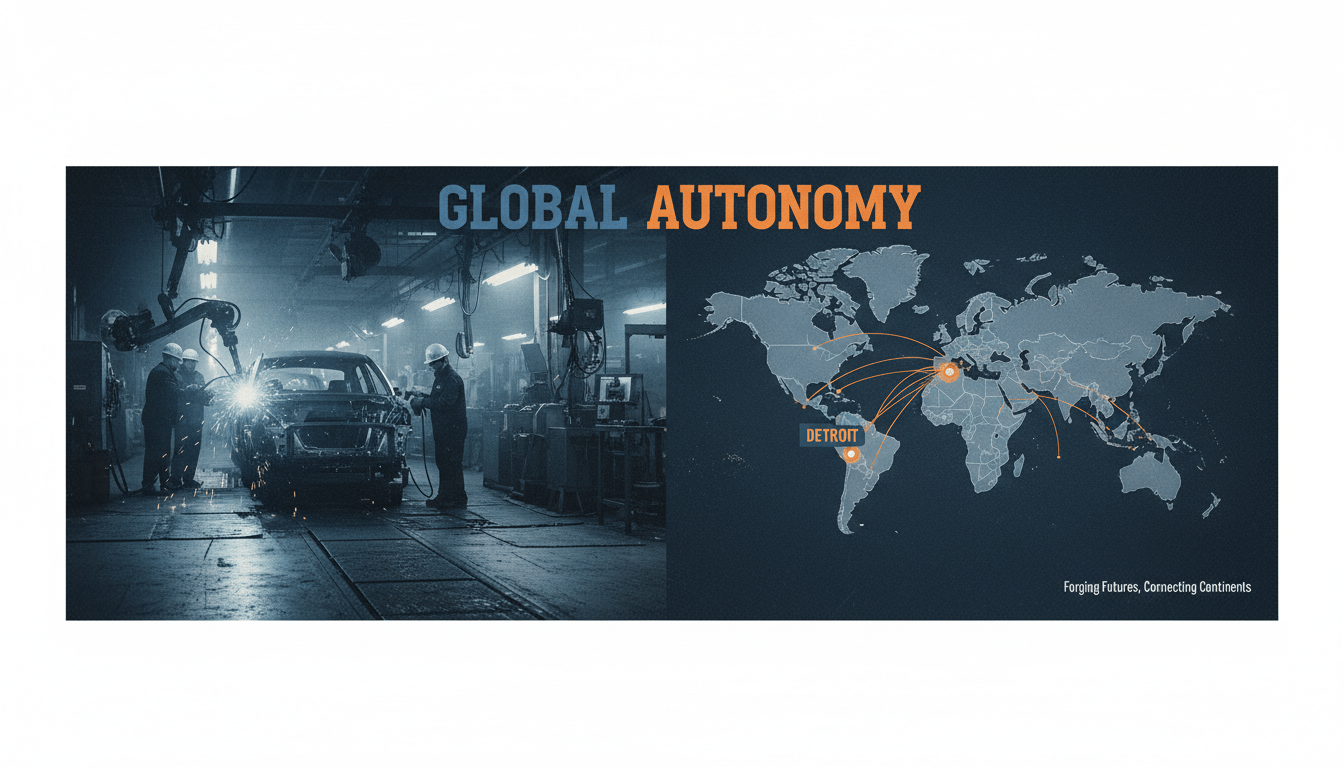
For decades, Detroit’s automotive giants relied on a borderless world where parts could move seamlessly from Shenzhen to Sterling Heights. However, the rise of authoritarian regimes and expansionist foreign policies—often categorized in diplomatic circles under the archetypes of "the dictator" and "the imperialist"—has shattered that model. The weaponization of energy supplies and critical minerals has forced Detroit automakers to pivot rapidly.
According to recent data from the Detroit Regional Chamber, the push for "near-shoring"—moving production closer to home to avoid geopolitical adversaries—has accelerated investment in Southeast Michigan. Ford and General Motors are no longer just looking for the cheapest labor; they are looking for the safest supply chains. This geopolitical friction is arguably the primary driver behind the sudden surge in local battery plant developments and the re-tooling of existing facilities.
"We are seeing a direct correlation between global instability and local investment strategies," noted Dr. Alan Reynolds, an economic analyst tracking regional development. "The risks associated with relying on nations with unpredictable leadership—the so-called ‘dictator risk’—have made Detroit and its surrounding suburbs attractive again simply because they offer stability. It is a chaotic way to achieve growth, but it is resulting in jobs returning to the region."
However, this transition comes with costs. Inflationary pressures, driven by trade wars and tariffs, are impacting local construction projects. Detroit housing market trends indicate that the cost of materials has risen sharply, complicating affordable housing developments in neighborhoods that desperately need them.
Impact on Detroit Residents and Diaspora Communities
Beyond the spreadsheets of the automotive executives, the rise of global authoritarianism hits Detroit at a visceral, human level. The city and its metro area boast some of the highest concentrations of Middle Eastern and Eastern European immigrants in the United States. When a "dictator" moves troops across a border halfway around the world, the tremors are felt instantly in living rooms in Dearborn, Hamtramck, and Troy.
In Hamtramck, where the Ukrainian and Yemeni communities live side-by-side, global news is local news. Residents have organized repeated forums and fundraisers over the past year, responding to conflicts driven by imperialist expansionism abroad. For these Detroiters, the "New World Order" isn’t an abstract theory; it is a daily concern regarding the safety of loved ones and the stability of their homelands.
"You cannot separate Detroit from the world," said Elena Kowalska, a community organizer working with recent refugees in the metro area. "When we talk about dictators or imperialism, we aren’t talking about history books. We are talking about why new families are arriving in Southeast Michigan this month, needing jobs and housing. The global political climate is directly shaping the demographics of our neighborhoods."
This influx of new residents is reshaping the cultural fabric of the city, breathing new life into older neighborhoods but also straining social services. Local non-profits report a 15% increase in demand for resettlement assistance compared to three years ago, a statistic directly attributable to geopolitical displacement.
Background & Data: The Shift to Deglobalization
To understand the magnitude of this shift, one must look at the trade numbers. Data from the U.S. Census Bureau shows a distinct change in the origin of imports flowing into Detroit’s customs district. There is a marked decline in reliance on single-source adversarial nations and an uptick in trade with North American partners (Canada and Mexico). This aligns with the United States–Mexico–Canada Agreement (USMCA) framework, which was designed to insulate the North American auto industry from external shocks.
Furthermore, federal incentives such as the CHIPS and Science Act are funneling money into the region to combat the dominance of foreign powers in technology manufacturing. This is the "New World Order" in practice: a return to industrial policy where the government actively supports strategic industries to protect national security. For Detroit, this means that the federal government is once again a partner in the city’s industrial health, a dynamic that has not been this prominent since the mid-20th century.
Local Business Reactions
Small business owners are also navigating these choppy waters. Local business development in Midtown has been hampered by supply chain unpredictability. Restaurant owners report fluctuating food costs tied to global energy prices, while local manufacturers struggle to source steel and aluminum at predictable rates.
"It feels like we are at the mercy of decisions made in capitols thousands of miles away," said Greg Mathis, a local logistics manager for a Tier-2 auto supplier. "The predictability is gone. We have to plan for worst-case scenarios—embargoes, tariffs, sudden conflicts—every quarter."
What Happens Next?
As the geopolitical landscape continues to fracture, Detroit stands at a crossroads. The rhetoric of "the dictator and the imperialist" appearing in global headlines serves as a grim warning of instability, yet the resulting "New World Order" of localized manufacturing offers a path toward economic resilience for Michigan.
The forecast for the coming years suggests a continued hardening of trade blocs. For Detroit, this likely means sustained investment in manufacturing technology and a continued pivotal role for its immigrant communities, who serve as the cultural and economic bridge between Michigan and the wider world. The city’s ability to adapt to this new era—balancing the economic benefits of reshoring with the social challenges of a volatile world—will define its trajectory for the next decade.