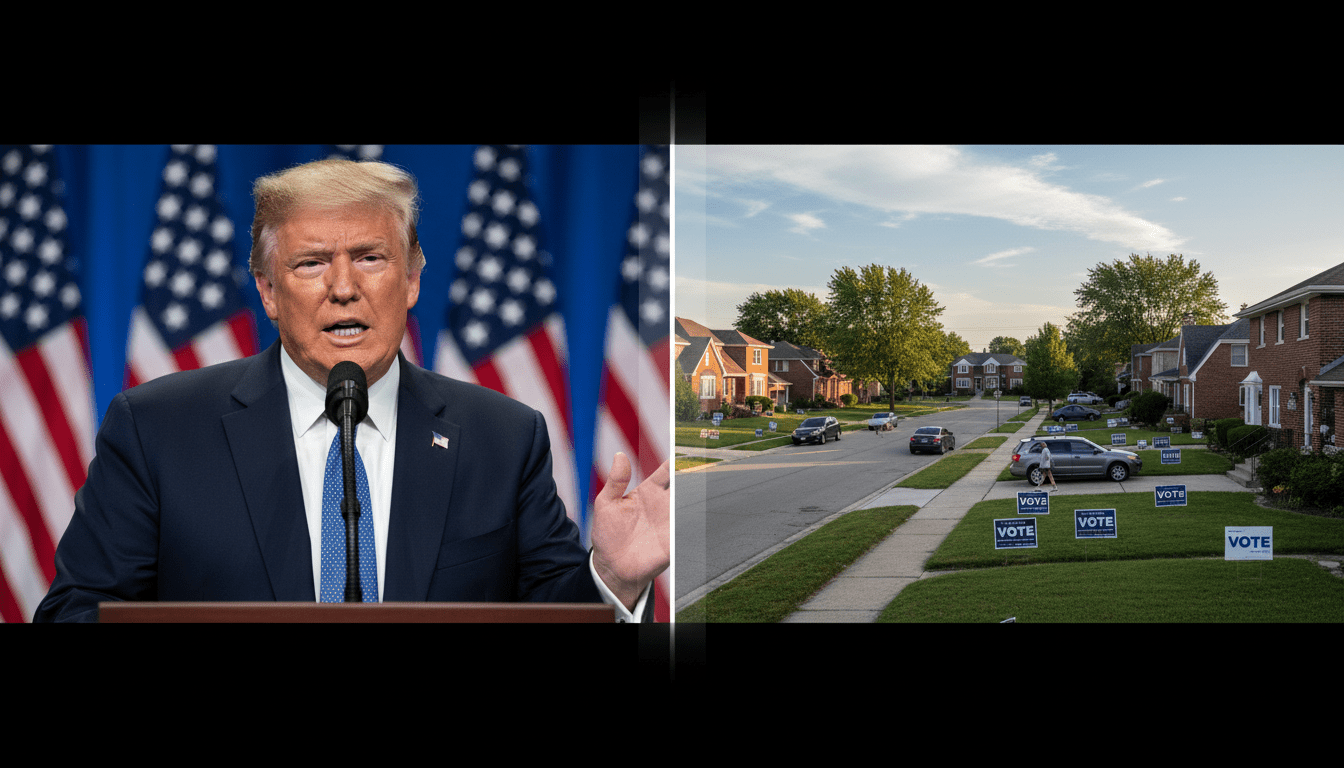
Former President Donald Trump is facing a significant and growing wave of internal dissent within the GOP, a phenomenon that political analysts are calling a surge in Republican revolts. While much of the national conversation focuses on Washington D.C., the repercussions of this intra-party conflict are being felt acutely in battleground states, with Metro Detroit emerging as a critical epicenter of the divide.
As the 2024 election cycle intensifies, the unity of the Republican party is being tested by a series of high-profile breaks from the former President’s influence. From donor class defections to open criticism regarding legal challenges and policy direction, the monolithic support Trump once enjoyed appears to be fracturing. For residents of Detroit and its sprawling suburbs—areas that often decide the fate of Michigan’s electoral votes—this political turbulence is creating a landscape of uncertainty and shifting alliances.
The Nature of the Republican Revolts
The current surge in Republican revolts is not defined by a single event, but rather a accumulation of friction points between the “MAGA” base and the traditional establishment, as well as moderate conservatives. Nationally, we have seen prominent GOP figures in the Senate and House break ranks on key legislative votes, and a noticeable hesitation among major donors to commit to a third Trump candidacy without exploring alternatives.
According to data analyzed by political scientists, there is a marked divergence in polling numbers between primary voters and general election voters, highlighting a vulnerability that dissenting Republicans are exploiting. The revolt is partly ideological—rooted in disagreements over protectionist trade policies that impact international commerce—and partly pragmatic, driven by fears that the former President’s legal entanglements could jeopardize down-ballot races.
In an interview with national outlets, several former administration officials have voiced concerns, signaling that loyalty to the party no longer necessitates automatic fealty to Trump. This sentiment is trickling down to local levels, emboldening state representatives and local officials to voice their own reservations.
Impact on Detroit Residents and Local Politics
For Detroiters, particularly those in the politically mixed suburbs of Oakland and Macomb counties, these Republican revolts are reshaping the choices available at the ballot box. Metro Detroit has long been a bellwether for national politics; Macomb County famously swung for Trump in 2016, while Oakland County has trended increasingly blue, driven by moderate Republicans distancing themselves from populist rhetoric.
Local business leaders in the automotive and manufacturing sectors are watching closely. The instability within the party creates uncertainty regarding future industrial policy, trade tariffs, and federal support for the transition to electric vehicles—a key economic engine for the region. If the GOP is fractured, the united front required to push for or against specific manufacturing legislation dissolves.
“The infighting distracts from local issues that matter,” says James Henderson, a long-time resident of Livonia and registered Republican. “We need focus on inflation, housing in Detroit, and infrastructure. Instead, we are watching a tug-of-war over leadership that feels disconnected from our daily reality.”
Furthermore, the internal chaos has implications for the Michigan Republican Party, which has faced its own parallel crises involving leadership disputes and fundraising shortfalls. The national revolts are mirroring the state-level dysfunction, leaving local organizers struggling to present a cohesive message to Detroit voters.
For more on how local dynamics are shifting, read our analysis on Oakland County Voter Trends.
The Suburban Shift: Where Dissent Grows
The epicenter of the anti-Trump Republican revolts in Michigan is undoubtedly the suburbs. Areas like Birmingham, Bloomfield Hills, and Troy were once reliable GOP strongholds. However, as the party’s identity has become more intertwined with Trump’s personal brand, these fiscal conservatives have begun to drift.
Recent canvassing data suggests that while the base remains enthusiastic, there is a “silent revolt” occurring among suburban women and college-educated voters. These demographics are signaling a willingness to split their tickets—voting for Republicans at the state level while withholding support for Trump at the top of the ticket, or supporting primary challengers.
This fragmentation poses a risk for the GOP’s ability to win statewide races in Michigan. Without strong, unified turnout in Metro Detroit’s suburbs to offset the Democratic stronghold of Detroit city proper, the path to victory becomes mathematically difficult. The Detroit Free Press has reported extensively on how these shifting margins in the suburbs have determined the outcomes of the last three major election cycles.
Background & Data: The Numbers Behind the Split
To understand the scale of these Republican revolts, one must look at the fundraising numbers and polling data. Reports from the Federal Election Commission (FEC) indicate that while small-dollar donations remain strong for Trump, institutional money is hedging its bets. In Michigan specifically, the donor class that funded the GOP dominance of the 1990s and early 2000s has largely paused contributions to the state party apparatus, citing a lack of confidence in leadership aligned too closely with the chaotic elements of the national movement.
A recent poll conducted by researchers at Wayne State University highlighted that approximately 18% of likely Republican primary voters in Southeast Michigan identify as “Non-MAGA Republicans.” While a minority, this bloc is large enough to swing a close general election. In a state decided by roughly 10,000 votes in 2016 and 150,000 votes in 2020, an 18% internal revolt is catastrophic for party unity.
We previously covered the financial implications of this divide in our report on Local GOP Fundraising Struggles.
What Happens Next?
As the primaries approach, the intensity of these Republican revolts is expected to increase. The key for Detroit voters will be watching how local candidates navigate this minefield. Will Congressional candidates in Michigan’s 10th and 11th districts embrace the revolt to win over moderates, or will they double down on loyalty to the former President to secure the base?
The outcome of this internal struggle will likely determine not just the future of the Republican party, but the political trajectory of Michigan. If the revolt succeeds in pulling the party back toward the center, Metro Detroit could see a return to competitive, policy-focused elections. If the revolt is quashed, the polarization between Detroit and its outer exurbs is likely to deepen.
For now, the only certainty is that the “solid” Republican front is showing visible cracks, and the aftershocks are rippling through every neighborhood in Detroit.