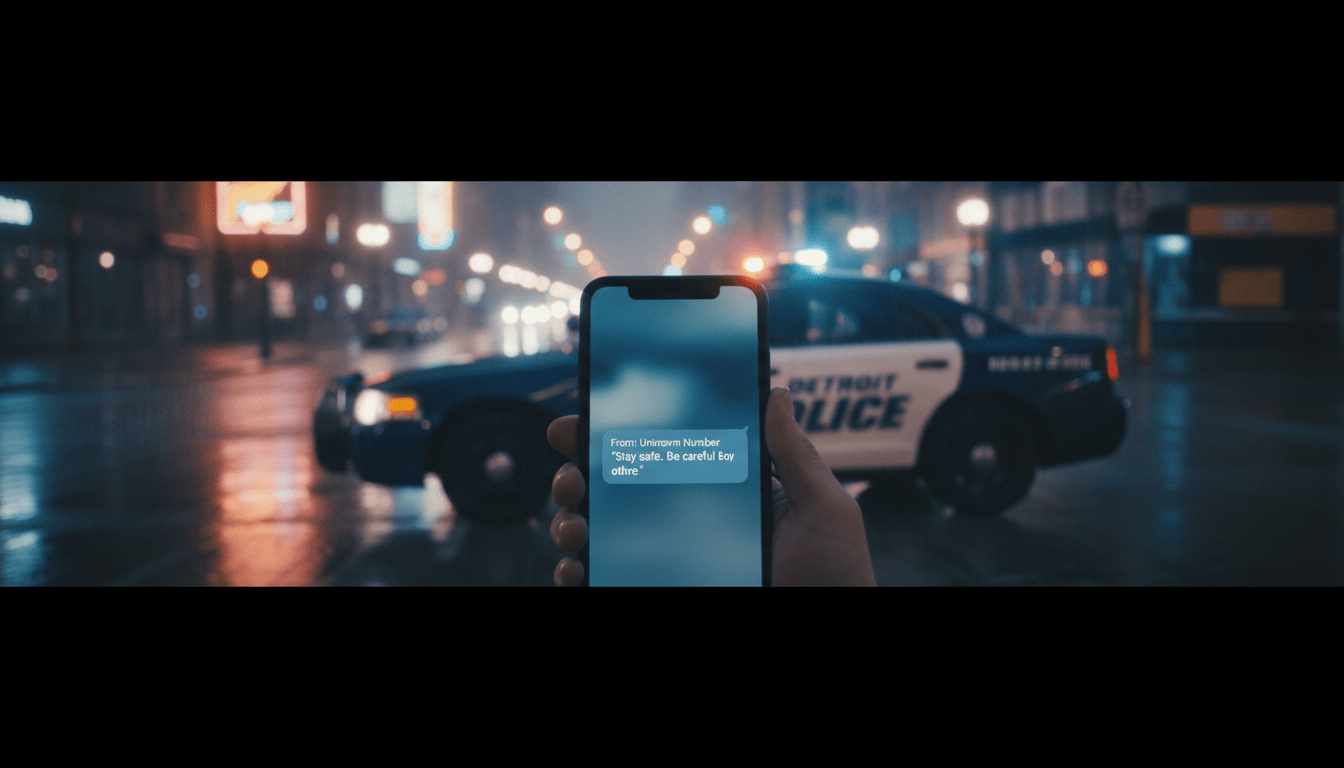
A Detroit police investigation into the disappearance of a local teenager has taken an urgent turn after detectives identified a chilling clue hidden within the missing teen’s last message. The discovery has shifted the focus of the search, prompting the Detroit Police Department (DPD) to issue new warnings regarding digital safety and location tracking for families across Wayne County.
The 16-year-old, whose name is currently being withheld by authorities to protect the integrity of the active investigation, was last seen leaving a residence in the Corktown neighborhood on Tuesday evening. While the case was initially treated as a potential runaway situation—a common classification in the early hours of such reports—digital forensics have since elevated the urgency of the case.
According to sources within the DPD Missing Persons Unit, the breakthrough came when investigators analyzed the metadata associated with the final text message sent from the teen’s phone at 11:42 PM. The text, which was sent to a parent, simply read, “Staying at a friend’s house, don’t worry.” However, police allege that the geolocation data embedded in the message log contradicted the text’s contents, pinpointing the device’s location to an abandoned industrial zone miles away from any residential area.
The Disappearance and the Chilling Clue
The sequence of events leading to the disappearance began innocuously. Reports indicate the teen left home around 6:00 PM, ostensibly to meet a study group. When the teen failed to return by curfew, the family attempted to call, but calls went straight to voicemail. The receipt of the text message nearly four hours later initially offered relief, but that relief was short-lived.
“The content of the message was designed to pacify the parents,” stated a source close to the investigation. “But the chilling clue was in the digital footprint. The device was not pinging from a residential neighborhood. It was pinging from a remote sector near the riverfront, an area known for having no residential properties. Furthermore, the syntax of the message did not match the teen’s typical texting patterns, which usually included specific emojis and abbreviations.”
This discrepancy—a calm message sent from a desolate location—suggests the possibility of duress or a third party controlling the device. Police are now canvassing the area where the signal originated, utilizing K-9 units and drone surveillance to scour the terrain.
Impact on Detroit Residents
This development has sent a ripple of concern through Detroit neighborhoods, particularly among parents of high school students. The realization that a reassuring text message could actually be a sign of danger is a terrifying prospect for local families.
Community leaders are urging parents to have open conversations with their children about digital safety. “We often trust the screen more than our instincts,” said a representative from a local Detroit community safety organization. “This case reminds us that digital communication can be manipulated. We are asking parents in Detroit neighborhoods to verify locations through voice calls or family tracking apps rather than relying solely on text messages.”
The case also highlights the critical nature of the “Golden Hour” in missing person cases. When inconsistencies in digital evidence are found early, resources can be deployed more effectively. For residents in the downtown and Midtown areas, the increased police presence serves as a grim reminder of the vulnerabilities facing the city’s youth.
Background & Data on Missing Teens
The issue of missing teens is not unique to Detroit, but the numbers in Michigan remain a point of focus for law enforcement. According to the Michigan State Police (MSP), thousands of children are reported missing in the state annually, though the vast majority are resolved quickly with the safe return of the child.
However, the cases that remain unsolved often hinge on digital forensic evidence. Data from the National Crime Information Center (NCIC) suggests that mobile devices are the single most important tool in modern missing persons investigations. In Detroit, the DPD has ramped up its capabilities in cyber-forensics to tackle this exact issue.
“In 2023, we saw a shift in how these investigations are handled,” a DPD spokesperson noted in a recent press briefing regarding local crime statistics. “It is no longer just about physical searching; it is about tracing a digital trail. The speed at which we can access carrier data often determines the outcome of the case.”
The disparity between a teen’s stated location and their actual GPS coordinates is a red flag that investigators are trained to look for immediately. In this specific investigation, that discrepancy was the “chilling detail” that escalated the response from a standard welfare check to a priority search operation.
What Happens Next
As the police investigation continues, the DPD is asking for the public’s assistance. Authorities are requesting that anyone who may have seen a vehicle or unusual activity in the industrial district near the riverfront on Tuesday night come forward. Dashcam footage from rideshare drivers or commercial trucks in the area is of particular interest.
The family of the missing teen remains in close contact with detectives. While the “last message” provided a terrifying clue, it also provided a starting point for the physical search. Police emphasize that anyone with information regarding this case or similar suspicious activities should contact the Detroit Police Department’s Major Crimes Division or Crime Stoppers anonymously.
For now, the city watches and waits, hoping that the digital breadcrumb left behind will lead to a safe recovery rather than a tragedy.