Standing as a marble anchor in the heart of the Midtown Cultural Center, the Detroit Public Library’s Main Branch is often cited as one of the most beautiful buildings in the United States. While thousands of patrons visit the Woodward Avenue landmark annually to access its vast collection of three million books, few realize they are walking through a masterclass of early 20th-century craftsmanship filled with hidden symbols, secret mosaics, and architectural puzzles.
Designed by Cass Gilbert—the same architect responsible for the U.S. Supreme Court Building in Washington, D.C.—the library opened its doors in 1921. It was the jewel of the “City Beautiful” movement, an urban planning philosophy that suggested grand civic architecture could inspire social harmony. Today, as the city experiences a resurgence in its historic neighborhoods, the library serves as a reminder of Detroit’s era of unparalleled craftsmanship. However, many of the building’s most intricate details remain hidden in plain sight, overlooked by visitors focused on their digital screens or checkout lines.
The Secret Language of Pewabic Tile
One of the most significant hidden treasures of the Detroit library architecture is found on the third-floor loggia. Behind the towering arches facing Woodward Avenue lies a series of intricate mosaics created by Mary Chase Perry Stratton, the co-founder of Detroit’s famed Pewabic Pottery. These mosaics are not merely decorative; they represent a complex narrative of human knowledge.
According to records from the Detroit Historical Society, Stratton spent months perfecting the iridescent glazes that define these panels. The mosaics depict characters from classical literature and mythology, yet their placement high above the street level means they are often missed by those entering through the modern Cass Avenue entrance. “The use of local Pewabic tile was a deliberate choice to ground this international style of architecture in the specific industrial heritage of Detroit,” says a local architectural historian. The vibrant blues and golds of the tiles remain as vivid today as they were a century ago, thanks to the unique firing process developed in Stratton’s East Jefferson workshop.
The Gari Melchers Murals and the Adam Strohm Hall
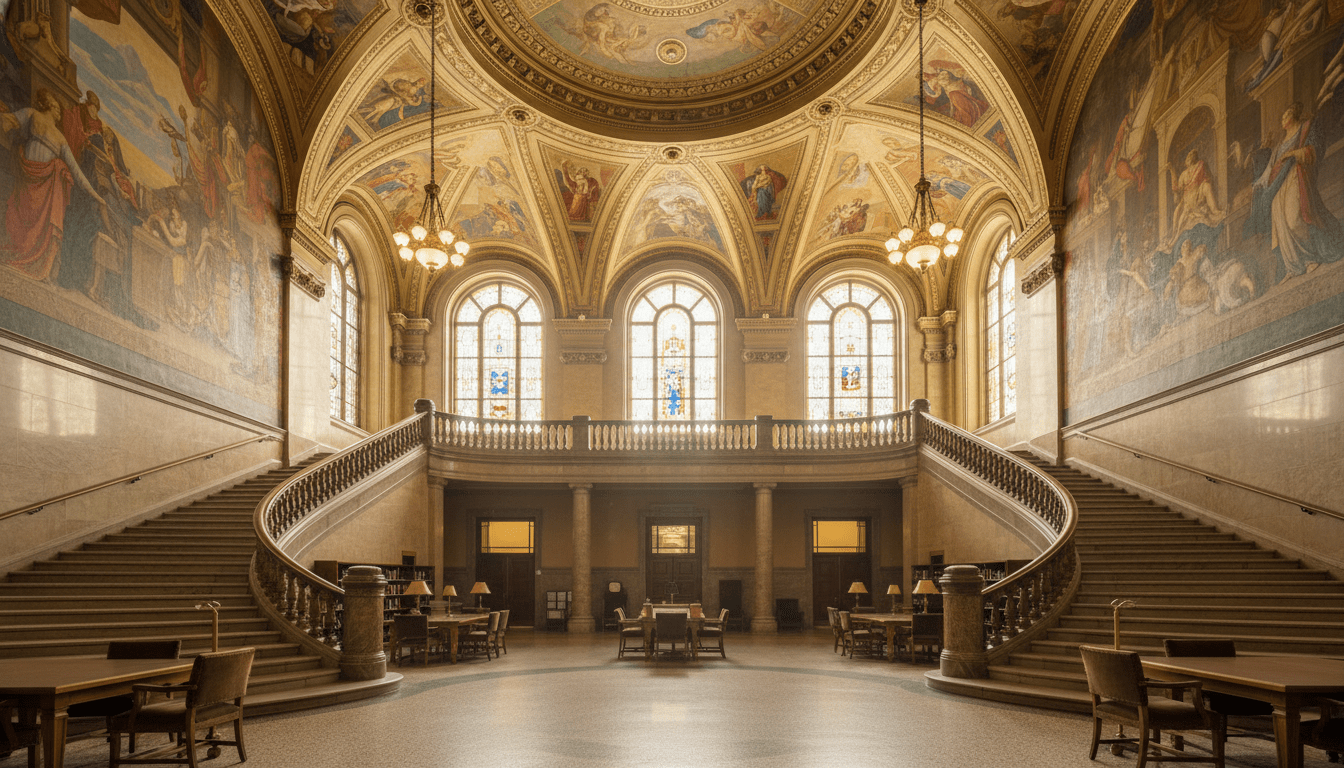
Ascending the grand staircase leads visitors to the Adam Strohm Hall, where the architecture takes on a more theatrical tone. The walls are adorned with massive murals by Gari Melchers, a world-renowned artist of the period. While the murals themselves are hard to miss, the hidden details within them tell the story of Detroit’s founding. The panels depict the landing of Cadillac and the early interactions between French settlers and Indigenous tribes.
A closer inspection of the surrounding woodwork reveals hand-carved motifs that repeat throughout the building. Data from the Detroit Public Library’s archival department suggests that the wood used in these halls was specifically selected for its acoustic properties, allowing the massive stone hall to remain surprisingly quiet even during peak hours. This attention to detail extends to the ceiling, where the hand-painted beams contain hidden initials of the master craftsmen who worked on the project—a common practice in the 1920s that is rarely documented in modern construction.
Impact on Detroit Residents and Local Identity
For modern Detroiters, these architectural details are more than just aesthetic flourishes; they are a source of civic pride and a free resource for cultural education. In a city where many historic structures were lost during the late 20th century, the Main Branch stands as a preserved link to the past. The library serves as a vital community hub, offering everything from digital literacy classes to historical research archives.
Local preservationists argue that understanding the hidden details of the library helps residents connect with the city’s narrative. As Detroit continues to see significant investment in historic preservation, the library serves as the gold standard for how public spaces can be maintained. For students and researchers, the environment provided by Cass Gilbert’s design fosters a sense of permanence and intellectual gravity that modern glass-and-steel offices often lack.
Background & Data: A Century of Service
The construction of the Main Branch was a massive undertaking for the city. According to a report by the Michigan State Historic Preservation Office, the building cost approximately $3.1 million in 1921—the equivalent of over $50 million today. The structure is clad in white Vermont marble, chosen for its ability to withstand the harsh Midwestern elements while maintaining a luminous quality.
The library system has had to adapt to a changing city. At its peak in the mid-20th century, the Detroit Public Library was one of the busiest systems in the world. While the digital age has changed how information is consumed, the physical building remains a primary draw. Recent traffic data from the library indicates that architectural tours are among the most requested services, suggesting a growing public interest in the building’s physical history. Additional information on the library’s historical designation can be found through the Detroit Historical Society archives.
What Happens Next for the Historic Landmark
Looking forward, the Detroit Public Library faces the dual challenge of modernizing its technological infrastructure while preserving its delicate architectural heritage. The Detroit Public Library Friends organization continues to raise funds for the restoration of the Pewabic mosaics and the Gari Melchers murals, ensuring that these hidden details do not fade with time.
Current plans for the Cultural Center include improving the walkability between the library and the Detroit Institute of Arts, which will likely increase foot traffic to the Main Branch. For the casual visitor, the secret to enjoying the library lies in slowing down. Whether it is the whispering gallery effect in the stairwells or the tiny, carved owls perched on the reading room shelves—symbols of wisdom—the building continues to reveal its secrets to those who take the time to look. As Detroit’s skyline continues to evolve with new developments, the hidden details of its past remain etched in the marble of Woodward Avenue.