As Detroit moves through 2026, the city’s financial landscape is experiencing a profound shift, driven by a combination of technological integration, localized community reinvestment, and an evolving regulatory environment. For Detroit residents, these changes are not merely abstract economic shifts; they represent a fundamental change in how the average citizen interacts with their money, secures home loans, and accesses credit for small businesses.
Financial analysts and city officials note that the Detroit of 2026 has become a testing ground for inclusive banking models. According to a recent report from the Michigan Department of Insurance and Financial Services (DIFS), there has been a 12% increase in the utilization of community-based financial institutions across Wayne County over the last two years. This trend reflects a growing preference for localized service over traditional big-box banking, as residents seek institutions that understand the specific economic nuances of the city’s neighborhoods.
The Rise of Hyper-Local Fintech and Digital Integration
One of the most visible Detroit banking and finance trends is the integration of financial technology (fintech) into the daily lives of residents. Downtown and Corktown have established themselves as regional hubs for financial innovation, attracting startups that focus on banking the underbanked. These firms are increasingly partnering with established banks to provide mobile-first solutions tailored to Detroit’s unique demographic needs.
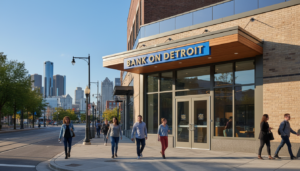
Data from the Federal Reserve Bank of Chicago indicates that mobile banking adoption in Detroit has reached an all-time high, with a significant surge in the 45-to-60 age bracket. This shift has prompted many traditional banks to consolidate physical branches in favor of “high-tech, high-touch” centers. These locations often feature fewer teller windows and more spaces for financial coaching and digital literacy training. While some residents express concern over the closure of traditional branches, the City of Detroit has been proactive in ensuring that digital equity programs are in place to prevent the widening of the financial divide.
Impact on Detroit Residents and Homeownership
The evolving financial climate is having a direct impact on the Detroit housing market. For years, securing traditional mortgages for homes in certain neighborhoods was a challenge due to low appraisal values and rigid lending criteria. However, in 2026, new lending products are emerging. Many local credit unions have introduced “rehabilitation-inclusive” mortgages, which allow buyers to fold the costs of home renovation directly into their primary loan.
For a resident living in the Russell Woods or MorningSide neighborhoods, this means a more streamlined path to homeownership. “We are seeing a shift where the criteria for creditworthiness is being viewed through a more localized lens,” says a representative from a prominent Detroit-based community development financial institution (CDFI). “Instead of relying solely on national credit scores, more lenders are looking at rent payment history and utility consistency, which opens doors for thousands of Detroiters.”
This accessibility is a key component of the broader Detroit housing market forecast, which suggests that stabilized lending will lead to more sustainable property values in the coming years. Residents are encouraged to seek out these specialized programs, many of which are supported by municipal grants and federal Community Reinvestment Act (CRA) credits.
Small Business Lending and the Entrepreneurial Surge
Small businesses remain the backbone of the city’s economy, and the Detroit banking and finance trends of 2026 show a renewed focus on entrepreneurial capital. The city’s Economic Development Corporation has reported a record number of micro-loans issued to minority-owned businesses in the past fiscal year. These loans are often paired with mandatory financial management workshops, ensuring that the capital is used effectively for long-term growth.
The growth of the small business ecosystem in Corktown and other revitalizing districts is largely attributed to these new flexible lending pools. Banks are increasingly participating in “syndicated lending,” where multiple smaller institutions share the risk of a single loan, allowing them to provide larger amounts of capital to local startups that might have been deemed too risky by a single large entity in the past.
Background, Data, and Regulatory Shifts
The regulatory environment in 2026 has also adapted to protect Detroiters. The Michigan state legislature recently passed measures to increase transparency in high-interest short-term lending, often referred to as payday loans. According to the City of Detroit’s official website, these regulations are designed to steer residents toward more traditional and lower-interest credit products offered by local banks and credit unions.
Furthermore, the Federal Reserve’s modern updates to the Community Reinvestment Act have incentivized large national banks to invest more heavily in Detroit’s low-to-moderate-income census tracts. This has resulted in a surge of neighborhood-level investment funds that focus on infrastructure and affordable housing. Statistics from the U.S. Department of the Treasury show that Detroit has received a 15% increase in New Markets Tax Credit allocations compared to five years ago, signaling strong federal confidence in the city’s financial recovery.
What Happens Next: Navigating the Future
Looking ahead toward the end of the decade, the primary challenge for Detroit’s financial sector will be maintaining the balance between rapid technological advancement and equitable access. As AI-driven algorithmic lending becomes more common, local advocacy groups and government regulators are expected to keep a close eye on potential biases in these systems.
Residents should expect to see more “financial health hubs” popping up in neighborhood libraries and community centers. These hubs are intended to be the bridge between the digital world of 2026 finance and the physical needs of the community. For those looking to capitalize on these Detroit banking and finance trends, the best course of action is to stay informed through local workshops and to maintain a relationship with a financial institution that demonstrates a clear commitment to the city’s long-term growth.
While the transition to a more digital and decentralized banking system presents learning curves, the overall outlook for Detroit’s financial health is the strongest it has been in decades. With increased transparency, more flexible lending, and a focus on community stability, the financial tools available to Detroiters in 2026 are more robust and accessible than ever before.