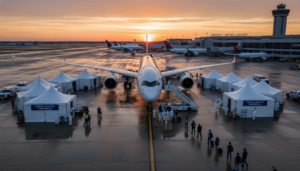
A recent flight diversion at Montreal-Trudeau International Airport has sent ripples through the international aviation community, prompting a closer look at health safety measures for transatlantic carriers. The incident involving an Air France flight has raised significant questions regarding current Ebola restrictions and the protocols used by major airlines that service Detroit Metropolitan Wayne County Airport (DTW). For Detroit residents who frequently use the direct Air France route between Detroit and Paris-Charles de Gaulle, the situation highlights the complexities of international health screenings in a post-pandemic travel era.
The Montreal Diversion Incident
According to official reports from the Public Health Agency of Canada (PHAC), an Air France flight traveling from Paris was diverted to Montreal following reports of a passenger exhibiting symptoms that necessitated immediate medical evaluation. While the airline initially categorized the incident as a medical emergency, the specific nature of the health protocols triggered led to widespread speculation regarding the enforcement of Ebola-related screenings. This Air France news has become a focal point for aviation safety experts monitoring how airlines manage potential infectious disease risks without causing undue panic.
During the incident at the Montreal airport, passengers remained on the tarmac for several hours while health officials conducted an assessment. Air France issued a statement following the event, emphasizing that the safety of its passengers and crew remains its highest priority. The airline noted that it strictly adheres to international health regulations as outlined by the World Health Organization (WHO) and the International Air Transport Association (IATA).
Impact on Detroit Residents and International Travel
The implications of such diversions are felt deeply in Detroit. As one of the major hubs for transatlantic travel in the Midwest, Detroit Metropolitan Airport serves as a vital gateway for business and leisure travelers heading to Europe. The direct route from Detroit to Paris is a cornerstone of DTW’s international service, and any change in how Ebola restrictions or health screenings are applied can lead to significant delays and procedural shifts for local passengers.
Travelers from Detroit often choose Air France for its connectivity to the rest of the world. However, a flight diversion of this magnitude raises concerns about the consistency of health screenings. Local travel analysts suggest that while the Montreal incident was handled according to standard operating procedures, it serves as a reminder of the rigorous checks that remain in place behind the scenes. For Detroiters, this means being prepared for additional screening measures during times of heightened global health awareness.
“Events like the Montreal diversion remind us that international travel is still governed by strict health mandates,” says a representative from a Detroit-based travel advocacy group. “While it may cause temporary inconvenience, these protocols are essential for maintaining the safety of the global aviation network, including our busy hub here at DTW.”
Evaluating Current Ebola Restrictions and Protocols
The current framework for managing infectious diseases on international flights is a combination of airline policy and national health mandates. In the United States, the Centers for Disease Control and Prevention (CDC) provides specific guidance for airlines regarding passengers arriving from regions with known outbreaks. According to data from the CDC, health screenings at major ports of entry, including Detroit, are designed to be non-intrusive yet thorough.
However, the Montreal case has brought to light the differences in how various jurisdictions handle the same threat. Canadian health officials at the Montreal airport utilized a specific set of quarantine protocols that differ slightly from the procedures used by U.S. Customs and Border Protection (CBP) at Detroit Metropolitan Airport. This discrepancy has led some industry experts to call for a more unified international standard to prevent confusion during a mid-flight crisis.
Internal data from DetroitCityNews.com previously reported on the technological upgrades at DTW designed to streamline passenger processing. These upgrades include thermal imaging and advanced passenger manifest reviews, which are part of the broader strategy to manage health risks without diverting flights unnecessarily.
Aviation Industry Response and Safety Standards
The aviation industry is no stranger to health-related challenges. Since the 2014 Ebola outbreak and the more recent global pandemic, airlines like Air France have significantly bolstered their on-board medical kits and crew training. This latest Air France news suggests that while the systems are in place, the execution of a flight diversion remains a complex logistical hurdle involving air traffic control, local health departments, and international consulate offices.
Industry observers note that the decision to divert to Montreal rather than continuing to the original destination or returning to Paris is often a matter of fuel, local medical facilities, and the severity of the passenger’s symptoms. In this instance, the proximity of Montreal-Trudeau’s specialized medical units made it the most viable option for the pilot and the medical team on the ground.
What Happens Next for Detroit Travelers
In the wake of the Montreal incident, Detroit travelers should expect a continued emphasis on health documentation and pre-flight screenings. While there are no new formal Ebola restrictions currently being implemented for travelers departing from Detroit, the awareness of such protocols is at an all-time high. Local officials at DTW continue to work closely with federal agencies to ensure that Detroit remains a safe and efficient port of entry for international flights.
For those planning upcoming trips to Europe, it is recommended to stay informed through official airline updates and government travel advisories. The collaboration between international partners, as seen in the communication between Canadian and French authorities, remains a critical component of aviation safety. As the situation evolves, DetroitCityNews.com will continue to monitor how these global incidents impact our local infrastructure and the residents who depend on it. For more information on local travel, check out our report on DTW infrastructure upgrades.
As the aviation sector continues to navigate the balance between efficiency and safety, the Montreal diversion serves as a high-profile case study in the necessity of robust, clear, and internationally recognized health protocols. For now, Detroit remains a key player in this global conversation, ensuring that the Motor City is connected safely to the world.