

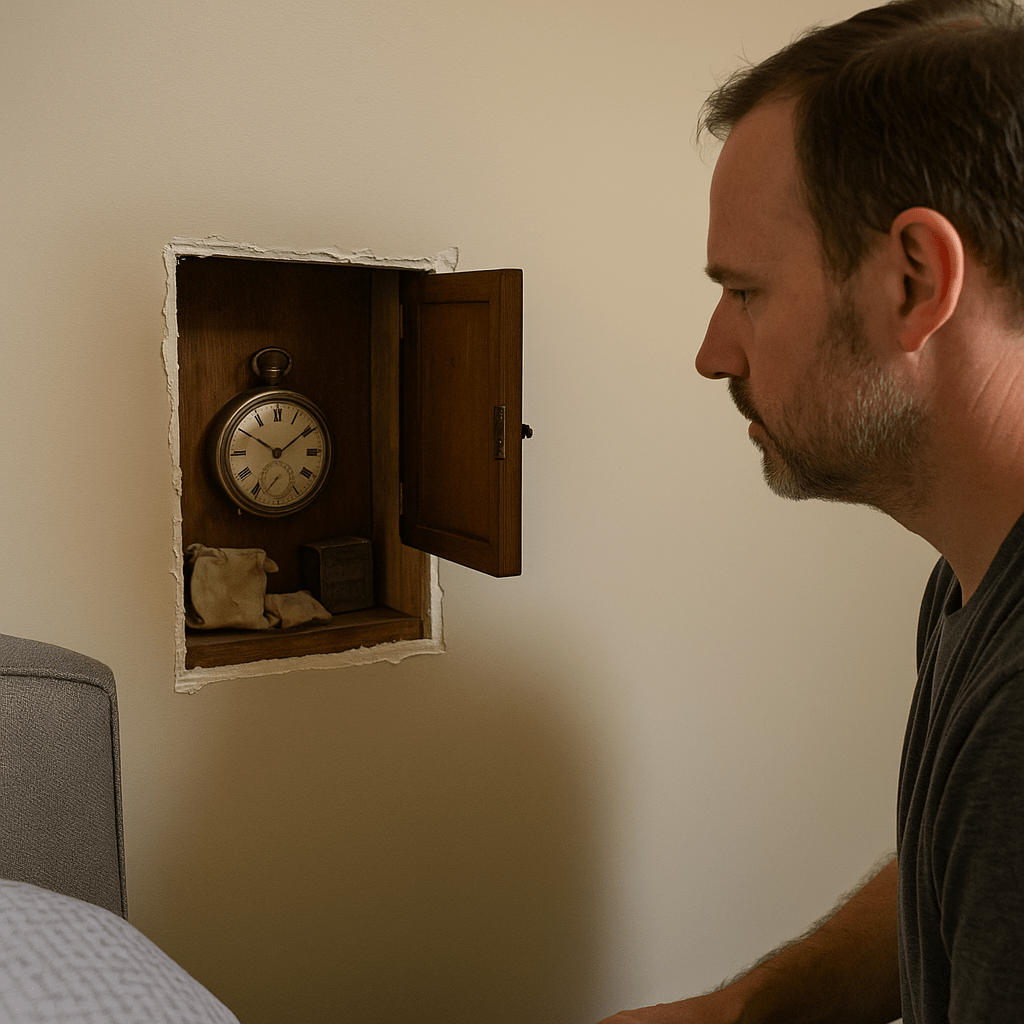
For months, the Middleton family lived with a soft, rhythmic ticking sound coming from the wall behind their bedroom headboard. It wasn’t loud enough to be disruptive, but it was persistent—steady, faint, and unmistakably mechanical.
At first, they assumed it was a pipe expanding with temperature changes. But the ticking didn’t follow any pattern. It wasn’t tied to the heating system, the weather, or even the time of day.
It simply ticked whenever the house was quiet.
One evening, after the noise grew slightly louder, Mr. Middleton pressed his ear to the wall and realized the sound was coming from a very specific spot—no larger than a dinner plate. A distinct area, isolated and strangely hollow.
Curiosity got the better of them. They removed the headboard, cleared the area, and tapped along the drywall. The hollow patch was unmistakable. The couple contacted a handyman to check for structural issues.
When he cut a small opening, everyone froze.
Behind the drywall was a perfectly preserved wooden box mounted between the studs. The box was securely fastened with brass brackets and sealed with an ornate latch carved with floral detailing. It looked far older than the house itself.
Inside the box was a delicate brass clock no larger than a grapefruit. Despite its age, the clock was still ticking steadily, its tiny gears turning flawlessly. Beneath it were several folded cloth bags and a notebook filled with neat handwriting.
The notebook revealed that the clock had been handcrafted by the home’s original builder—an avid horologist who specialized in precision timepieces. According to his notes, he had installed the clock inside the wall as a “heartbeat” for the home, a symbolic reminder that every structure has its own rhythm and life.
He built several of these miniature clocks into different properties he worked on, each hidden away where only future owners might someday find them.
Over the decades, renovations covered the clock entirely, leaving it forgotten until the ticking slowly made its presence known again. The sound had grown louder because the wooden housing around it had dried slightly, allowing more sound to pass through.
Clock restoration experts who examined the piece called it an extraordinary example of early 20th-century craftsmanship. The mechanism was so well-made that it had run uninterrupted for nearly 80 years, powered by a long-forgotten winding system the builder documented in his notes.
The Middletons decided to create a recessed glass display in the wall to showcase the clock exactly where they found it. They say it still ticks softly every night, a constant reminder that the house had been quietly keeping time long before they arrived.