


Elias Turner had been hiking the same forest trail since childhood. Nothing about it surprised him anymore—or so he thought. On a late autumn afternoon, while exploring a familiar rocky ridge, he ducked into a shallow cave he had passed dozens of times.
That’s when he heard it.
A faint, hollow echo that didn’t match the shape of the cave. It wasn’t the typical bounce of sound off stone. It was deeper, rounder, as if the cave was hiding something just beyond its visible walls.
Curious, Elias knocked again, this time harder. The echo repeated—clear, metallic, and unmistakably artificial.
He examined the cave wall more closely. One section looked slightly smoother than the rest, as if it had been shaped or placed rather than naturally formed. Brushing away dirt and moss, he uncovered a narrow seam running vertically across the stone.
It wasn’t stone at all.
It was a panel.
Elias returned the next day with tools. After carefully chiseling around the seam, he managed to loosen the panel. With a final pull, it swung open, revealing a narrow passageway descending deeper into darkness.
He steadied his flashlight and stepped inside.
At the end of the passage was a small underground chamber constructed from metal and reinforced concrete—completely different from the natural rock surrounding it. The air was cool and perfectly still.
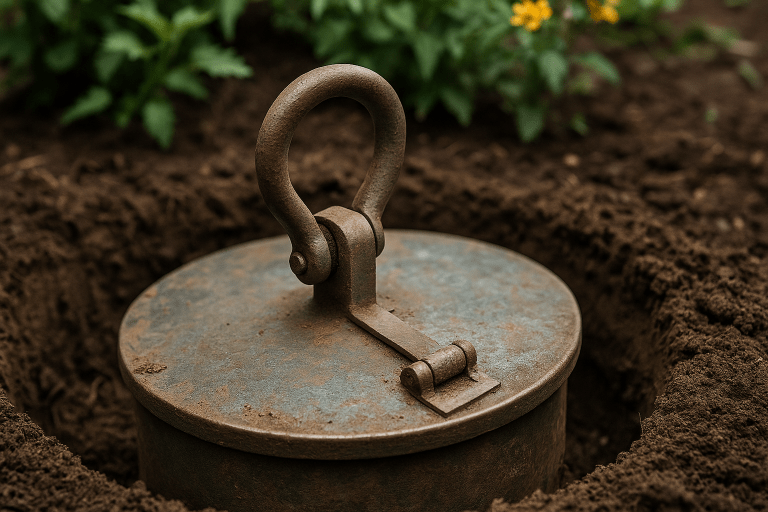
In the center of the chamber stood a cylindrical metal pod about four feet tall, resting on a raised platform. Dust coated the floor, but the pod itself was spotless, as if sealed tightly since the day it was placed there. A small emblem was etched onto its side, weathered but legible enough to identify: it belonged to an abandoned research organization from the 1970s known for studying extreme environments.
Elias unlatched the pod. Inside were several carefully preserved containers holding soil samples, plant specimens, and vials of microorganisms collected from remote regions around the world. A binder lay beneath the vials, filled with detailed notes documenting experiments designed to understand how life adapts to harsh climates.
The chamber had been a hidden field research station—constructed discreetly during a decade when environmental science was rapidly evolving but not yet well-funded. At some point, the project was quietly shut down, and the chamber was sealed behind the cave wall to protect the samples.
Over the years, natural erosion partially revealed the panel, allowing Elias to find the hidden door.
When scientists later examined the samples, they found several strains of microorganisms once believed lost, offering rare insight into ecosystems that had since been altered by climate change.
The chamber was stabilized but left as-is, now considered an accidental time capsule of early scientific ambition.
Elias says the echo he heard that day was more than sound—it was the past calling out from behind a forgotten wall of stone.