
Margaret Hill had worked at the Willow Creek Public Library for nearly twenty years. She knew every shelf, every dusty corner, every misplaced children’s book left behind in the reading nook. So when she spotted a thick, leather-bound volume lying on a return cart one quiet morning, she knew immediately something was off.
The library didn’t own a book like this.
It had no barcode, no classification label, no record in the catalog.
Just a plain, weathered cover with no title.
Thinking it was a donation dropped into the returns slot by mistake, Margaret opened it.
Inside, the pages weren’t printed — they were handwritten.
Hundreds of entries, each dated, each describing sightings and events around Willow Creek dating back more than a century. Strange lights over the river in 1924. A missing farmhand found wandering the woods without memory in 1948. An unexplained tremor beneath Main Street in 1961. The entries were methodical and detailed, as if part of an ongoing investigation.
But the final page chilled her.
It was dated three days earlier — long after the supposed author would have been alive.
The entry described “a disturbance inside the library itself,” noting the exact time Margaret opened the building that Monday morning. It detailed her footsteps through the aisles, what lights she turned on, even what she hummed while shelving books.
Someone was watching her.
She immediately checked the security cameras. Footage showed no one placing the book on the cart, no one walking in after hours, no shadows, no movement. The cart had been empty when she closed the previous night. Yet the book appeared on it at dawn, as if it had materialized from thin air.
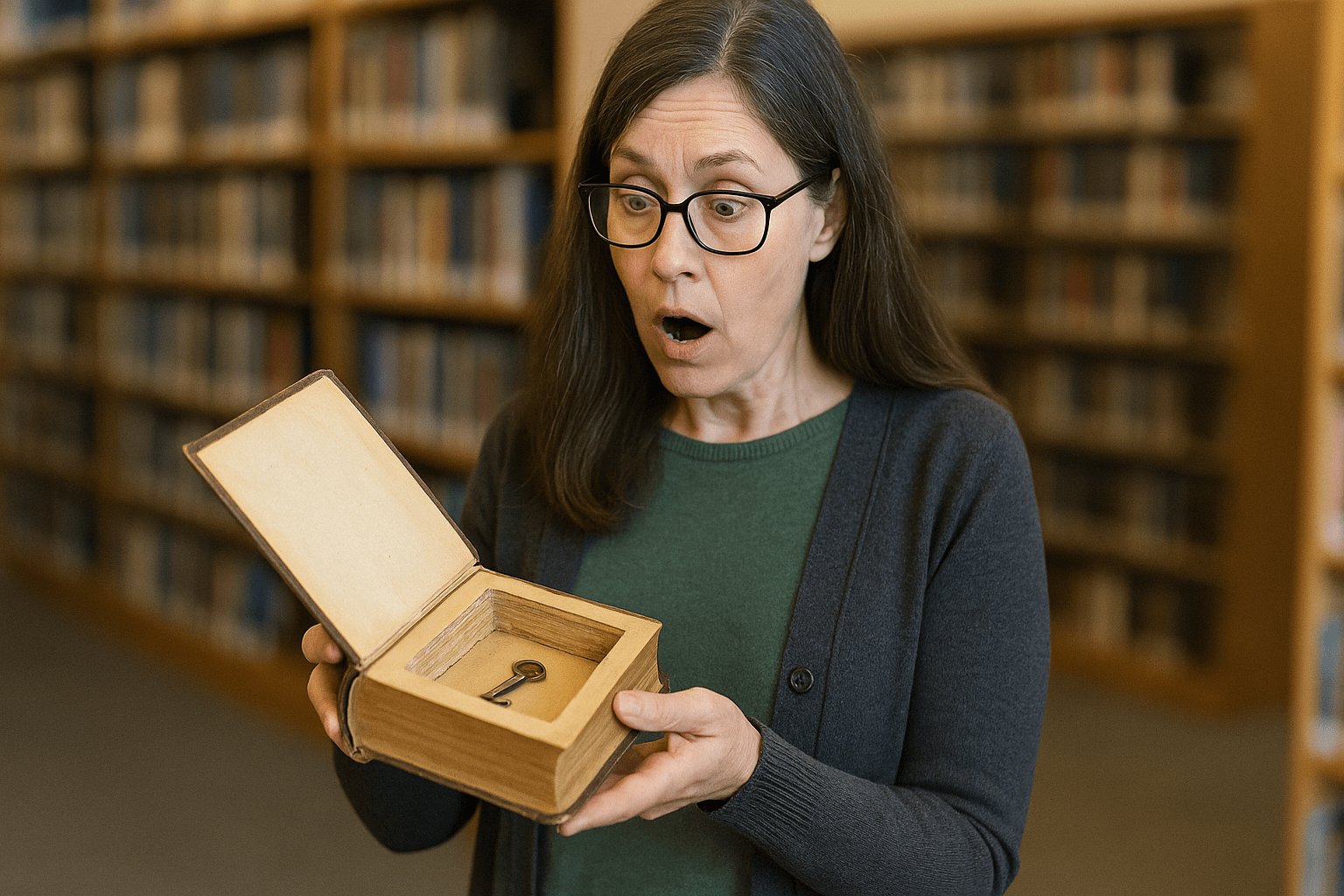
Margaret turned the book over again and noticed the spine was slightly loose. Gently pulling it back, she discovered a hidden compartment.
Inside the hollow was a small metal key.
She contacted local authorities, and an officer accompanied her to the basement archives — a section of the library rarely used and filled with boxes dating back to its founding in 1895. There, behind a row of old filing cabinets, they found a locked wooden drawer no one had ever mentioned before.
The key fit perfectly.
Inside the drawer were dozens of similar handwritten volumes, each covering a different decade. Together, they documented a continuous line of observers — anonymous individuals who had tracked unexplained events in the town for more than 120 years.
According to one note tucked behind the oldest book:
“When the previous observer is gone, the next will find the key.”
Margaret hadn’t volunteered.
But the arrival of the latest book suggested she had been chosen.
Historians later verified that the events described were real incidents recorded in old newspapers, though many had been forgotten. How the latest entries were written — and by whom — remains unexplained.
Margaret keeps the first mysterious book locked in her office now, though she admits one thing:
Some mornings, she swears she hears the return cart rolling on its own.