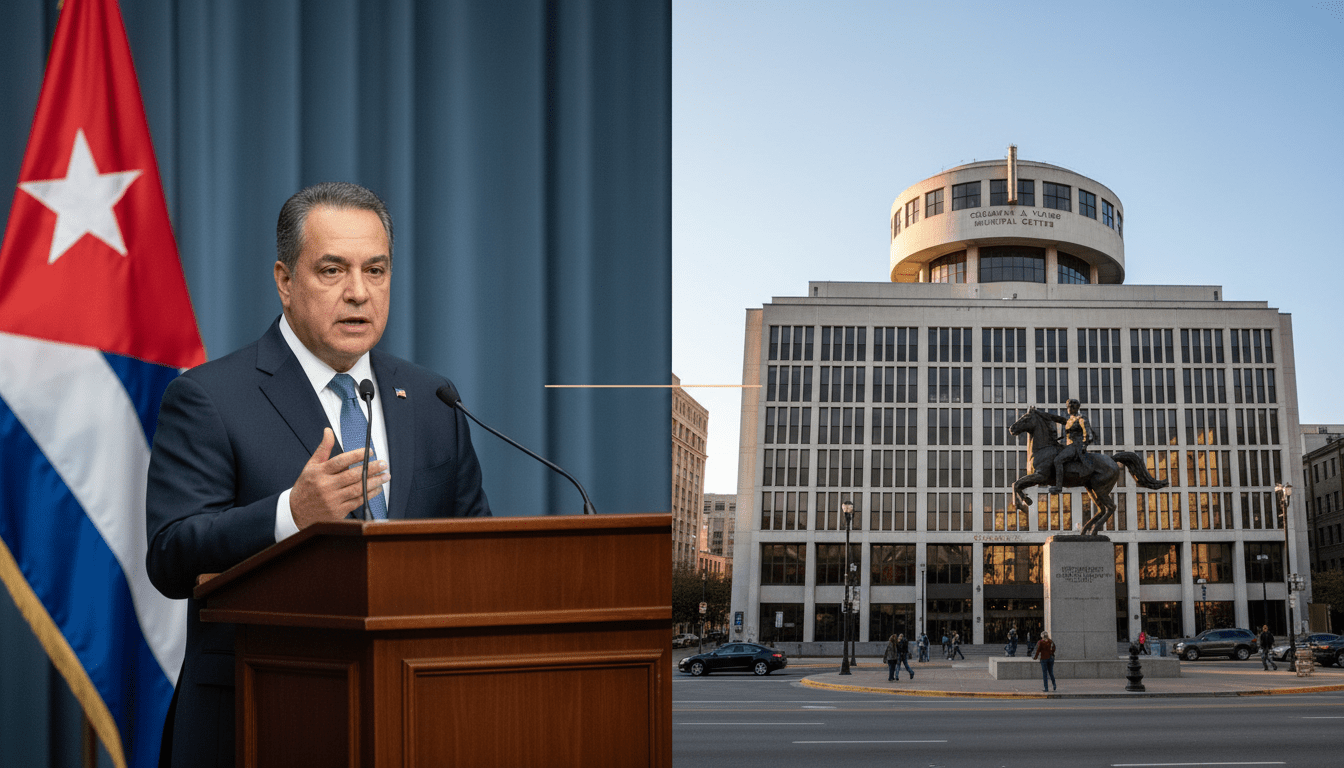
Cuban Foreign Minister Bruno Rodríguez Parrilla has issued a blistering condemnation of United States foreign policy, accusing the federal government of maintaining a strategy of “maximum pressure” and aggression designed to collapse the island nation’s economy. While the diplomatic standoff is taking place on the international stage, the repercussions and rhetoric are finding a distinct echo in Detroit, where local city leaders and activists have increasingly engaged in the debate over US-Cuba relations.
Speaking to international bodies and through official state media channels this week, Rodríguez Parrilla vowed continued resistance against what he termed “unilateral coercive measures.” His comments come amidst a deepening economic crisis in Cuba, characterized by blackouts and shortages of food and medicine—conditions the Foreign Minister attributes directly to the tightening of the decades-old US embargo and Cuba’s inclusion on the US State Sponsor of Terrorism (SSOT) list.
“The US government is fully responsible for the impact of its aggression on the Cuban people,” Rodríguez Parrilla stated in a press briefing. He further emphasized that despite the economic strangulation, the Cuban government would not capitulate to foreign demands, signaling a continuation of the ideological stalemate that has defined the Florida Straits for over sixty years.
Detroit City Council’s Stance on the Blockade
While foreign policy is typically the domain of Washington D.C., the City of Detroit has formally entered the conversation regarding US-Cuba relations. The Foreign Minister’s recent accusations align closely with sentiments expressed within the Coleman A. Young Municipal Center regarding the humanitarian impact of federal sanctions.
In recent legislative sessions, the Detroit City Council joined a growing list of American municipalities—including Chicago, Cleveland, and Minneapolis—in passing a resolution urging President Joe Biden to end the blockade and remove Cuba from the SSOT list. The resolution, supported by local labor unions and advocacy groups, highlighted the potential benefits of medical and cultural exchange between Detroit and Havana.
According to the text of the resolution, the council argued that the embargo creates “unjustifiable hardships” for Cuban families and hinders potential collaboration in healthcare, noting Cuba’s development of treatments for conditions like diabetes and cancer—health issues that disproportionately affect Detroit residents.
“Detroit has a long history of international solidarity,” said a representative from the Detroit Coalition Against the Blockade of Cuba during a recent public comment session. “When the Foreign Minister speaks of aggression, he is describing a policy that prevents Detroit doctors from easily accessing Cuban medical innovations that could save lives right here in Wayne County.”
The Economic and Human Context
The accusations leveled by Rodríguez Parrilla focus heavily on the extraterritorial nature of the sanctions, which penalize foreign companies for trading with Cuba. For a manufacturing and trade hub like Detroit, the implications of restricted trade corridors are a point of discussion among economic observers, though the immediate impact is largely humanitarian.
Data from the U.S. Chamber of Commerce has historically suggested that the embargo costs the US economy billions annually in lost export potential. For Michigan farmers and Detroit-based logistics firms, the inability to freely trade with a market of 11 million people just 90 miles off the coast represents a missed economic opportunity.
However, the US State Department maintains that sanctions are a necessary tool to pressure the Cuban government regarding human rights concerns and political prisoners. Washington officials have repeatedly stated that the embargo targets the regime, not the people, and have authorized exemptions for food and medicine—claims that Rodríguez Parrilla disputes, citing the bureaucratic hurdles that effectively block such transactions.
Impact on Detroit Residents
For Detroit’s diverse immigrant community, the rhetoric from Havana and Washington has tangible consequences. While Detroit’s Cuban population is smaller compared to Miami’s, the broader Caribbean and Latino communities in Southwest Detroit monitor these geopolitical shifts closely.
Local travel agents and families report that the “maximum pressure” strategy criticized by Rodríguez Parrilla complicates travel for family reunification. Changes in visa regulations and flight restrictions often leave families in limbo.
Furthermore, local health advocates have pointed to the disparities in local healthcare outcomes as a reason to look outward. The Detroit resolution explicitly mentioned the desire to access Cuba’s Heberprot-P, a treatment for diabetic foot ulcers. With diabetes rates in Detroit significantly higher than the national average, the Foreign Minister’s vow of resistance is viewed by some local leaders not just as political rhetoric, but as a barrier to accessing necessary medical technology.
Background & Data
The tension between the two nations escalated significantly during the previous administration, which added Cuba to the State Sponsors of Terrorism list just days before leaving office. The current administration has largely maintained these strict measures, prompting the recent outburst from Rodríguez Parrilla.
According to the United Nations General Assembly, which votes annually on the necessity of ending the embargo, the global consensus is overwhelmingly against the US position. In the most recent vote, 187 countries voted against the embargo, with only the US and Israel voting in favor. This international isolation is frequently cited by Detroit activists as evidence that US policy is out of step with global norms.
“The continued inclusion of Cuba on the terrorism list creates a chilling effect on all financial transactions,” stated an analyst from the Center for International Policy. “This is what Minister Rodríguez Parrilla refers to when he speaks of ‘economic asphyxiation.’ It prevents the purchase of spare parts for the power grid and inputs for agriculture.”
What Happens Next
As Rodríguez Parrilla vows continued resistance, the stalemate appears set to continue into the next fiscal year. For Detroit, this means the aspirations of the City Council’s resolution remain unfulfilled. However, local organizations plan to continue their advocacy.
Upcoming forums in Detroit’s community centers are scheduled to discuss the impact of US foreign policy on local economies, keeping the issue alive in local discourse. While the geopolitical lever is pulled in Washington, the ripples continue to be felt in neighborhoods from Southwest Detroit to the riverfront, where the potential for international trade remains stifled by frozen diplomatic relations.
The vow of resistance from Havana suggests that without a significant shift in US policy, the status quo—marked by mutual accusation and economic difficulty—will persist, leaving cities like Detroit to navigate the fallout of federal inaction.