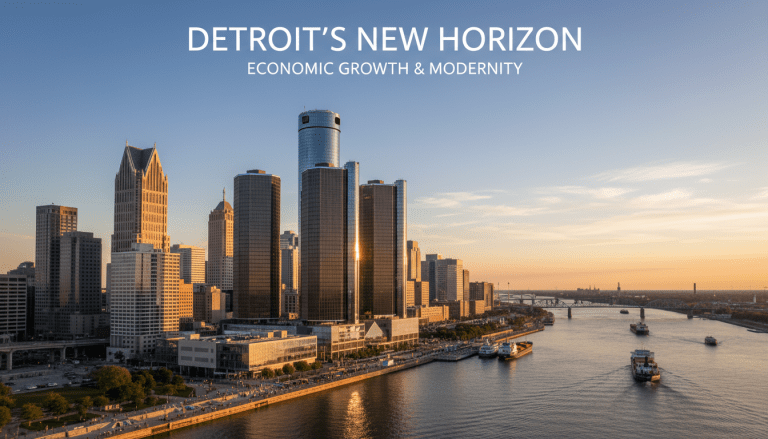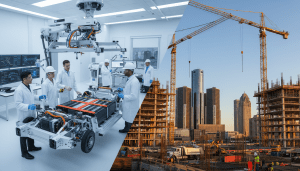


Detroit is rapidly shedding its rust-belt reputation to emerge as a sophisticated hub for Detroit global business expansion, attracting a wave of foreign direct investment while simultaneously serving as a launchpad for local companies entering international markets. As the global economy shifts toward electrification and advanced manufacturing, the Motor City is leveraging its century-old industrial DNA to secure a pivotal role in the future of global trade.
According to recent economic indicators, the region is seeing a marked increase in international interest, driven by favorable tax structures, a skilled engineering workforce, and the upcoming completion of major infrastructure projects like the Gordie Howe International Bridge. For city officials and business leaders, the message is clear: Detroit is open for the world.
“We are seeing a fundamental shift in how international companies view Southeast Michigan,” said a representative from the Detroit Regional Partnership during a recent economic forum. “It is no longer just about automotive manufacturing in the traditional sense. It is about mobility, fintech, and clean energy. Detroit is becoming a soft landing spot for global companies looking to expand into the North American market.”
The Surge in Foreign Direct Investment
The primary driver of this economic evolution is Foreign Direct Investment (FDI). Over the past 24 months, Michigan has secured billions in investments from companies based in South Korea, Germany, and China, particularly within the electric vehicle (EV) battery supply chain. However, the scope of Detroit global business expansion goes beyond the auto industry.
Tech startups and logistics firms from Canada and Europe are increasingly establishing satellite offices in downtown Detroit and Corktown. The draw is not just proximity to legacy automakers, but the cost of living and doing business compared to coastal hubs like New York or San Francisco.
According to the Michigan Economic Development Corporation (MEDC), strategic site readiness programs have played a crucial role. By preparing industrial land and office spaces specifically for rapid deployment, the state has made it easier for international corporations to break ground quickly. This agility is essential in a global market where speed-to-market can determine the success or failure of a product launch.
Furthermore, local Detroit companies are looking outward. Small to mid-sized manufacturers in the region are utilizing export assistance grants to send goods to markets in Mexico, the European Union, and Southeast Asia, diversifying the local economy against domestic downturns.
Impact on Detroit Residents
For the average Detroiter, high-level discussions about global trade can often feel abstract. However, the local impact of this global integration is tangible and growing. The influx of international business translates directly into job creation, and not just for specialized engineers.
The expansion of logistics hubs and manufacturing plants creates a demand for skilled tradespeople, construction workers, and administrative staff. Moreover, as international companies set up headquarters, there is a downstream effect on the local service economy. Restaurants, housing developments, and retail businesses see increased patronage from a growing, diverse workforce.
“When a global company plants a flag in Detroit, they aren’t just building a factory; they are integrating into the neighborhood,” noted a community liaison for a Southwest Detroit development corporation. “We are seeing training programs funded by these international partners that are designed to upskill local residents, ensuring that the people living here are the ones getting hired.”
However, challenges remain. Residents have expressed concerns about ensuring that the economic benefits are distributed equitably across all neighborhoods, not just concentrated in the downtown corridor or Midtown. City officials have responded by emphasizing Community Benefits Agreements (CBAs) for large-scale projects involving foreign investment.
Background & Data: The Trade Numbers
To understand the current trajectory of Detroit global business expansion, it is necessary to look at the trade data. The Detroit-Windsor corridor remains the busiest commercial land border crossing in North America. According to data from the U.S. Bureau of Transportation Statistics, roughly 25% of all merchandise trade between the United States and Canada crosses through this region.
Recent reports indicate that Michigan’s total exports have rebounded significantly post-pandemic, with transportation equipment, chemicals, and computer and electronic products leading the charge. The diversification of exports is a key indicator of a maturing economy. While automotive parts still dominate, the percentage of non-automotive exports is slowly ticking upward, signaling a broader economic base.
The Detroit Regional Chamber has also highlighted the importance of “insourcing”—bringing supply chains back from overseas or shortening them to include near-shore partners like Canada and Mexico. This trend positions Detroit, geographically and logistically, as the linchpin of North American manufacturing independence.
Infrastructure as a Catalyst
A major component fueling this global expansion is physical infrastructure. The anticipated completion of the Gordie Howe International Bridge is set to revolutionize logistics in the region. By providing a direct highway-to-highway connection between Detroit and Windsor, the bridge will reduce transit times and increase capacity for international freight.
This development is paired with improvements at the Port of Detroit and continued investment in Detroit Metro Airport. For local businesses and startups, these improvements lower the barrier to entry for international trade. A small manufacturer in Detroit can now more reliably promise delivery times to clients in Toronto or Montreal, effectively expanding their customer base by millions without leaving the state.
What Happens Next
Looking ahead to the remainder of 2025 and beyond, experts predict that Detroit will continue to aggressively court international business. Delegations from the city and state are expected to increase their presence at major global trade shows in Hanover, Tokyo, and Dubai.
The focus will likely sharpen on the semiconductor industry and green energy sectors. As the U.S. federal government pushes for more domestic chip production and green energy infrastructure, Detroit is positioning itself to be the manufacturing floor for these technologies, funded in part by global capital.
For Detroit, the era of relying solely on the Big Three is evolving into a more complex, interconnected global economy. While the transition brings challenges regarding gentrification and workforce readiness, the overarching trend suggests that Detroit’s role on the world stage is expanding, not shrinking.