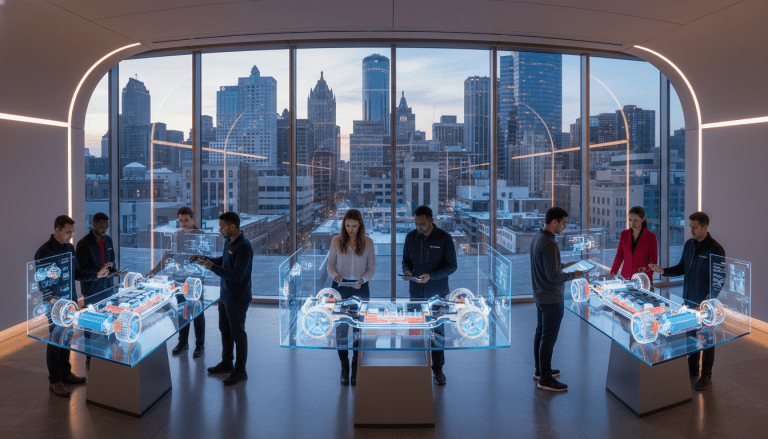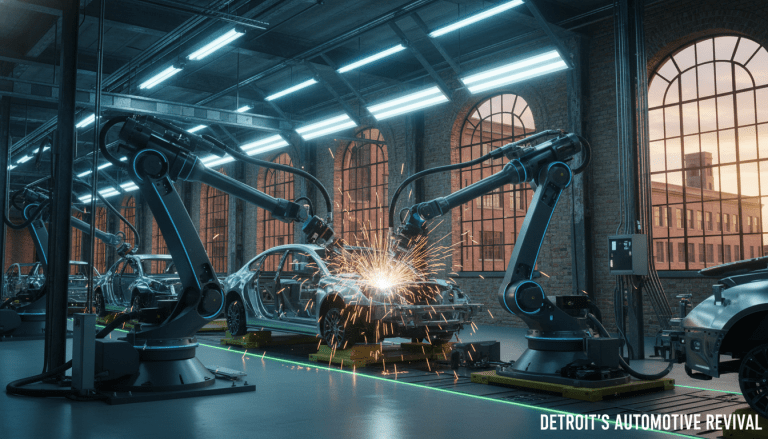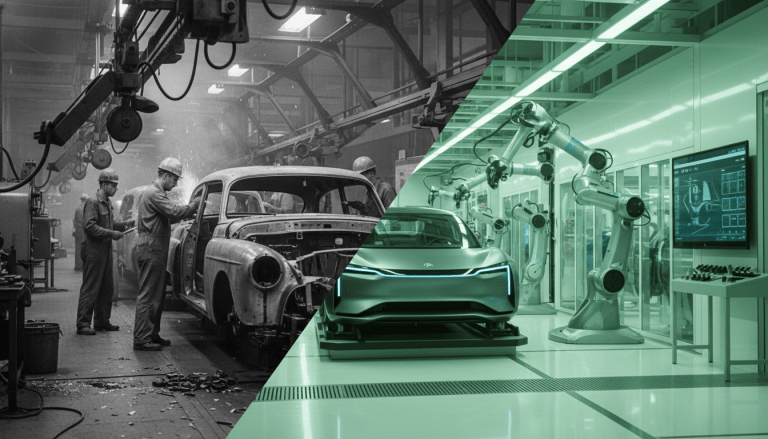

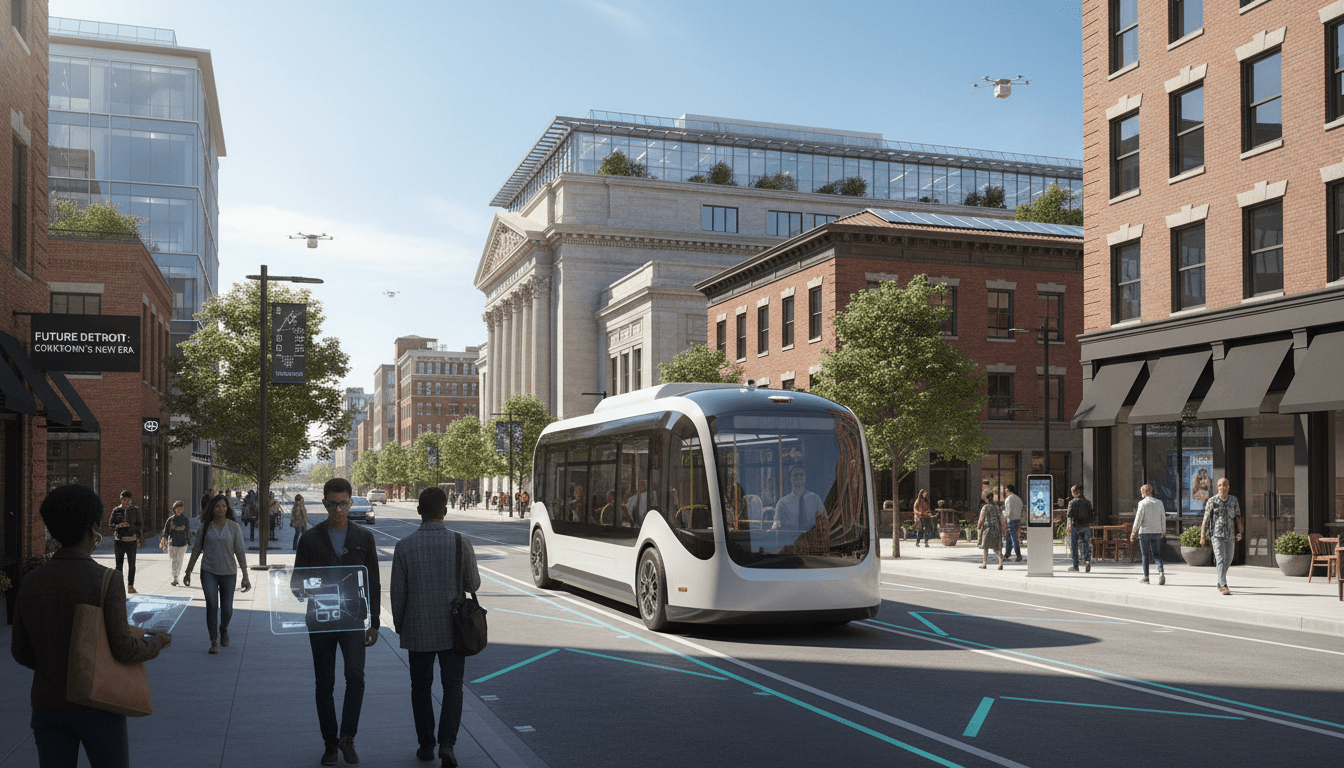
Detroit, long recognized globally as the Motor City, is aggressively pivoting to claim a new title: the Mobility City. As 2025 unfolds, a series of high-tech Detroit mobility projects are moving from theoretical whiteboards to the asphalt of Corktown and downtown streets. These pilot programs, ranging from electrified roadways to autonomous shuttles, represent a significant collaboration between the City of Detroit, the State of Michigan, and private tech entities.
The epicenter of this transformation is undoubtedly the Michigan Central innovation district. Following Ford Motor Company’s restoration of the historic train station, the surrounding area has become a living laboratory for transportation technology. However, officials are keen to emphasize that these initiatives are not just about flashy technology, but about solving practical transit gaps for residents.
The Wireless Charging Road: A Nation First
One of the most discussed Detroit mobility projects is the wireless electric vehicle (EV) charging roadway installed on 14th Street, adjacent to Michigan Central. In a partnership involving the Michigan Department of Transportation (MDOT) and Israeli tech company Electreon, Detroit became home to the nation’s first public wireless charging road for EVs.
The technology works similarly to wireless smartphone charging but on a massive scale. Copper coils embedded under the asphalt transfer energy to a receiver on the underside of a vehicle as it drives over the coils. “This pilot allows us to test the viability of continuous charging for transit fleets,” said an MDOT spokesperson in a recent press briefing. “If buses and delivery trucks can charge while in motion, we can reduce battery size and downtime, ultimately making public transit more efficient.”
While currently a quarter-mile stretch used primarily for testing a specially equipped Ford E-Transit van, the data gathered here is expected to inform future infrastructure projects across the Midwest. For more on local infrastructure developments, read our coverage on Detroit infrastructure updates.
Autonomous Shuttles and the ‘Connect’ Pilot
Beyond electrification, automation remains a key pillar of the city’s strategy. The “Connect” autonomous shuttle pilot has been ferrying passengers between Corktown and downtown Detroit, providing a glimpse into the future of public transportation.
Operated by May Mobility, these shuttles utilize a suite of lidar, radar, and cameras to navigate complex urban environments. Unlike early autonomous tests that were confined to closed tracks, these vehicles operate in mixed traffic, dealing with human drivers, pedestrians, and cyclists.
According to the City of Detroit’s Office of Mobility Innovation (OMI), the goal is not to replace existing bus lines but to fill the “first-mile, last-mile” gap. “Residents often cite the difficulty of getting from their homes to a main bus terminal,” a representative from the OMI stated. “Autonomous shuttles can bridge that gap, making the entire transit network more accessible.”
Impact on Detroit Residents
While the technology attracts international headlines, local leaders are focused on the tangible benefits for Detroiters. The integration of Detroit mobility projects is designed to address systemic issues regarding access to jobs and healthcare.
Tim Slusser, Chief of the Office of Mobility Innovation, has previously noted that one-third of Detroiters do not own a car. Consequently, affordable and reliable multi-modal transportation is not a luxury—it is an economic necessity. The pilot programs are currently being evaluated on several metrics:
- Reliability: Can these systems operate in Detroit winters?
- Cost: Can they lower the cost per ride compared to traditional rideshare?
- Accessibility: Are the vehicles equipped to handle passengers with disabilities?
Furthermore, the influx of mobility tech companies is stimulating the local job market. Michigan Central has launched skills-training programs to ensure that Detroit residents can access the new technical jobs being created, rather than importing talent solely from Silicon Valley.
Smart Intersections and Safety Data
Not all mobility pilots involve vehicles; some involve the infrastructure itself. Detroit has been upgrading intersections with “smart” technology capable of communicating with connected vehicles. These intersections can warn drivers of pedestrians stepping off the curb or alert vehicles that a light is about to turn red.
Data from the National Highway Traffic Safety Administration (NHTSA) suggests that connected vehicle technology could eliminate up to 80% of non-impaired traffic crashes. In Detroit, where pedestrian safety remains a critical concern, these digital safeguards are a welcome development.
For a deeper look at how local businesses are adapting to these changes, check out our report on Detroit businesses adopting new tech.
The Role of Aerial Mobility
Looking skyward, Detroit is also exploring the utility of drones. The Detroit Region Aerotropolis and various private partners are testing drone usage for medical supply delivery. In time-sensitive scenarios, such as transporting blood or organs between hospitals, drones can bypass gridlocked traffic on I-75 or I-94.
While widespread commercial drone delivery is still navigating Federal Aviation Administration (FAA) regulations, Detroit’s participation in these early pilot programs positions the city as a leader in the Advanced Air Mobility (AAM) sector.
What Happens Next?
As 2025 progresses, the data collected from these Detroit mobility projects will determine which initiatives scale up and which are shelved. The Michigan Central district continues to recruit startups from around the world, solidifying the city’s status as a global hub for transportation innovation.
For residents, the changes will be incremental but noticeable. Whether it is a quieter electric bus, a shuttle that arrives on demand, or a safer intersection, the fabric of how people move through Detroit is being rewoven. The city that put the world on wheels is now intent on teaching the world how to drive intelligently.
You can find more official details on state-wide transportation initiatives at the Michigan Department of Transportation website.