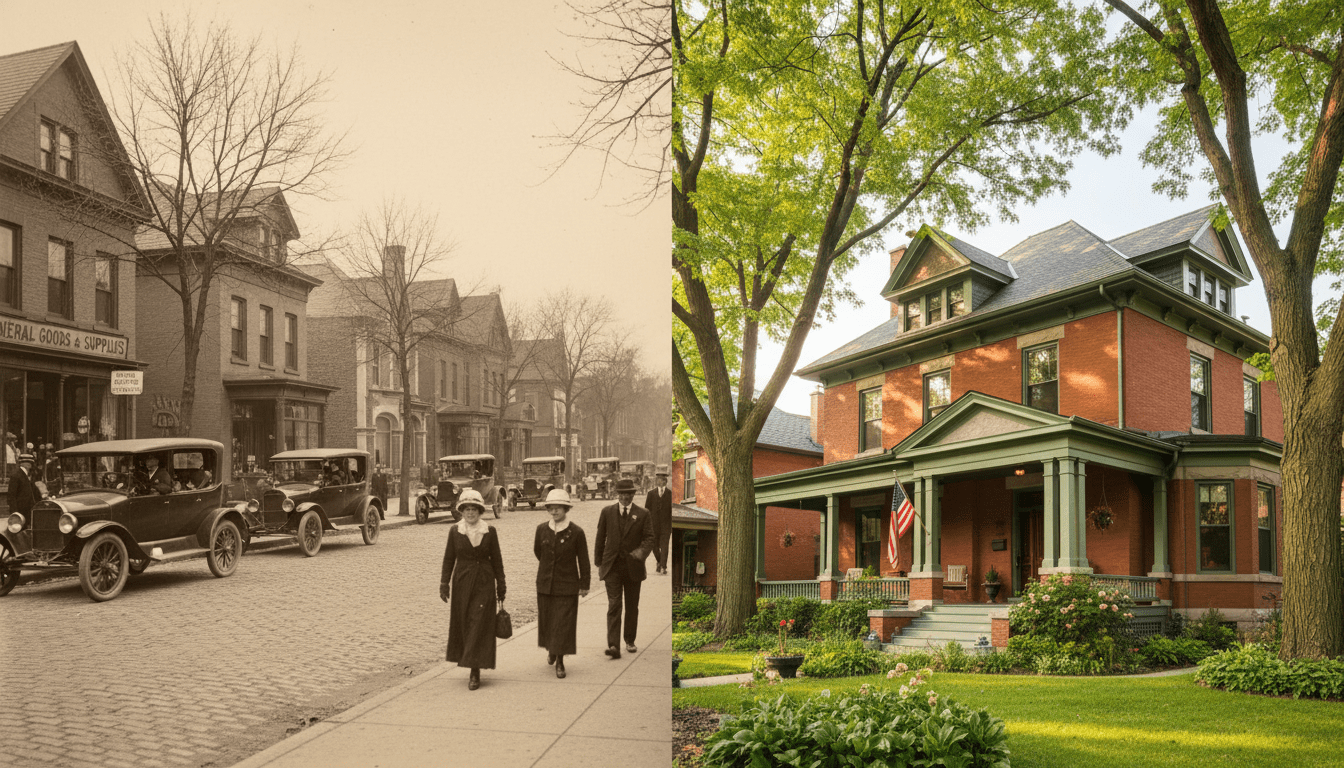
Detroit is a city defined by its communities. While the skyline is dominated by the Renaissance Center and the roar of the auto industry echoes through its history, the true soul of the Motor City lies in its residential streets. To understand the city today, one must explore the history of Detroit neighborhoods, a complex narrative of agricultural roots, industrial explosions, systemic segregation, and modern resilience.
For current residents and potential newcomers alike, the architectural diversity and geographic layout of the city tell a story of rapid expansion and profound change. From the historic mansions of Boston-Edison to the dense, working-class roots of Southwest Detroit, every block holds a piece of the puzzle that explains how Detroit became the metropolis it is today.
The Foundations: French Ribbon Farms
Long before Detroit was the automobile capital of the world, it was a strategic trading post. In the early 18th century, the city’s geography was defined by French settlers who established “ribbon farms.” These long, narrow strips of land started at the Detroit River and extended miles inland, ensuring that every landowner had access to the water—the primary highway of the era.
According to the Detroit Historical Society, the names of these early farm owners still grace the city’s streets today: Beaubien, Campau, and Rivard. This early layout dictated the radial avenues—Woodward, Gratiot, Grand River, Michigan, and Jefferson—that still serve as the primary arteries connecting the city’s sprawl. As the population grew, these farms were subdivided, forming the grid that would eventually become Detroit’s first neighborhoods.
The Industrial Boom: Housing the Motor City
The dawn of the 20th century brought the automobile, and with it, an insatiable demand for labor. Between 1900 and 1930, Detroit’s population soared from roughly 285,000 to over 1.5 million. This explosion required rapid housing development, birthing many of the districts recognized today as historic strongholds.
Neighborhoods like Indian Village and Boston-Edison rose during this era, built by the titans of industry and the growing upper-middle class. These areas featured grand homes designed by renowned architects, showcasing Tudor, Colonial Revival, and Italianate styles. Meanwhile, working-class neighborhoods sprang up around the factories. For instance, the area surrounding the original Ford Piquette Avenue Plant and later the Highland Park plant saw the construction of thousands of bungalows and two-family flats intended to house the workforce that put the world on wheels.
This era also cemented the city’s reputation for single-family detached homes, a distinct contrast to the tenement-style housing common in East Coast industrial cities like New York. The high wages of the auto industry allowed many workers to achieve homeownership, embedding a sense of pride and stability in the local culture.
Segregation, Redlining, and The Great Migration
No history of Detroit neighborhoods is complete without addressing the systemic inequities that shaped the city’s demographics. As African Americans moved North during the Great Migration seeking industrial jobs, they faced severe housing restrictions. Restrictive covenants and federal redlining policies forced Black residents into overcrowded and under-resourced areas.
The most prominent of these was Black Bottom and the adjacent business district, Paradise Valley. These areas were cultural hubs, rich with jazz and entrepreneurship, yet they suffered from neglect by city services due to discriminatory policies. In the 1950s and 60s, under the guise of “urban renewal,” the city demolished Black Bottom to make way for the Chrysler Freeway (I-375) and Lafayette Park. This displacement scattered residents and left a scar on the city’s landscape that urban planners are only now beginning to address through new infrastructure projects aimed at reconnecting communities.
Post-War Shifts and Suburbanization
Following World War II, the landscape of Detroit neighborhoods shifted again. The construction of the interstate highway system and the availability of VA loans—often denied to Black veterans—facilitated a mass exodus of white residents to newly forming suburbs. This phenomenon, known as “white flight,” drained the city of its tax base and population density.
By the late 20th century, many once-vibrant neighborhoods faced decline. However, communities like Palmer Woods, Sherwood Forest, and Rosedale Park managed to maintain stability through strong neighborhood associations and a commitment to preservation. These areas remained anchors of the middle class within the city limits during turbulent economic times.
Impact on Detroit Residents Today
For today’s locals, this history is not just academic; it dictates property values, community resources, and neighborhood identity. The legacy of ribbon farms provides the unique connectivity of the riverfront, while the preservation of historic districts protects the architectural integrity of the city.
Residents in areas like Corktown—Detroit’s oldest surviving neighborhood—have seen property values skyrocket as the district transforms with projects like Ford’s restoration of Michigan Central Station. Conversely, residents in neighborhoods further from the downtown core continue to advocate for equitable investment, fighting against the concept of “two Detroits” where development benefits only a select few.
Understanding the history of one’s neighborhood empowers residents to engage in local governance. “Knowing where we came from is essential to deciding where we are going,” said a representative from a local community development corporation in a recent town hall. “Preserving the story of our streets helps us protect our future.”
Background & Data
Data from the U.S. Census Bureau highlights the shifting tides of Detroit’s residential makeup. After decades of population loss, recent estimates suggest a stabilization in certain core neighborhoods. The sheer volume of historic structures is also notable; Detroit possesses one of the largest collections of pre-Depression era housing in the country.
- 1701: Founding of Detroit by Antoine de la Mothe Cadillac.
- 1910-1930: The peak construction era for many of Detroit’s iconic brick homes.
- 1950s: The height of Detroit’s population at 1.85 million.
- 2020s: Renewed focus on neighborhood strategic funds and the rehabilitation of vacant land.
For a deeper look into current housing trends, readers can view our analysis on Detroit real estate market trends.
What Happens Next?
The future of Detroit neighborhoods lies in a delicate balance between revitalization and retention. The City of Detroit has launched initiatives like the Strategic Neighborhood Fund, aimed at spreading development beyond Downtown and Midtown into areas like Live6, Southwest Detroit, and East Warren.
As the city moves forward, the challenge will be to modernize infrastructure and housing stock while ensuring longtime residents are not displaced by gentrification. The history of Detroit neighborhoods proves that the city is resilient, constantly evolving to meet the demands of the era while fighting to maintain the distinct character that makes Detroit, Detroit.