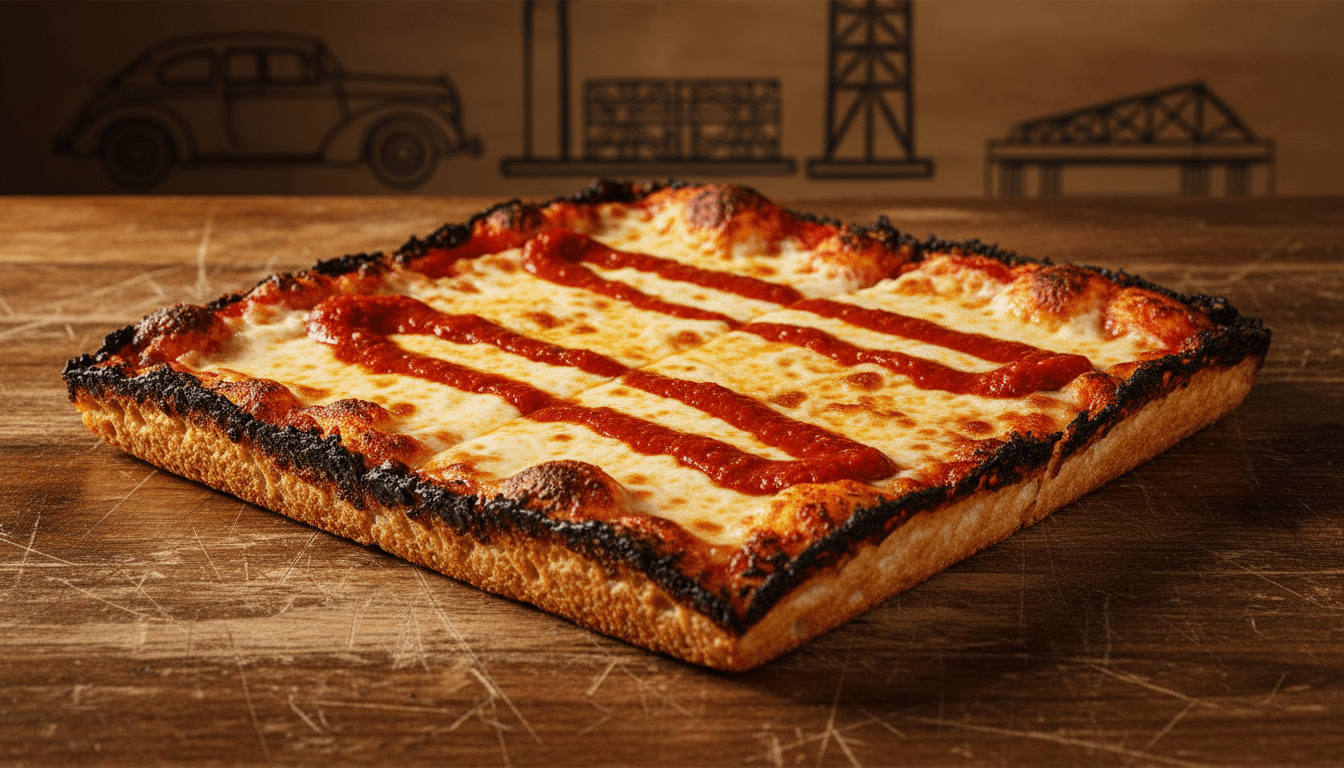
It is a culinary signature defined by its contradictions: a thick crust that remains light and airy, a cheese blend that is baked underneath the sauce rather than on top, and a shape that defies the traditional circle. Detroit-style pizza, once a local secret kept within the confines of neighborhood taverns, has evolved into an international phenomenon. However, its roots remain deeply entrenched in the industrial history and immigrant culture of the Motor City.
For decades, this rectangular pie was simply known as “pizza” to locals. Today, it is recognized globally as a distinct regional style, standing alongside New York and Chicago varieties. The evolution of Detroit-style pizza is not just a story of culinary innovation, but a reflection of Detroit’s mid-century manufacturing might and the communities that built the city.
The Origins: 1946 and the Automotive Connection
The story of Detroit-style pizza begins in 1946 at a speakeasy-turned-tavern known as Buddy’s Rendezvous on Conant Street. According to historical accounts from the Detroit Historical Society, the establishment was owned by Gus Guerra. Seeking to add a new item to the menu to feed returning World War II soldiers and auto workers, Guerra adapted a Sicilian recipe—sfincione—to local resources.
The defining characteristic of the pizza—its square shape and crispy edges—was born out of necessity and industrial availability. Lacking traditional baking pans, Guerra utilized blue steel utility trays intended for holding small parts and scrap metal in automotive factories. These heavy, dripping pans were readily available in Detroit’s manufacturing plants. The steel conducted heat intensely, creating the caramelized cheese perimeter, or “frico,” that has become the style’s hallmark.
Unlike other styles, the construction of the Detroit pie follows a specific order: the dough is pressed into the pan, followed by pepperoni (often placed directly on the dough to infuse flavor), a thick layer of Wisconsin brick cheese, and finally, ladles of red sauce applied in racing stripes across the top. This “upside-down” layering prevents the dough from becoming soggy during the baking process.
The Pizza Family Tree
The proliferation of Detroit-style pizza throughout the metro area can be traced through a lineage often referred to as the “Pizza Tree.” In 1953, Gus Guerra sold Buddy’s and opened Cloverleaf Pizza in East Detroit (now Eastpointe), bringing his original recipe with him. Buddy’s continued under new ownership, maintaining the style that had already won over local diners.
In the years that followed, former employees of Buddy’s and Cloverleaf branched out to establish their own institutions. Shield’s Pizza began serving the square pies in the late 1940s, evolving into another pillar of the local scene. Loui’s Pizza in Hazel Park, founded by long-time Buddy’s chef Louis Tourtois in 1977, is widely cited by food critics for perfecting the style’s signature crust.
For decades, these establishments operated largely as local secrets. While New York slices and Chicago deep-dish pies dominated the national conversation, Detroit’s square pizza remained a staple of Food & Drink in Detroit, rarely found outside the tri-county area.
National Recognition and Modern Evolution
The shift from local staple to national trend began in the early 2010s. A resurgence of interest in regional American foods, combined with Detroit’s growing reputation as a culinary destination, brought the style into the spotlight. In 2012, intense competition in the International Pizza Expo saw Detroit-style pizza makers taking top honors, signaling to the wider gastronomic world that this was a serious category of pizza.
Restaurateurs outside of Michigan began adopting the style. From “Emmy Squared” in New York to specialty shops in Colorado and California, the blue steel pan method was replicated, although often with modifications. Despite this global expansion, local purists maintain that the specific alchemy of Michigan water, Wisconsin brick cheese, and seasoned decades-old steel pans keeps the authentic version unique to the city.
Recent data from industry analysts indicates a surge in frozen Detroit-style options in supermarkets nationwide, further cementing the style’s transition from niche to mainstream. However, the operational complexity of the dough—which requires a long fermentation process and high hydration—means that artisanal, pizzeria-made versions retain a significant quality advantage over mass-produced alternatives.
Impact on Detroit Residents and Economy
For Detroit residents, the pizza is more than a meal; it is a point of cultural pride and a driver of local economic activity. The enduring popularity of the original “big four”—Buddy’s, Cloverleaf, Shield’s, and Loui’s—supports hundreds of service and culinary jobs in the region. Furthermore, newer entrants to the market, such as Michigan & Trumbull and Pie-Sci, have utilized the style as a canvas for modern experimentation, revitalizing neighborhoods and attracting tourism.
According to the Michigan Restaurant & Lodging Association, the state’s restaurant industry is a primary economic engine, and destination dining—driven heavily by Detroit-style pizza—plays a crucial role in that ecosystem. The style has become a key component of Detroit Local Living, with residents frequently debating the merits of sauce consistency and cheese browning across different establishments.
Local business owners have noted that the national fame of the pizza brings visitors specifically looking to taste the “real thing.” This culinary tourism helps support the broader ecosystem of bars, suppliers, and districts surrounding these historic pizzerias.
Preserving the Legacy
As Detroit-style pizza continues to evolve, efforts to preserve its history have intensified. The city has seen a renewed appreciation for the original techniques. While toppings have expanded beyond the traditional pepperoni to include everything from coriander to hot honey, the fundamental architecture of the pie remains unchanged.
The evolution from automotive drip pans to a celebrated global dish serves as a metaphor for Detroit itself: resilient, innovative, and capable of turning industrial utility into something enduringly beloved. As the city continues its development, its signature pizza remains a constant, anchoring the community to its history while feeding its future.