The Detroit riverfront, once a landscape defined by industrial silos and restricted access, is undergoing a final, transformative push that will see several landmark projects reach completion by 2026. As the city prepares for an influx of global attention following the 2024 NFL Draft and ongoing revitalizations, the stretch of land along the Detroit River is becoming a central pillar of Detroit urban planning efforts. From expansive world-class parks to luxury residential high-rises, the scale of current Detroit riverfront development represents one of the most significant public-private partnerships in the city’s history.
The Crown Jewel: Ralph C. Wilson, Jr. Centennial Park
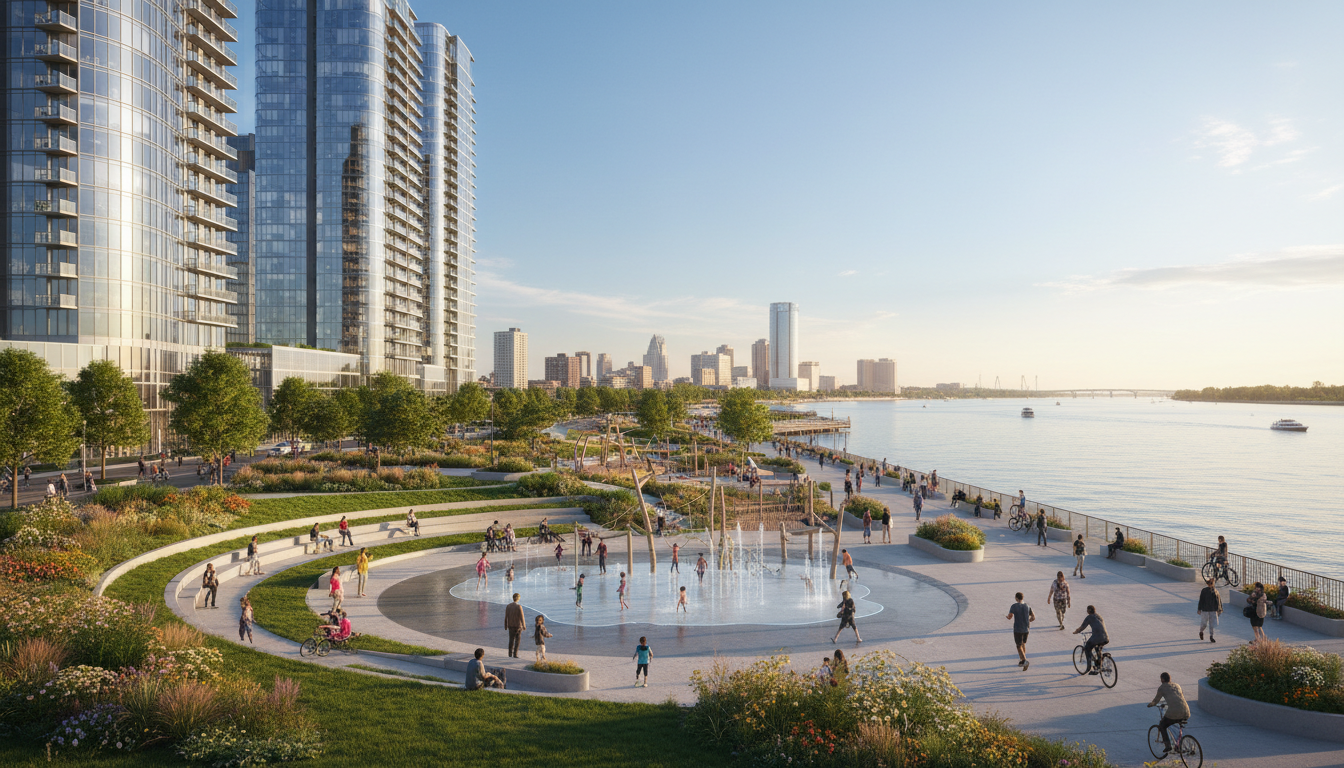
At the heart of the 2026 vision is the Ralph C. Wilson, Jr. Centennial Park. Spanning 22 acres on the West Riverfront, this project is managed by the Detroit Riverfront Conservancy. According to official project timelines from the Conservancy, the park is designed to be a regional magnet, featuring a large-scale “Monstrum” playground, a water power station, and a sprawling lawn for major community events. The transformation of this former industrial site into a lush green space is a cornerstone of the broader city development Detroit initiative to improve quality of life for residents.
The park is part of a larger $350 million investment strategy aimed at completing the riverwalk and connecting it to the city’s inland neighborhoods. Mark Wallace, former president and CEO of the Detroit Riverfront Conservancy, has previously noted that the goal is not just to build a park, but to create a “gathering place for all Detroiters,” ensuring that the waterfront remains accessible regardless of socioeconomic status.
Water Square and Residential Expansion
Complementing the public park spaces is a surge in private real estate investment. On the site of the former Joe Louis Arena, the Water Square development has already begun to change the skyline. The 25-story luxury residential tower is the first of its kind in this sector of the riverfront, offering hundreds of apartments with unobstructed views of the water. This project serves as a bellwether for Detroit riverfront development, signaling a shift toward high-density, mixed-use living spaces that cater to a growing demographic of urban professionals.
Urban planning Detroit experts suggest that the concentration of housing along the water is intentional. By creating a 24/7 population on the riverfront, the city aims to support new retail and dining establishments that have historically struggled in the central business district. According to data from the City of Detroit Planning and Development Department, these projects are expected to generate significant property tax revenue that will be reinvested into neighborhood services across the city’s seven districts.
The Joe Louis Greenway Connection
Perhaps the most ambitious aspect of the 2026 outlook is the integration of the Detroit riverfront with the Joe Louis Greenway. The Greenway is a planned 27.5-mile loop that will connect the riverfront to neighborhoods like Corktown, Woodbridge, and the Avenue of Fashion. By 2026, several key segments of the Greenway are expected to be operational, providing a seamless transition for cyclists and pedestrians from the interior of the city directly to the Detroit waterfront.
This connectivity is vital for residents who do not live within walking distance of the water. A recent report by the Michigan Economic Development Corporation (MEDC) highlighted that improved non-motorized transportation infrastructure is a primary driver for retaining young talent in Michigan. The Greenway serves as the physical link that ensures Detroit riverfront development benefits more than just those living in the immediate downtown area.
Impact on Detroit Residents
For long-time Detroiters, the rapid pace of city development Detroit can bring both excitement and concern regarding displacement and accessibility. To address this, the City of Detroit has implemented community benefits agreements on several riverfront projects. These agreements often include provisions for local hiring, affordable housing set-asides, and the preservation of public access to the water.
The economic impact is also measurable. The Detroit Riverfront Conservancy reports that over $2 billion in public and private investment has been sparked by the initial phases of the riverwalk. This has resulted in thousands of construction jobs and permanent positions in property management, hospitality, and park maintenance. For the local community, the riverfront has transitioned from a barrier to a resource for physical health, mental well-being, and economic opportunity.
Background and Future Outlook
The journey toward the 2026 milestone began decades ago. Data from the U.S. Census Bureau and historical city records show that the Detroit waterfront was largely inaccessible to the public for nearly a century due to heavy industrial use. The shift began in 2003 with the formation of the Conservancy, and since then, the riverwalk has been voted the best in the country by USA Today readers for three consecutive years.
As 2026 approaches, the focus is shifting toward the East Riverfront and the eventual redevelopment of the Uniroyal site. This 40-acre plot near Belle Isle is slated to become a mixed-use community, finally closing one of the last remaining gaps in the riverfront trail system. External stakeholders, including the Detroit Riverfront Conservancy, continue to monitor environmental remediation efforts on these former brownfields to ensure they are safe for public use.
Looking ahead, the successful completion of these projects by 2026 will solidify Detroit’s reputation as a leader in innovative urban planning Detroit. The city is proving that industrial legacy sites can be reimagined as vibrant, inclusive, and economically productive public assets. Residents and visitors alike can expect a riverfront that is more connected, more active, and more representative of the city’s resilient spirit than ever before.
For more updates on local growth, see our previous coverage on neighborhood infrastructure investments and upcoming housing trends in Detroit.