For decades, Detroit has held the global title of the Motor City, a moniker earned through its deep-seated history as the automotive capital of the world. However, for thousands of residents, students, and commuters, the daily reality involves navigating the region not behind the wheel of a personal vehicle, but via an evolving network of buses, streetcars, and autonomous shuttles. As the city continues its economic revitalization, the conversation surrounding public transportation in Detroit has shifted from mere necessity to a critical component of urban sustainability and equitable access.
While the region has historically struggled with a fragmented transit system, recent efforts by local government bodies and regional authorities aim to bridge the gaps between the city and its suburbs. Understanding the current landscape requires a deep dive into the four primary operators—DDOT, SMART, the QLine, and the Detroit People Mover—and how they are attempting to function as a cohesive unit.
The Backbone: DDOT and SMART
The vast majority of public transit ridership in the region is handled by two distinct bus systems: the Detroit Department of Transportation (DDOT) and the Suburban Mobility Authority for Regional Transportation (SMART).
According to the City of Detroit, DDOT is the largest public transit provider in Michigan, serving the city limits and neighboring communities. It is the lifeline for many Detroiters who rely on the service to reach employment centers, healthcare facilities, and grocery stores. In recent years, DDOT has focused on fleet modernization and hiring initiatives to address driver shortages that have historically plagued route frequency.
“Our priority remains ensuring that every resident has reliable access to the opportunities Detroit has to offer,” a spokesperson for the Detroit Department of Transportation stated in a recent press briefing. “Reliability is the key to trust, and we are seeing improvements in on-time performance.”
Complementing the city service is SMART, which connects the city to the wider tri-county area, including Oakland, Macomb, and Wayne counties. SMART operates fixed routes as well as the FAST (Frequent Affordable Safe Transit) service, which provides limited-stop connections along major corridors like Woodward, Gratiot, and Michigan Avenue.
For years, the transfer between these two systems was a point of friction for riders. However, the introduction of the “Dart” payment system has streamlined the process. This unified payment method allows riders to use a single pass for both DDOT and SMART buses, as well as the QLine streetcar, significantly reducing the logistical headache for cross-county commuters.
Rail in the City: QLine and The People Mover
Beyond rubber-tire transit, Detroit features two rail-based systems that serve the downtown core, though they serve different functions.
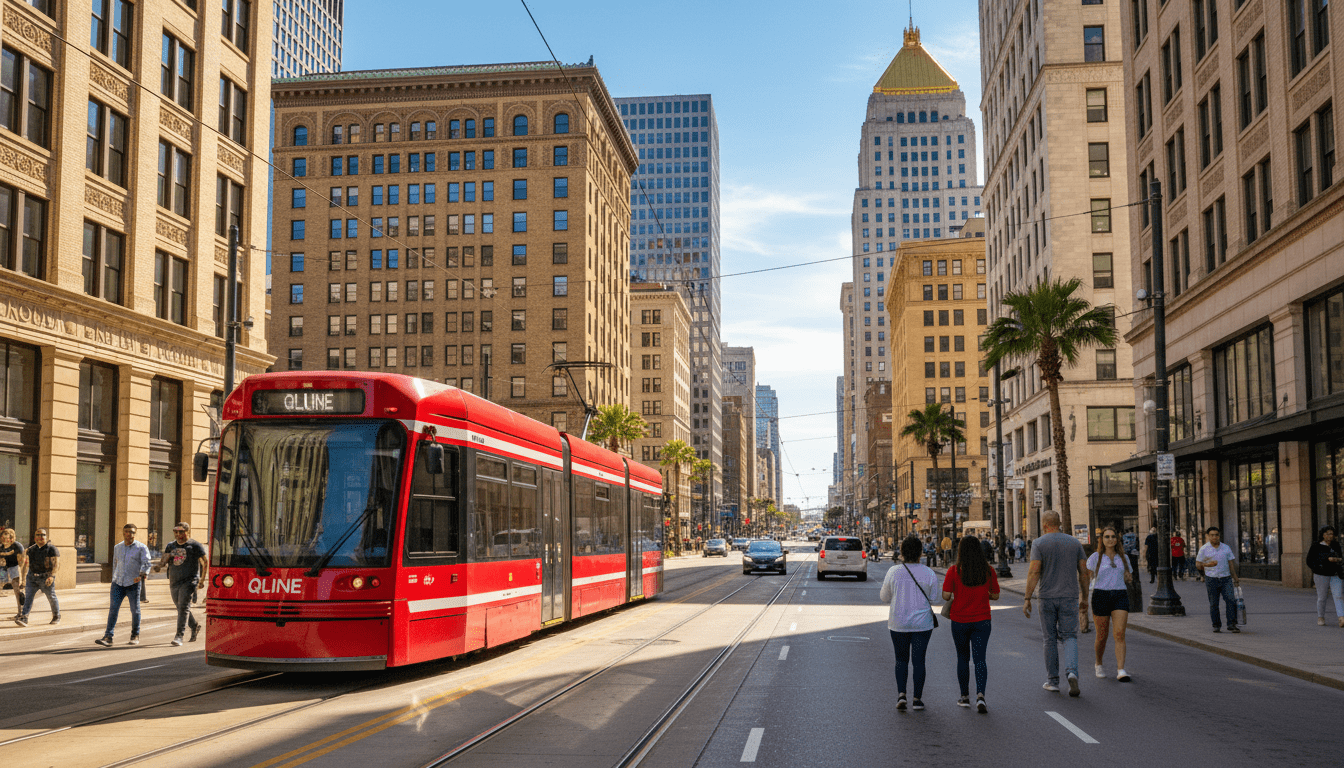
The QLine, a 3.3-mile streetcar loop along Woodward Avenue, connects the riverfront to the New Center area. Initially launched largely with private funding, the system transitioned to public ownership under the Regional Transit Authority of Southeast Michigan (RTA) recently to ensure long-term sustainability. While critics have historically pointed to its limited range, supporters argue it has spurred significant economic development along the Woodward corridor.
“The QLine has become more than just a ride; it is a connector for the cultural and business districts,” noted a representative from M-1 RAIL during the transition announcement. Data indicates that ridership fluctuates heavily with major sporting events and concerts, highlighting its role in the tourism and entertainment sector.
Meanwhile, the Detroit People Mover, an elevated automated guideway transit system, loops around the downtown central business district. After struggling with maintenance issues and closures post-pandemic, the system has seen renewed interest due to fare-free initiatives and the reopening of key stations. It primarily serves as a circulator for visitors moving between hotels, Huntington Place, and the Renaissance Center.
Impact on Detroit Residents
The effectiveness of public transportation in Detroit is a matter of economic survival for many. Data from the U.S. Census Bureau suggests that a significant percentage of Detroit households do not own a private vehicle, making reliable transit essential for economic mobility. When buses are late or routes are cut, the impact is felt immediately in lost wages and missed appointments.
Local business owners along the Jefferson and Woodward corridors have expressed cautious optimism regarding recent improvements. “When the bus runs on time, my staff gets here on time. It’s that simple,” said the owner of a coffee shop in Midtown. “A few years ago, it was a gamble. Now, with the tracking apps and better communication, it feels more stable, though we still have a long way to go compared to cities like Chicago.”
The integration of technology has been a game-changer for residents. Apps like the Transit app allow riders to track real-time arrivals for DDOT, SMART, and the QLine, removing some of the uncertainty that used to define the transit experience in Detroit.
Connecting the Region: The Role of the RTA
The Regional Transit Authority of Southeast Michigan (RTA) remains the entity tasked with the difficult job of coordinating these disparate systems into a true regional network. One of the most significant recent additions overseen by the RTA is the Detroit Air Xpress (DAX), a pilot service providing direct bus connections between downtown Detroit and Detroit Metro Airport (DTW).
Prior to DAX, travelers without cars had to rely on expensive rideshares or a convoluted series of bus transfers to reach the airport. The DAX service represents a step toward the kind of seamless connectivity found in other major metropolitan areas. According to RTA reports, initial ridership numbers for DAX have been promising, suggesting a strong latent demand for airport connectivity.
For more insights on how infrastructure changes are influencing the local housing market, readers can explore our coverage on Detroit real estate trends.
Challenges and Future Outlook
Despite improvements, challenges remain. The region lacks a high-speed rapid transit system, and the “last mile” problem—getting people from a bus stop to their final destination—persists in the sprawling suburbs. Furthermore, funding for public transit in Michigan has historically lagged behind other states, leaving agencies reliant on millages that must be approved by voters.
Looking ahead to 2025 and beyond, the conversation is turning toward Bus Rapid Transit (BRT) and further regional integration. Planners are looking at dedicated lanes on major thoroughfares to prevent buses from getting stuck in mixed traffic, a move that would significantly increase average speeds and reliability.
“We are at a pivot point,” states a recent urban planning report from the Southeast Michigan Council of Governments (SEMCOG). “The future of the region’s economic competitiveness depends on our ability to move people efficiently across county lines.”
As Detroit continues to evolve, so too must the systems that move its people. Whether through the expansion of the QLine, the optimization of DDOT routes, or new regional initiatives, the drive to improve public transportation in Detroit is more active now than it has been in decades.