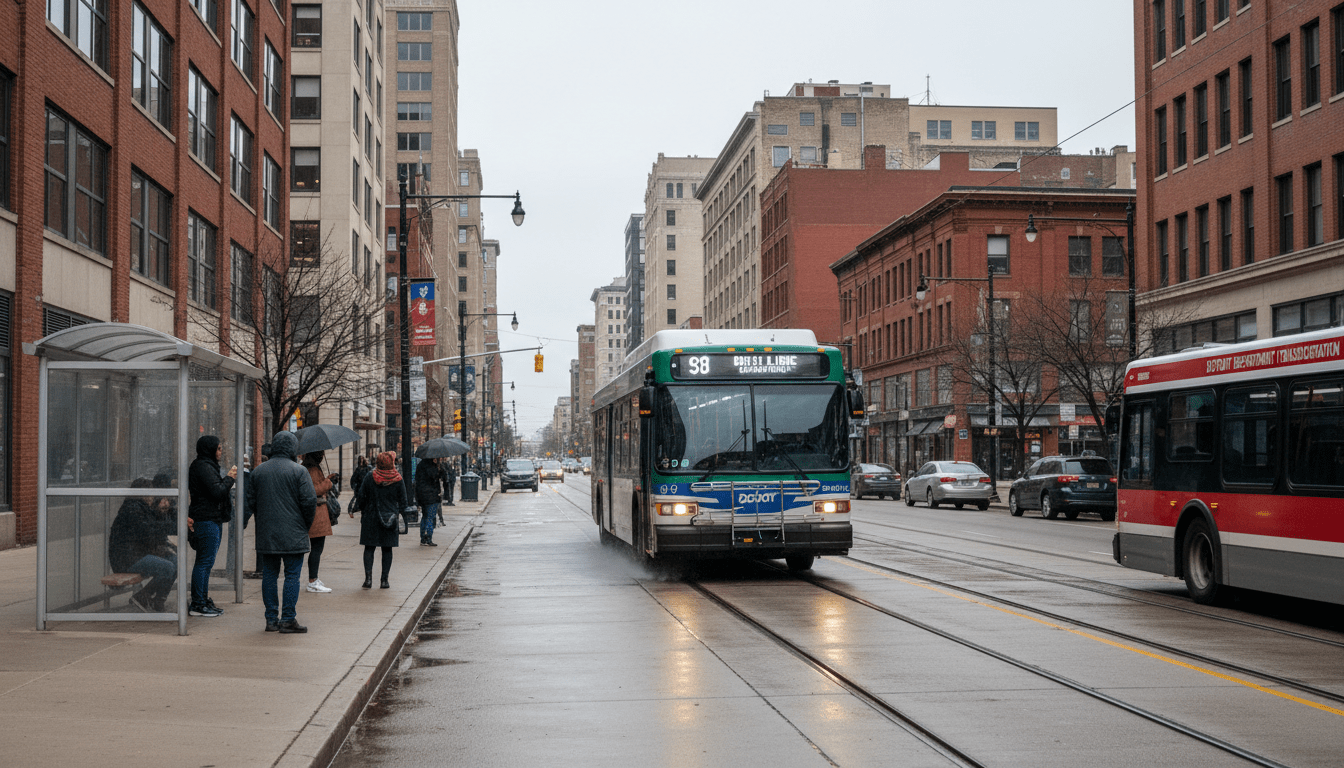
For decades, Detroit has held the global moniker of the “Motor City,” a title that reflects the region’s deep historical ties to the automotive industry. However, for thousands of residents and an increasing number of visitors, the reliance on personal vehicles is shifting toward a reliance on shared transit. The state of public transportation in Detroit is a complex narrative of fragmented systems, recent improvements, and ongoing challenges to connect the city’s sprawling neighborhoods with its suburban counterparts.
While Detroit does not possess the extensive subway networks of New York or Chicago, the current landscape involves a mix of bus systems, streetcars, and an elevated automated people mover. Understanding how these distinct entities operate—and how they interact—is essential for anyone living in or visiting the region.
The Backbone: DDOT and SMART Bus Systems
The primary mode of public transportation in Detroit remains the bus network, which is bifurcated into two distinct operators: the Detroit Department of Transportation (DDOT) and the Suburban Mobility Authority for Regional Transportation (SMART).
DDOT operates exclusively within the city limits and the enclaves of Highland Park and Hamtramck. It is the largest public transit provider in Michigan. According to the City of Detroit, DDOT serves millions of riders annually, acting as a lifeline for residents commuting to work, school, and healthcare appointments. In recent years, the department has focused on increasing frequency on major corridors like Woodward, Gratiot, and Grand River Avenues.
Conversely, SMART connects the city to the surrounding suburbs in Wayne, Oakland, and Macomb counties. A critical development in recent years was the introduction of the FAST (Frequent Affordable Safe Transit) service. These high-frequency routes connect downtown Detroit to the suburbs with limited stops, significantly reducing commute times.
“The introduction of FAST buses has been a game-changer for regional connectivity,” stated a representative from the Regional Transit Authority of Southeast Michigan (RTA). “It bridges the gap between the city core and the job centers in the suburbs, which has historically been a friction point for Detroit’s workforce.”
Rail Options: The QLine and People Mover
Beyond buses, Detroit offers two rail-based options that serve the downtown core, though their utility differs significantly from traditional heavy rail.
The QLine, a streetcar system running 3.3 miles along Woodward Avenue, connects Downtown to the New Center area. Initially launched with private funding before being transferred to regional public control, the QLine serves major cultural institutions, including the Detroit Institute of Arts and Wayne State University. While criticized early on for traffic delays, operational improvements have stabilized its schedule, making it a viable option for traversing the Woodward corridor without a car.
Complementing the streetcar is the Detroit People Mover, an elevated automated guideway that loops 2.9 miles around the central business district. Often viewed by critics as a novelty, it serves a practical purpose during major events, shuttling attendees between hotels, Huntington Place, and sporting venues. Data indicates that ridership spikes significantly during Lions games and conventions, highlighting its role in the tourism and event economy.
Impact on Detroit Residents
The effectiveness of public transportation in Detroit is not merely a matter of convenience; it is an issue of economic equity. In a city where automobile insurance rates are among the highest in the nation, car ownership is a financial burden many cannot afford. Consequently, a reliable transit system is the only link to economic opportunity for a significant portion of the population.
Local advocacy groups have long pointed out that while downtown transit options like the QLine are robust, neighborhood routes often suffer from delays and gaps in coverage. “If you live near Woodward, you have options,” noted a community organizer during a recent transit town hall. “But for residents in the outer neighborhoods, missing a bus can mean being an hour late for work. The reliability of the DDOT connectors is where the real impact on daily life is felt.”
Recent initiatives by the City of Detroit have aimed to address these disparities by upgrading bus shelters and aiming for 24-hour service on key routes. Improving the “last mile” connectivity remains a priority for city planners seeking to revitalize Detroit’s diverse neighborhoods outside the downtown core.
Regional Connectivity and the Airport
One of the most significant recent additions to the transit landscape is the Detroit Air Xpress (DAX). Launched to solve the long-standing issue of transit-accessible travel to Detroit Metropolitan Airport (DTW), DAX provides direct service between downtown Detroit and the airport terminals.
Prior to DAX, travelers relying on public transit faced a disjointed journey involving transfers and long travel times. The RTA’s implementation of this pilot program represents a shift toward modernizing regional infrastructure to match competitor cities. According to RTA documentation, the service is designed not just for tourists, but for airport employees living in the city, further emphasizing the link between transit and employment.
Challenges and Future Outlook
Despite these improvements, public transportation in Detroit faces structural hurdles. The lack of a comprehensive regional tax millage has historically limited the expansion of a true rapid transit system that crosses all county lines seamlessly. The “opt-out” model, where certain municipalities can choose not to participate in the SMART system, creates holes in the coverage map that complicate regional travel.
However, the outlook is shifting. Increased federal infrastructure funding and a renewed focus from state leadership have brought transit back to the forefront of policy discussions. The vision for the future involves better integration between payment systems—allowing a single pass to work seamlessly across DDOT, SMART, and the QLine—and the potential expansion of bus rapid transit (BRT) lanes that are physically separated from traffic.
For Detroit to continue its trajectory of economic recovery, experts agree that the transit network must evolve from a safety net for those without cars into a preferred choice for commuters across the region. As new businesses and startups continue to populate the city, the demand for a cohesive, reliable transit ecosystem will only grow.
Residents looking for schedules, route maps, and real-time updates are encouraged to visit the official Detroit Department of Transportation website or use the mobile apps provided by SMART and the QLine.