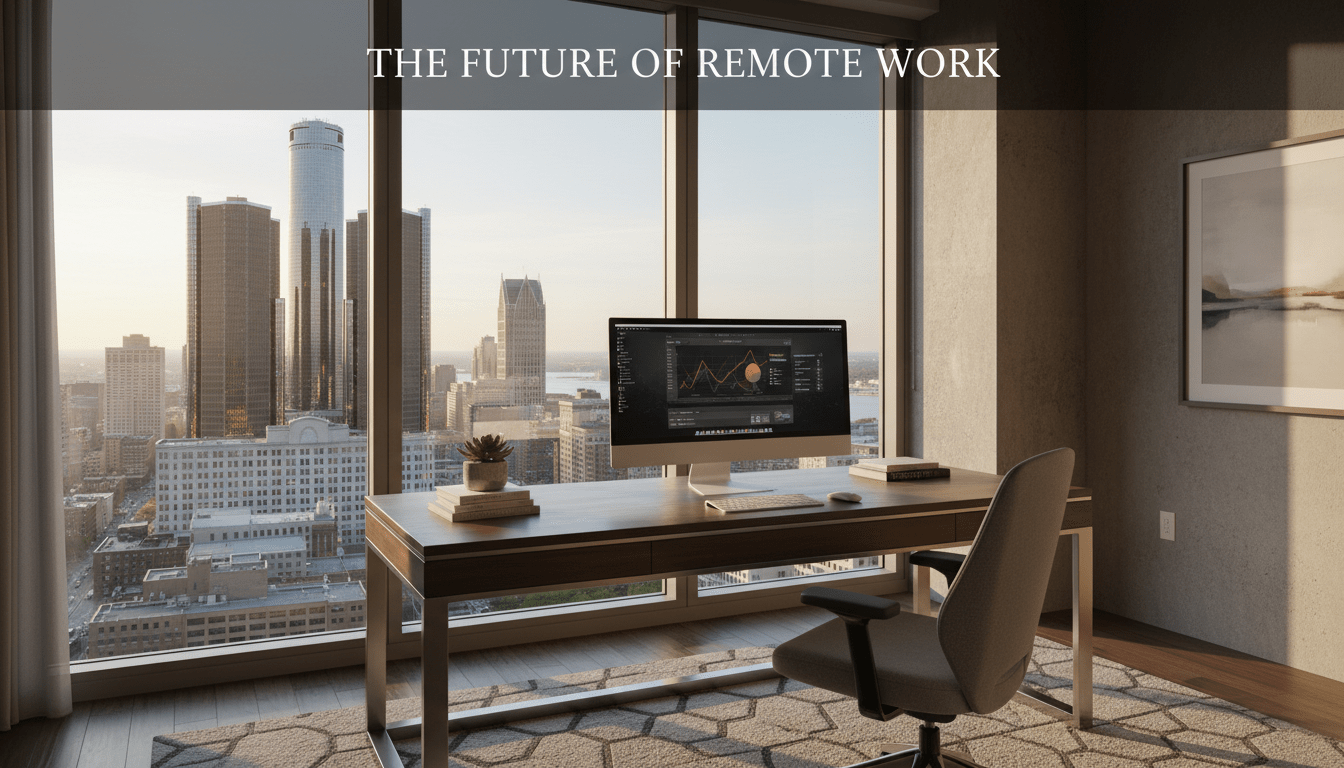
As the global workforce continues to navigate the post-pandemic landscape, the dynamic of remote work in Detroit has evolved from a temporary necessity into a persistent economic driver. While the Motor City is historically rooted in manufacturing and on-site industrial labor, a significant transformation is underway within the city’s service, technology, and financial sectors.
Despite aggressive return-to-office (RTO) mandates from some of the region’s largest employers, data suggests that flexibility remains a key component of the local job market. For Detroit residents, this shift offers access to a broader range of employment options, allowing locals to tap into national salary bands while maintaining the cost-of-living advantages of residing in Southeast Michigan.
The Current State of Remote Employment
According to recent data from the U.S. Census Bureau, the percentage of Michigan residents working primarily from home has stabilized significantly higher than pre-2020 levels. While the initial surge has receded, a “hybrid equilibrium” has emerged, particularly in Detroit’s growing fintech and mobility sectors.
Local recruitment analysts note that while fully remote positions in manufacturing remain non-existent for obvious reasons, the administrative, logistical, and technological support arms of these industries are increasingly decentralized. “The definition of a Detroit job is changing,” says a representative from a local workforce development agency. “It is no longer strictly defined by a commute to a downtown high-rise or a suburban factory. We are seeing Detroiters employed by companies based in California, New York, and Austin, contributing to the local tax base without occupying local office space.”
This trend is corroborated by job posting analytics, which show that searches for Detroit-based employment with “remote” or “hybrid” tags remain high volume, suggesting a disconnect between employer mandates and employee preferences.
Sectors Driving Remote Opportunities in Detroit
Several key industries are leading the charge for remote work in Detroit. Unlike the monolithic automotive era, today’s opportunities are fragmented across various high-growth verticals.
Technology and Startups
Detroit’s burgeoning tech ecosystem, anchored by hubs like TechTown and the innovation district around Michigan Central, has adopted a flexible approach to talent acquisition. Startups, often competing with coastal giants for engineering talent, utilize remote work as a leverage point. Software developers, data analysts, and cybersecurity experts living in neighborhoods like Corktown or Midtown are increasingly finding roles that do not require a daily commute.
Fintech and Mortgage Services
While some major local mortgage lenders have publicly emphasized the importance of office culture, the broader financial services sector in the region offers a mixed bag. Smaller fintech firms and insurance agencies are maintaining remote-first policies to reduce overhead costs associated with downtown real estate.
Customer Support and Administration
A significant portion of entry-level remote opportunities lies in customer success and administrative support. National corporations are increasingly looking to the Midwest for these roles due to the region’s neutral accent and reliable infrastructure. This provides an accessible entry point for residents without specialized technical degrees to enter the digital workforce.
Impact on Detroit Residents and Local Economy
The rise of location-independent work has profound implications for the city’s economy and its residents. Economists argue that remote work creates a form of “wage arbitrage” for Detroiters. By securing high-paying remote roles from companies based in high-cost-of-living cities, residents can spend those dollars locally, boosting the local Detroit economy via housing, restaurants, and retail.
However, this shift presents challenges for the downtown core. Small businesses that rely on foot traffic from office workers—coffee shops, dry cleaners, and lunch spots—have had to adapt to a reality where workers may only come downtown two or three days a week. The Downtown Detroit Partnership and other stakeholders have been working to diversify the usage of downtown spaces to mitigate the impact of reduced daily commuter volume.
Furthermore, the digital divide remains a critical issue. For remote work to be a true equalizer, access to high-speed internet is non-negotiable. Initiatives like Project Green Light and various city-led broadband expansion efforts are critical in ensuring that opportunities for remote work in Detroit are available to residents in all neighborhoods, not just those in the revitalized corridors.
Navigating the Hybrid Future
The landscape is not without friction. Several major Detroit-area employers have instituted structured hybrid models, requiring employees to be on-site for specific days. This “structured hybrid” approach attempts to balance the collaboration benefits of in-person work with the retention benefits of flexibility.
For job seekers, clarity is paramount. Career counselors at Detroit at Work advise residents to clarify the specific terms of “remote” listings. “We see many listings labeled ‘remote’ that are actually ‘hybrid’ requiring residence within 50 miles of Detroit,” noted a career coach familiar with the local market. “It is vital for applicants to understand if a role is truly location-independent or if it is a flexible local role.”
Future Outlook
As we move further into the decade, the infrastructure for remote work in Detroit is expected to mature. Co-working spaces are continuing to pop up across the city, offering a middle ground for remote workers who want to escape the home office. Additionally, as the automotive industry pivots further toward software-defined vehicles, the convergence of tech and auto will likely create more roles that can be performed from a home office.
Ultimately, while the factory floor remains the heart of Detroit’s history, the cloud is becoming an increasingly important part of its future. For residents, staying competitive means adapting to digital tools and seeking out employers who value output over physical presence.