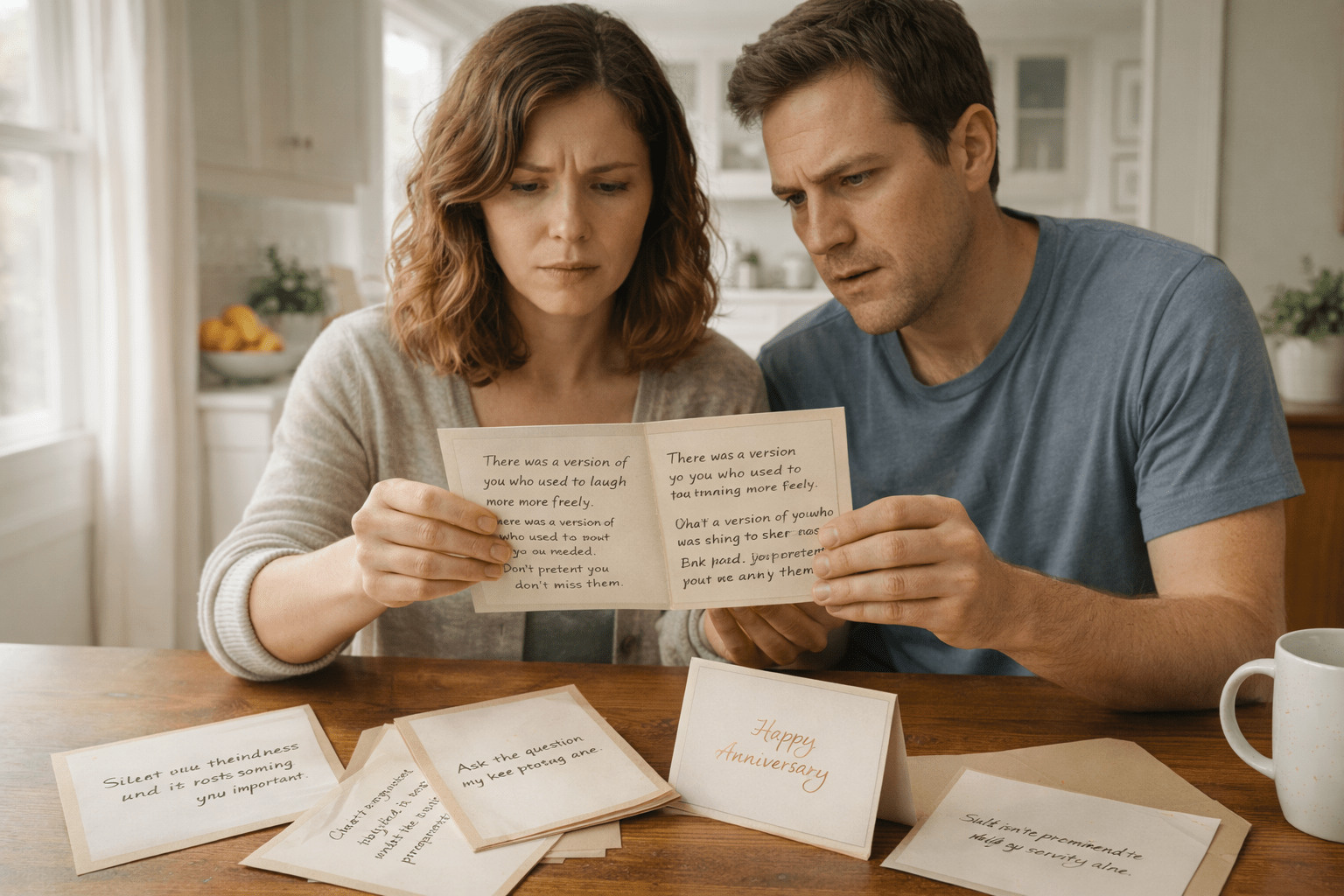
The first card arrived in late March, tucked neatly among grocery flyers and a dentist reminder.
Hannah almost threw it away.
It was thick, ivory-colored, edged in gold foil—too elegant for junk mail, too formal for anyone she knew. She turned it over in her hands while standing at the kitchen counter, sunlight slanting through the window and catching on the embossed script.
Happy Anniversary.
No names on the front. No return address on the back.
“That’s odd,” she murmured.
Mark looked up from his coffee. “What is?”
She opened it.
Inside, the handwriting was careful, old-fashioned, unmistakably personal.
Another year of choosing each other. May you remember why you began.
Hannah frowned. “Is this for us?”
Mark shrugged. “Our anniversary isn’t until June.”
“And no one writes like this anymore,” she said.
They stood there, reading it again, a faint unease settling between them like dust in still air.
They set the card on the counter and forgot about it.
Or thought they did.
The second card arrived a month later.
Same ivory paper. Same gold edging. Same deliberate handwriting.
This one read:
Love isn’t proven by longevity alone. It’s proven by attention.
Hannah felt something twist in her chest.
Mark noticed her staring. “Okay. This is weird.”
She nodded. “Someone has the wrong address.”
“Twice?”
They checked the envelope carefully. Their address was written correctly. Their names weren’t written at all.
Hannah laughed weakly. “Maybe it’s some kind of marketing thing.”
Mark didn’t laugh.
They put the card in a drawer.
By the fourth card, Hannah stopped pretending it was nothing.
The messages grew more specific. More unsettling.
Don’t confuse peace with avoidance.
Ask the question you keep postponing.
Silence can look like kindness until it rots something important.
Hannah read that one three times, her pulse quickening.
“This feels…” she trailed off.
Mark finished the thought quietly. “Personal.”
They sat at the kitchen table that night, the stack of cards between them like a quiet accusation.
“Do you think someone’s messing with us?” Hannah asked.
“Who?” Mark replied. “And why?”
Neither of them had an answer.
What they didn’t say—what hovered unspoken—was that the cards sounded like things they had once known about themselves. Things they had carefully set aside.
The cards didn’t arrive on a schedule.
Sometimes weeks passed.
Sometimes only days.
They began to dread the sound of mail slipping through the slot.
One evening, Hannah came home to find Mark already standing in the hallway, holding the latest card.
He didn’t hand it to her right away.
“What does it say?” she asked.
Mark swallowed. “You should read it.”
She took the card slowly.
There was a version of you who used to laugh more freely.
There was a version of you who used to ask for what you needed.
Don’t pretend you don’t miss them.
Hannah’s hands trembled.
“That’s not okay,” she whispered.
Mark looked at her, eyes dark. “It feels like someone’s watching us.”
She shook her head. “No. It feels like someone remembers us.”
The silence that followed was thick, uncomfortable.
“I miss us,” Hannah said suddenly.
Mark flinched.
The cards on the table seemed to hum faintly, as if acknowledging the truth.
They argued that night for the first time in months.
Not loudly. Not dramatically.
But honestly.
“You shut down when things get hard,” Hannah said. “You disappear behind work.”
“And you stop telling me when you’re unhappy,” Mark replied. “You act like everything’s fine until it isn’t.”
They stopped mid-argument, startled.
This was new.
Or rather, it was old—something they hadn’t allowed themselves in a long time.
The next card arrived the following morning.
Good. Keep going.
Hannah dropped it.
Mark stared at the words, breath shallow. “Okay. That’s impossible.”
She nodded. “Someone’s responding.”
“But how would they know what we talked about?”
Hannah’s voice was barely audible. “Unless the cards aren’t coming from someone else.”
They stared at each other.
“That doesn’t make sense,” Mark said. “We didn’t write them.”
“No,” Hannah agreed. “But… what if we did?”
The idea felt ridiculous—and terrifying.
That night, Hannah dreamed of a small apartment they had lived in years ago. Bare walls. Cheap furniture. Late-night conversations that stretched until dawn. She woke with the taste of nostalgia sharp on her tongue.
Mark woke too.
“I dreamed about us,” he said quietly in the dark.
“So did I.”
The next card arrived with a date written in the corner.
Their wedding date.
And beneath it:
This is what you promised. Not perfection. Presence.
Hannah sat down hard on the floor.
“I don’t think these cards are for us,” she said slowly.
Mark frowned. “What do you mean?”
“I think they’re for the marriage we almost had.”
He sank down beside her.
The realization settled between them like a truth they had been circling for years.
They had drifted—not dramatically, not catastrophically—but gently, politely, away from the people they’d been when they first chose each other. Life had filled the space where intention once lived.
The cards weren’t reminders.
They were invitations.
The final card arrived on their actual anniversary.
Hannah found it waiting on the kitchen table when she woke, placed carefully beside two cups of coffee.
Mark stood nearby, watching her.
She opened it with steady hands.
Inside, the message was shorter than all the others.
This marriage still belongs to you—if you want it.
Hannah looked up at Mark, eyes shining.
“Do you?” she asked.
He didn’t hesitate. “Yes. But not the quiet version. Not the careful one.”
She nodded, tears slipping free. “Me too.”
They sat together for a long time, the morning unfolding softly around them.
Later, when Hannah went to gather the cards from the drawer, she found it empty.
No ivory envelopes.
No gold-edged reminders.
Only the faint impression of something that had done its work and stepped aside.
That night, as they lay in bed talking—really talking—Mark laughed softly.
“Do you think they’ll come back?” he asked.
Hannah smiled. “I don’t think they need to.”
Because some messages don’t exist to haunt you forever.
They arrive only until you remember how to listen—
to yourself,
to each other,
to the marriage you’re still allowed to choose.