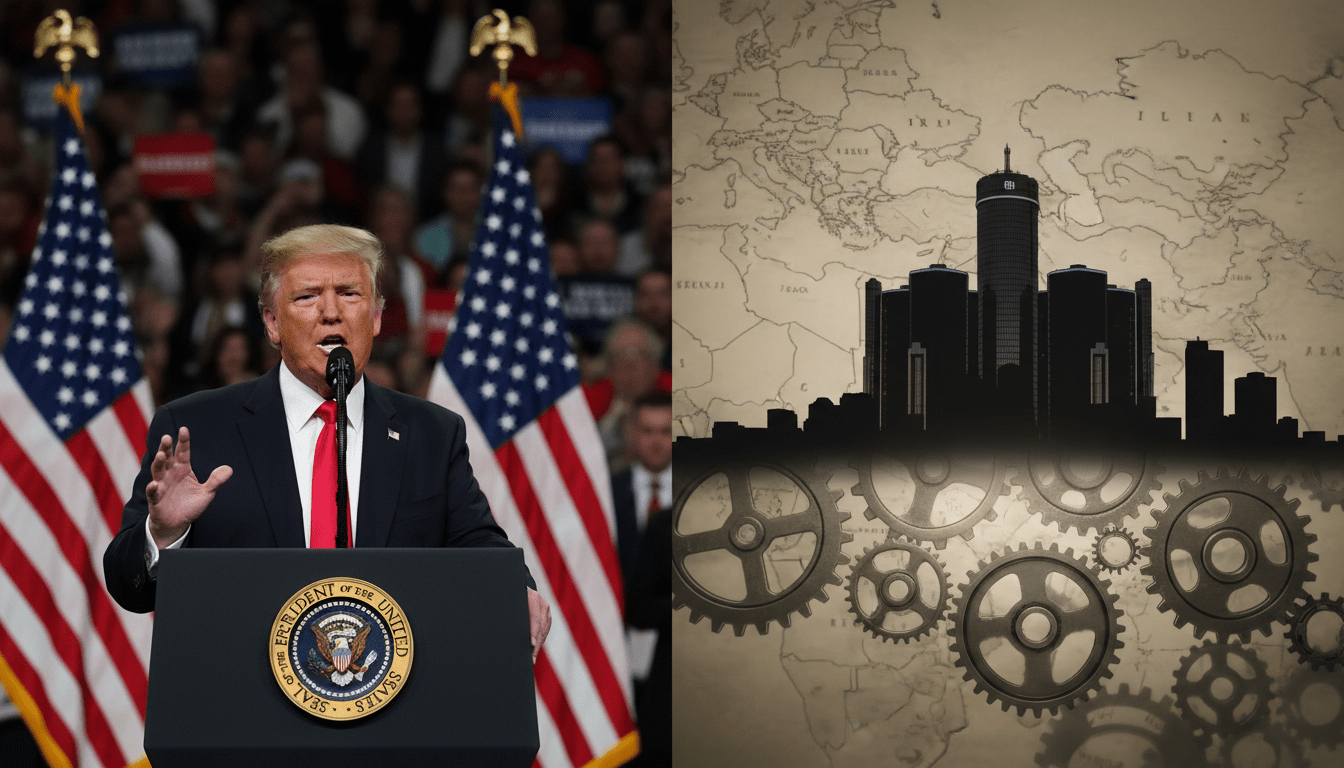
President-elect Donald Trump has stated that the United States possesses a “very good idea” regarding who will succeed Supreme Leader Ayatollah Ali Khamenei in Iran, a comment that has rippled through Washington and resonated deeply within Metro Detroit’s diverse communities. The remarks, made during a recent interview, come amidst swirling unverified rumors regarding the 85-year-old Iranian leader’s health.
While the geopolitical implications of a leadership transition in Tehran are vast on a global scale, the issue holds particular weight in Michigan. As the home to the nation’s largest concentration of Middle Eastern Americans and the hub of the automotive industry—which remains highly sensitive to global oil market fluctuations—Detroit finds itself uniquely positioned at the intersection of this developing foreign policy narrative.
The President-Elect’s Remarks on Succession
During an interview with Time magazine, Donald Trump addressed recent speculation concerning the health of Ayatollah Khamenei. While reports of the Supreme Leader being in a coma have been widely dismissed by experts and Iranian state media, the question of succession remains a critical topic for U.S. intelligence.
“We have a very good idea,” Trump said when asked about potential successors, though he declined to name specific individuals. His comments suggest that the incoming administration is already relying heavily on intelligence assessments regarding the Assembly of Experts, the clerical body in Iran responsible for selecting the next Supreme Leader.
Analysts suggest the likely frontrunners include Khamenei’s second son, Mojtaba Khamenei, who wields significant influence behind the scenes, or Alireza Arafi, a prominent cleric. However, Trump’s assertion of clarity on the matter signals a confidence in U.S. intelligence capabilities as he prepares to return to the White House.
Impact on Metro Detroit Communities
For many residents in Wayne County, particularly in Dearborn and Hamtramck, news regarding Iran is not merely a distant headline; it is a matter of immediate family concern and community discourse. Metro Detroit is home to a robust population of Iranian Americans, as well as Iraqi and Lebanese communities whose homelands are deeply affected by Iranian foreign policy.
Local community leaders have been monitoring the rhetoric closely. The transition of power in Iran could lead to significant shifts in regional stability across the Middle East. “The uncertainty is always the most difficult part for the diaspora here,” said a representative from a local community advocacy group who asked to remain anonymous. “When leadership changes in Tehran, the ripple effects are felt in Baghdad, Beirut, and eventually, right here in Michigan dining rooms.”
Michigan voters, who proved decisive in the recent election, have consistently expressed that foreign policy is a top priority. The prospect of a destabilized Iran or a hardline succession could reignite tensions that many hoped would de-escalate, affecting everything from travel visas to the safety of relatives abroad.
The Economic Angle: Oil, Autos, and Inflation
Beyond the cultural impact, Detroit’s economic engine—the automotive industry—is inextricably linked to the stability of the Persian Gulf. Iran remains a major player in the global energy market, and any chaotic transition of power could threaten the Strait of Hormuz, a critical chokepoint for global oil shipments.
For Detroit automakers like General Motors and Ford, stability in oil prices is essential for maintaining consumer demand for high-margin trucks and SUVs. A spike in oil prices caused by geopolitical uncertainty often leads to a rise in gas prices, which historically correlates with a slowdown in vehicle sales.
“Stability in the Middle East is actually a local economic issue for Detroit,” notes analysts from the U.S. Energy Information Administration. “Any suggestion of a power vacuum in Iran creates volatility in crude oil futures, which eventually trickles down to the pump prices on Woodward Avenue.”
Trump’s comments may be intended to project strength and stability to markets, reassuring investors that the U.S. is not flying blind regarding Iran’s future. However, local economists warn that the transition period—whenever it occurs—will likely bring a period of unpredictability for Detroit’s economy.
Strategic Outlook and ‘Maximum Pressure’
The President-elect’s confidence aligns with his previous tenure’s “maximum pressure” campaign against Iran. As Trump prepares to take office again, questions remain about whether he will double down on sanctions or seek a new diplomatic avenue with the next generation of Iranian leadership.
In his interview, Trump reiterated his stance that Iran must not obtain a nuclear weapon, a policy goal that enjoys bipartisan support but differs wildly in execution strategies. Knowing the identity of the next leader allows the incoming administration to tailor its strategies—whether diplomatic or coercive—before the transition officially takes place.
For now, Detroit residents and business owners alike are left to parse the tea leaves. Whether it is a family in Dearborn concerned for relatives or a logistics manager in Warren worried about fuel surcharges, the question of Iran’s next leadership is far more than just a talking point—it is a factor in the region’s future stability.
What Happens Next?
As the inauguration approaches, expect the Trump transition team to release more signals regarding their Middle East strategy. Locally, Detroit organizations will continue to facilitate dialogue among the diaspora communities to navigate the anxieties surrounding these geopolitical shifts.
For continuous updates on how international policy affects local governance and economics, stay tuned to our Local Politics section.