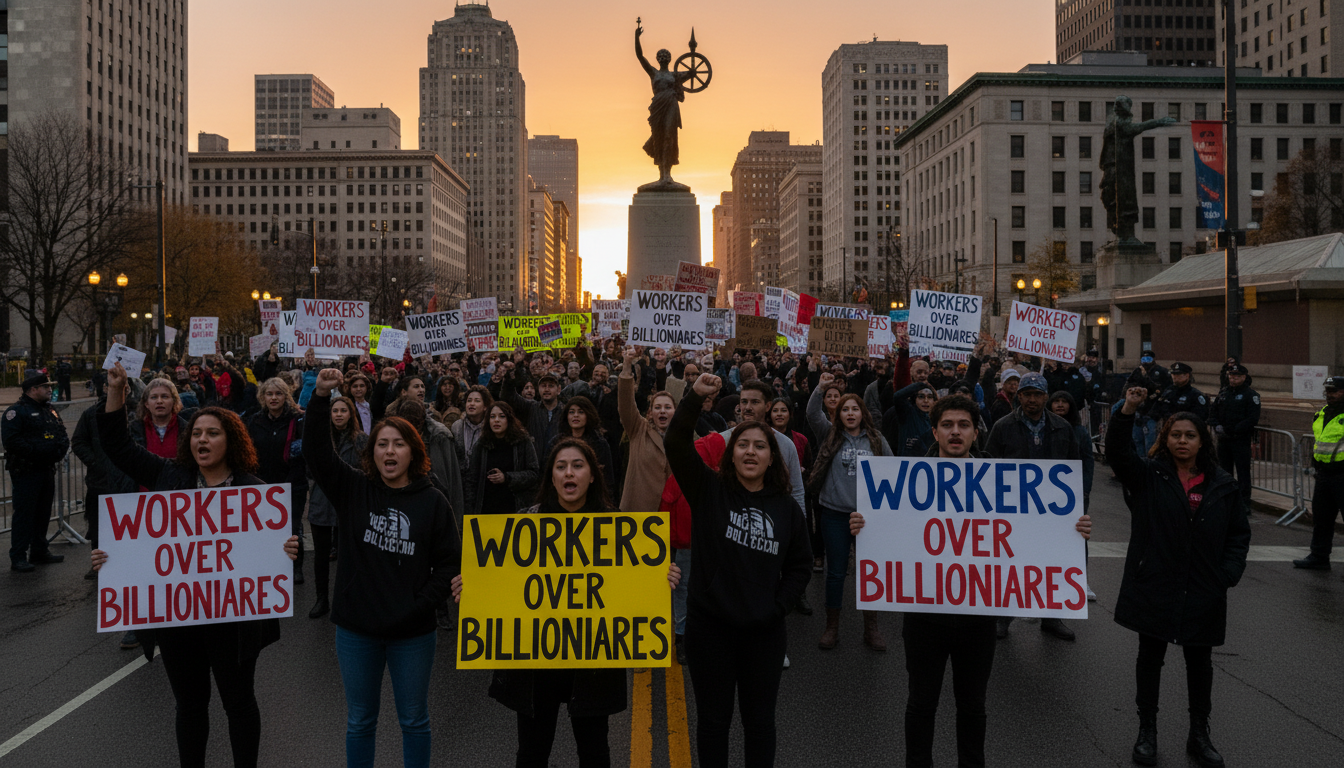
Hundreds of labor activists, union members, and community organizers gathered in downtown Detroit on Wednesday to observe International Workers’ Day, using the historic May Day protests to demand systemic changes to the American labor landscape. The demonstration, which began at the Spirit of Detroit statue before marching toward Cadillac Square, centered on the theme of “Workers Over Billionaires,” a message that resonates deeply in a city defined by its industrial heritage and recent labor resurgences.
The Resurgence of the Detroit Labor Movement
The 2024 May Day rallies in Detroit come at a pivotal moment for the Detroit labor movement. Following the high-profile “Stand Up Strike” by the United Auto Workers (UAW) last year, local organizers say the momentum for workers rights in the USA has reached a level not seen in decades. Protesters on Wednesday highlighted the stark contrast between record-breaking corporate profits and the stagnant wages of the working class.
According to the Michigan State AFL-CIO, the state has seen a significant uptick in union organizing efforts across diverse sectors, including service industries, healthcare, and higher education. This local shift reflects a broader national trend where economic inequality has become a central focus of public discourse. Labor leaders at the rally emphasized that while Detroit has seen a construction boom in its downtown core, many residents in the city’s neighborhoods feel left behind by the wealth generated by large-scale developments.
Economic Inequality and the Struggle for Fair Wages
Data from the Economic Policy Institute (EPI) indicates that the gap between CEO compensation and typical worker pay has increased by over 1,200% since 1978. In Detroit, where the cost of living—particularly housing and transportation—has risen sharply, this disparity is felt acutely. Speakers at the rally pointed to the use of public tax incentives for billionaire-backed developments as a primary point of contention.
“We are seeing a tale of two cities,” noted one community organizer from the Detroit People’s Platform during the rally. “While billions of dollars are funneled into the skyscrapers downtown, the people who keep this city running—the janitors, the bus drivers, and the service workers—are struggling to find affordable housing within the city limits.”
The May Day protests also addressed the necessity of strengthening federal protections for workers. Advocates are calling for the passage of the PRO Act (Protecting the Right to Organize), which would remove barriers to unionization and penalize employers who engage in union-busting tactics. For Detroit residents, the passage of such legislation is seen as a critical step in addressing the systemic roots of economic inequality.
Impact on Detroit Residents
The outcomes of these protests and the broader labor movement have direct implications for the everyday lives of Detroiters. Higher union density has historically led to higher wages, not just for union members, but for non-union workers in the same sectors through the “union wage effect.” As the labor movement gains ground, many residents are hopeful that it will lead to more stable, family-sustaining jobs that can combat the city’s poverty rate.
Furthermore, the focus on “Workers Over Billionaires” has sparked a renewed conversation about Community Benefits Agreements (CBAs). These agreements ensure that large developers provide tangible benefits to the local population, such as job training programs, local hiring quotas, and investments in Detroit housing. For residents in neighborhoods like Southwest Detroit and the North End, these protections are vital to preventing displacement as property values rise.
Background & Data: The National Context
While the Detroit rallies were intensely local in their focus, they were part of a global day of action. According to the U.S. Bureau of Labor Statistics, union membership in the private sector remains near historic lows, despite a surge in public approval for unions. However, Michigan’s recent repeal of the “Right to Work” law has reinvigorated local organizers, who believe the state is once again becoming a vanguard for workers rights in the USA.
The Economic Policy Institute further notes that in states with stronger labor protections, workers generally experience safer working conditions and better access to healthcare. In Detroit, where healthcare disparities remain a significant concern, the link between labor rights and public health is a recurring theme in social justice advocacy.
What Happens Next
Looking forward, the organizations involved in the May Day protests plan to maintain pressure on both local government and corporate entities. With several major municipal and private contracts set to expire in the coming year, the spirit of the labor movement will likely manifest in upcoming negotiations. The City of Detroit has signaled a willingness to engage in dialogue regarding workforce development, but activists argue that substantive policy changes are required to truly shift the balance of power.
As the sun set over Cadillac Square, the message of the day remained clear: the workers of Detroit are no longer content with the status quo. The May Day protests served as a powerful reminder that the fight against economic inequality is ongoing, and that the labor movement remains a cornerstone of the city’s identity and its future. For those interested in the evolving landscape of the city, staying informed on Detroit news will be essential as these labor stories continue to unfold.