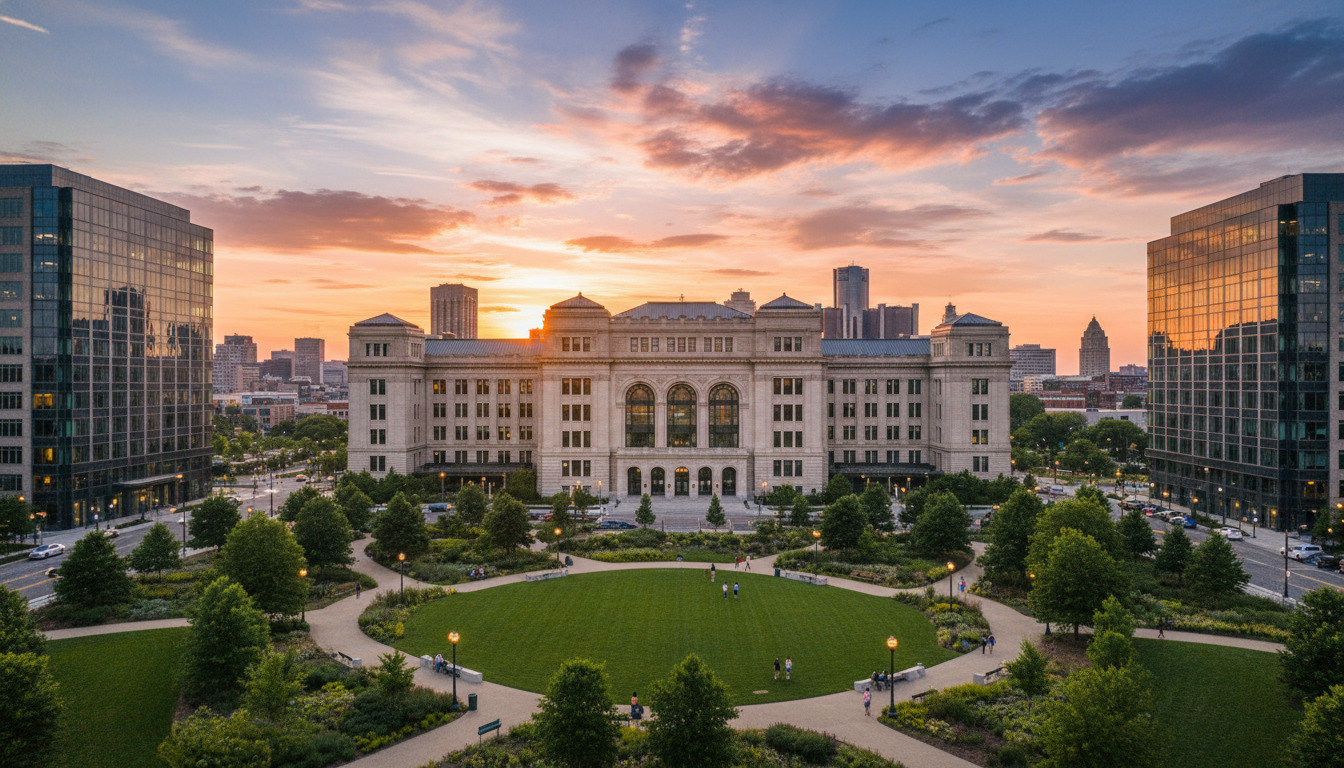
The reopening of the Michigan Central Station in Detroit’s Corktown neighborhood represents more than just the restoration of a historic landmark; it serves as the cornerstone of a massive $950 million innovation district. After decades of standing as a symbol of the city’s economic decline, the 18-story Beaux-Arts building has been reimagined as a hub for mobility and technology. According to Ford Motor Company, the anchor tenant and primary developer, the project aims to create a 30-acre campus that will eventually house 5,000 employees, including 2,500 Ford workers. This influx of professional activity is already beginning to ripple through the surrounding residential and commercial corridors, altering the economic landscape of Detroit’s oldest neighborhood. The Michigan Central redevelopment is not merely a construction project; it is a strategic shift intended to position Detroit as a global leader in the future of transportation and clean energy.
The Economic Engine of the Michigan Central Redevelopment
The financial scale of the Michigan Central redevelopment is staggering. Ford’s investment has been bolstered by significant public-private partnerships, including support from the Michigan Strategic Fund and the City of Detroit. The focus of the campus is the ‘Newlab’ at Michigan Central, situated in the former Book Depository building. Currently, Newlab houses more than 90 startups and over 600 entrepreneurs focusing on robotics, sustainable energy, and autonomous systems. Reporting from the City of Detroit suggests that this concentration of talent is designed to create a ‘sticky’ economy, where talent stays in the city rather than migrating to Silicon Valley or Austin. Local economic analysts note that the presence of high-wage tech jobs is already increasing local tax revenue, which the city has pledged to reinvest in neighborhood services. This redevelopment project has acted as a catalyst for other developers who are now looking at vacant lots and underutilized buildings within a two-mile radius of the station.
Impact on Detroit Residents and Corktown Small Businesses
For the residents of Corktown and the nearby Hubbard Richard neighborhood, the Michigan Central redevelopment brings both opportunity and anxiety. On one hand, the influx of workers and visitors has provided a massive boost to local small business grants and revenue for existing establishments along Michigan Avenue. Long-standing restaurants like Slows Bar-B-Q and newer cafes have reported increased foot traffic since the station’s public opening in mid-2024. However, the rise in property values has been swift. Data from the U.S. Census Bureau and local real estate tracking firms indicate that property assessments in Corktown have risen significantly over the last five years, outpacing many other Detroit neighborhoods. To mitigate the risk of displacement, the City of Detroit implemented the ‘Greater Corktown Neighborhood Framework Plan.’ This plan, according to the City of Detroit Planning and Development Department, includes provisions for affordable housing and community benefits to ensure that long-term residents are not priced out of the revitalization. Furthermore, the redevelopment has brought improvements to local parks and public spaces, such as the Roosevelt Park renovation, which transformed a fractured series of roads into a cohesive green space for the community.
Infrastructure, Mobility, and Connectivity
One of the primary goals of the Michigan Central redevelopment is to improve Detroit’s transportation infrastructure. The campus serves as a testing ground for ‘smart’ infrastructure, including inductive vehicle charging roads and autonomous shuttle routes. This focus on mobility is expected to influence broader city planning. As Detroit continues to analyze Detroit real estate trends and urban density, the Michigan Central campus provides a blueprint for walkable, transit-oriented development. Plans are also underway to better connect Corktown with the Detroit Riverfront and the Ralph C. Wilson Jr. Centennial Park. Residents have expressed a desire for better public transit options that link the tech hub to other parts of the city, such as the North End and the East Side. Ford and city officials have held several community meetings to discuss how the mobility solutions developed at the station can be scaled to benefit residents who rely on the DDOT bus system, ensuring that the ‘future of mobility’ is inclusive of all Detroiters, regardless of their socioeconomic status.
Background and Historical Context
The Michigan Central Station originally opened in 1913, designed by the same architects responsible for Grand Central Terminal in New York. At its peak, it was the tallest train station in the world, handling hundreds of trains daily. However, the decline of rail travel and the decentralization of Detroit led to its closure in 1988. For 30 years, it stood empty, its broken windows becoming a global icon of ‘ruin porn.’ The turnaround began in 2018 when Ford purchased the property from the Moroun family. The subsequent restoration involved over 3,000 specialized workers and the sourcing of limestone from the same quarry in Indiana used for the original construction. This meticulous attention to detail has preserved the historical integrity of the building while integrating modern fiber-optic networks and sustainable HVAC systems. The project is now cited by historic preservationists as one of the most significant adaptive reuse projects in the United States, proving that Detroit’s architectural heritage can be a foundation for its future economy rather than a reminder of its past losses.
What Happens Next for Corktown and Beyond
Looking forward, the Michigan Central redevelopment enters its next phase, which includes the completion of the Bagley Parking Hub and the ‘Yellowstone’ residential projects. These developments will add hundreds of housing units to the area, a mix of market-rate and restricted-income apartments. Experts from the University of Michigan’s economic forecasting team suggest that the true impact of the innovation district will be measured over the next decade as startups graduate from Newlab and establish permanent offices within the city limits. There is also ongoing discussion regarding the potential return of passenger rail service to the station, which would connect Detroit more efficiently to Chicago and Toronto, further boosting the regional economy. While challenges regarding housing affordability and neighborhood equity remain, the Michigan Central redevelopment stands as a pivotal moment in Detroit’s 21st-century narrative, transitioning the city from a focus on traditional manufacturing to a diversified economy built on innovation and community-centered urban planning.