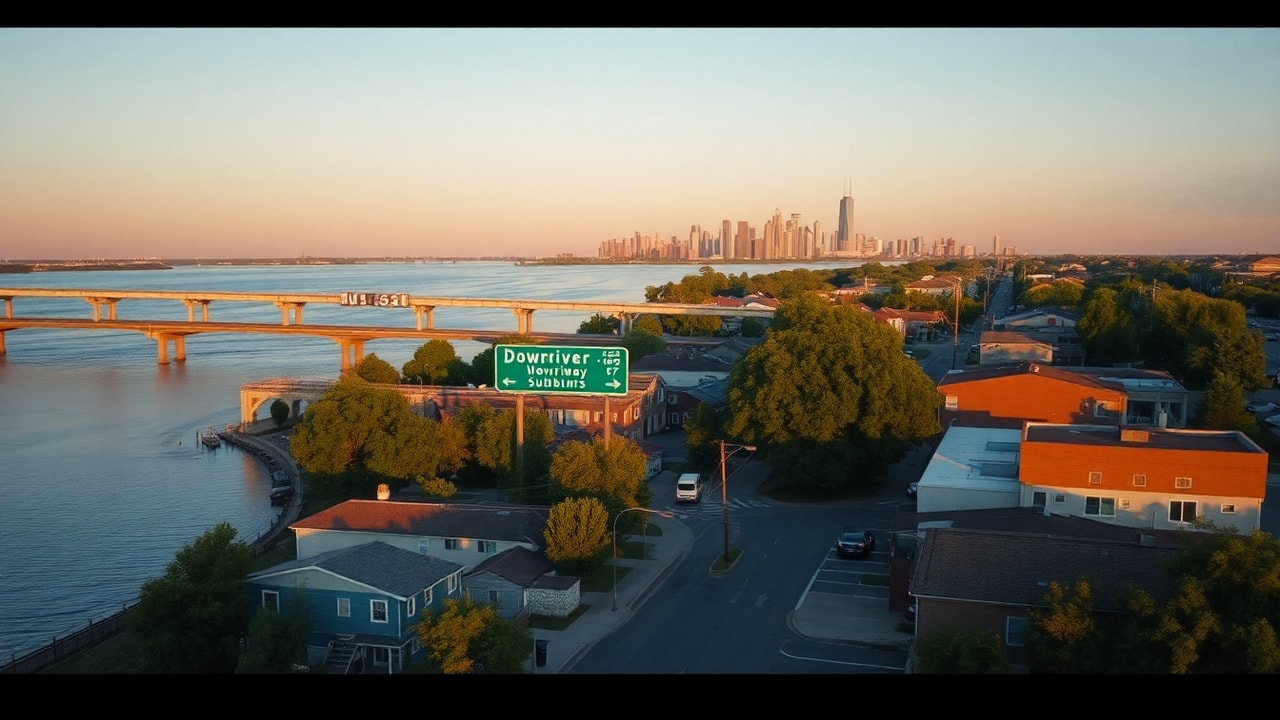
For many Detroit residents, the term “Downriver” is less a street address than a shared shorthand—an arc of communities stretching along the Detroit River and down toward Monroe County. Now, a new local project known as the CuriosiD list is putting those neighborhoods in sharper focus, offering readers a guided way to understand what makes Detroit’s “Downriver” region distinct—culturally, economically and, increasingly, in how residents advocate for services and development.
The list is drawing attention because it connects everyday local knowledge with the bigger questions facing the metro Detroit area: housing stability, transportation access, public safety priorities and the long-term competitiveness of smaller industrial and retail corridors.
What the CuriosiD list is—and why Downriver shows up
While “Downriver” can be a casual label, it covers communities that often experience the same regional forces—shipping and manufacturing legacies, job-market shifts, commute patterns and the environmental realities of living near the Detroit River. The Detroit Downriver communities referenced in the CuriosiD list are those where local identity is intertwined with day-to-day life: where people work, attend schools, shop and gather.
CuriosiD frames the list as a way to help residents learn about Detroit regional neighborhoods beyond the city proper and to understand how the suburbs along major corridors connect back to Detroit. The project also emphasizes that “Downriver Detroit” isn’t one single municipality—it’s a network of places with different histories, governance structures and development challenges.
A map of places, not a single municipality
Downriver’s boundaries are discussed more than they’re formally defined. In practice, residents often use “Downriver” to describe communities in Wayne County—such as Allen Park, Ecorse, Flat Rock, Riverview and Trenton—plus additional areas that many Metro Detroiters associate with the broader corridor extending toward Monroe County suburbs. The CuriosiD list reflects that lived geography by highlighting local institutions and community markers rather than attempting to force all communities into one definition.
That approach matters because infrastructure and economic development are often planned by multi-jurisdiction partnerships, not by one city government alone. When residents talk about “Downriver Detroit,” they are typically describing the same commuting realities: getting to employment centers, accessing regional healthcare, and moving through roadways that tie suburban streets back to Detroit and its industrial and commercial zones.
Local impact: how CuriosiD-style storytelling connects to real priorities
At its best, a neighborhood spotlight can do more than inform—it can influence what residents pay attention to and what elected officials feel pressure to address. In the Downriver corridor, those pressures frequently include transit access, housing supply and affordability, water and stormwater management, and the health of commercial strips.
According to data from the U.S. Census Bureau, suburban and downriver areas have faced uneven housing and population trends since the Great Recession, with some communities seeing slower growth while others have worked to stabilize neighborhoods through redevelopment and code-enforcement strategies. Those trends can translate into different experiences across the corridor—higher turnover in some blocks, reinvestment in others, and long stretches where homeowners and renters wait for improvements that require coordination.
Meanwhile, Wayne County and its partners continue to plan for transportation and regional services that cut across municipal lines. That regional planning is crucial for residents who depend on major roadways and public services to reach jobs and schools in multiple jurisdictions. A storytelling project like CuriosiD can help residents understand how decisions made elsewhere—through county or state channels—reach their daily routine.
Public safety and neighborhood stability: a shared concern
Downriver communities are also experiencing the same national-local tension between public safety expectations and resource constraints. While each city or township operates under its own public safety structure, the patterns of crime, traffic enforcement and neighborhood stabilization often spill over city boundaries in ways residents recognize immediately.
The Wayne County approach to community safety and stabilization is shaped by ongoing work with municipal partners and community organizations, particularly when it comes to youth programs, substance-use prevention and efforts to reduce repeat incidents. CuriosiD’s focus on places and community anchors is relevant here because local institutions—libraries, schools, faith groups and small businesses—are often where residents look for early intervention.
According to the U.S. Department of Justice, community-based violence prevention strategies can improve outcomes when programs are designed around local needs and sustained through partnerships. While the CuriosiD list is not itself a public-safety program, by spotlighting where community life concentrates, it can nudge attention toward those prevention networks.
Housing and real estate: Downriver’s mix of challenges and opportunities
Real estate in Downriver is rarely uniform. Some blocks reflect long-term ownership stability; others carry the legacy of deferred maintenance, property vacancy, or the slow pace of redevelopment in certain commercial nodes. In other areas, new projects and infill development have helped reintroduce housing options closer to regional amenities.
For residents, these differences matter. Housing affordability, insurance costs and property taxes can determine whether a family stays in the same neighborhood or looks for alternatives across the corridor. That is one reason the CuriosiD list’s emphasis on Detroit regional neighborhoods is resonating: it encourages readers to compare how different communities manage growth and reinvestment.
It also matters that Downriver stretches across multiple counties—creating a complex policy environment. For instance, Wayne County downriver communities often align with Wayne County planning initiatives, while areas associated with Monroe County Detroit suburbs may navigate a different set of local resources and development pressures. Residents and businesses do not experience these distinctions the way planners do; they experience them through commuting times, school assignments, utility rates and access to services.
Education, youth and the “places that form people” angle
Education is another thread running through the CuriosiD list concept: not only where students attend school, but the broader environment that supports learning—after-school programs, athletic opportunities, public spaces and libraries. Across the Downriver corridor, families often look for stability in school performance and transportation options, and they closely follow community investment in youth resources.
According to the National Center for Education Statistics, school districts frequently face challenges related to enrollment swings and resource allocation, particularly in areas experiencing demographic change. While CuriosiD doesn’t attempt to quantify school performance, its focus on the community context around schools reflects what residents already know: education outcomes are shaped by multiple local systems working together.
Transportation and the daily commute: where Downriver meets Detroit
One of the most practical ways to understand Downriver Detroit is by how people move. The corridor’s residents often rely on major arteries to connect to employment centers inside Detroit and in other suburbs. As regional traffic patterns shift, road maintenance and transit planning become immediate issues—whether the concern is road conditions, bus routes, or access to services.
The CuriosiD list’s community-by-community storytelling offers a framework for thinking about mobility beyond a single roadway. For example, when readers learn about local anchors—parks, shopping districts, cultural institutions—they also gain a clearer picture of why some residents experience access differently than others, depending on where they live along the corridor.
Background & data: what “Downriver” means in practice
Unlike a formally designated district, Downriver is a regional identity. In common usage, it refers to communities along the lower Detroit River and the geographic belt leading toward the Monroe County line. Wayne County cities and villages in the corridor often include residents who commute both inward toward Detroit and outward to other metro employment centers. Monroe County suburbs associated with the broader Downriver identity can experience different county-level planning priorities, even when economic and commute ties remain strong.
That complexity is why the CuriosiD list approach—grounded in community context—is getting attention. It aligns with how the region actually functions: residents build relationships and routines across municipal boundaries, especially when it comes to jobs, schools and retail.
What happens next
As the CuriosiD list continues to evolve, its influence will likely depend on how residents, local organizations and officials engage with it. If readers use it as a prompt to learn about neighborhood assets and civic needs, it could strengthen community advocacy around housing stability, public safety partnerships, and corridor improvements.
For Detroit-area residents, the practical takeaway is straightforward: understanding Detroit Downriver communities as interconnected rather than isolated can help residents communicate their needs more clearly—whether they are calling for safer streets, stronger neighborhood services, or more reliable infrastructure. In a region where county lines and municipal boundaries shape policy, shared neighborhood awareness can still become a common language.
Over the coming months, expect more public conversation around which community markers matter most—from local businesses and cultural venues to schools and public spaces. If the CuriosiD list succeeds, it will do so by turning regional curiosity into informed community participation—without losing sight of the real-life issues that define Downriver Detroit every day.