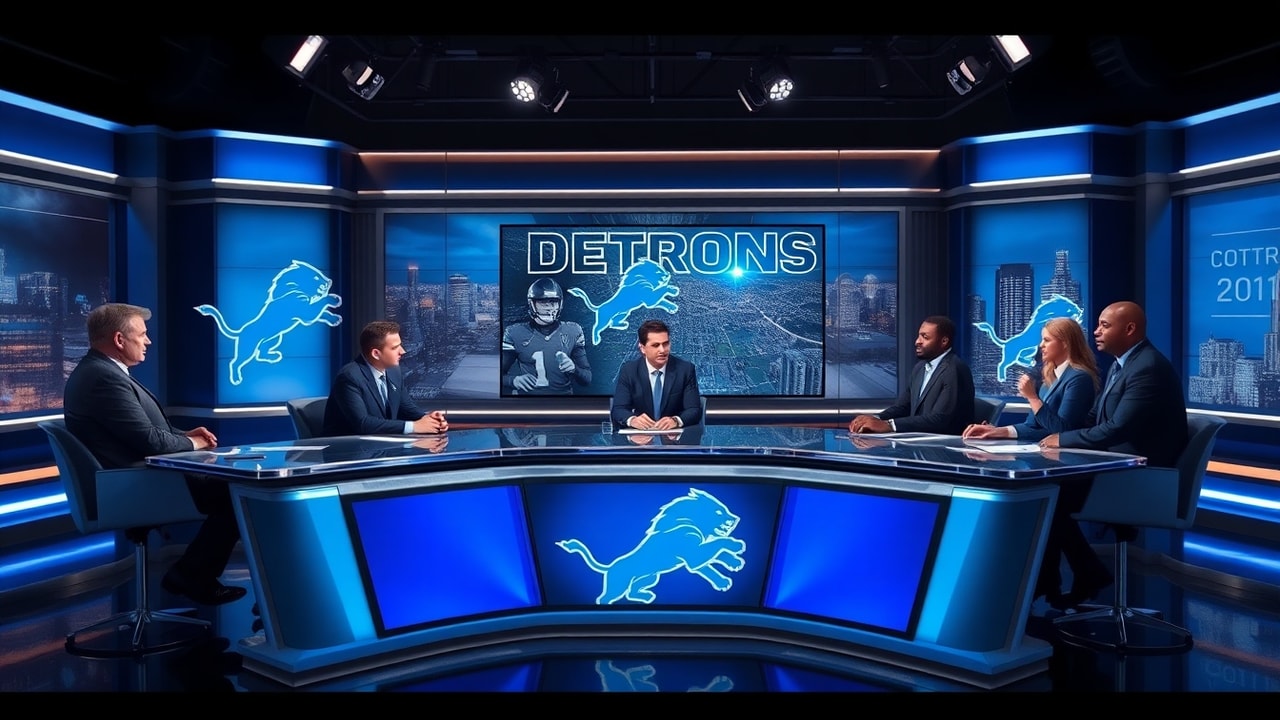
In Detroit, football debates rarely stay inside the lines. This week, a Detroit Roundtable discussion on the Detroit Lions’ direction zeroed in on the central question many fans now ask after another uneven season: how much blame should Brad Holmes take for Detroit’s roster-building outcomes—and how should people judge NFL draft evaluation when success and misses often show up years apart?
The debate was framed around the Lions’ current roster decisions, including the selection and early impact of Terrion Arnold, and broader decisions by the front office that can be difficult for fans to evaluate in real time. While no one in the roundtable dismissed the need for improvement on the field, the conversation focused on what accountability should look like for a general manager tasked with sustaining a competitive team.
What the Roundtable discussion says about accountability
Holmes has been a lightning rod in recent Detroit football debates because Detroit team building requires both instant results and long-term planning. On one side of the roundtable were fans who view the roster as falling short of expectations too often—especially on defense and in roster stability. On the other side were those who argued that a general manager’s “grade” should reflect the full process: evaluation, fit, coaching implementation, contract management, and the reality of player development.
According to a 2024 report from the NFL’s Players Association on roster turnover and player availability, team-building timelines are frequently disrupted by factors outside a general manager’s control, including injuries and scheme changes across the league. That kind of context, the roundtable suggested, can make it unfair to treat every early-career outcome as proof of an evaluation failure.
Still, the roundtable also acknowledged that Holmes’ job is inherently tied to draft decisions and roster construction. The argument wasn’t whether the general manager should be accountable, but how accountability should be calibrated.
Terrion Arnold and the question of early returns
A major point of discussion centered on Terrion Arnold, one of the Lions’ more notable recent selections. For fans, a player’s first-season role—whether that role is defined by nickel snaps, coverage responsibilities, or special teams—can feel like a direct reflection of the draft evaluation process.
But the roundtable wrestled with the timing problem: young players often take time to translate college strengths into pro technique, play recognition, and assignments against advanced NFL offenses. NFL teams also manage development differently depending on coaching philosophy and defensive scheme complexity. When the team is contending, that development window can appear shorter than it actually is.
To bring structure to the debate, analysts in the roundtable referenced how teams are expected to improve by leveraging high draft picks while avoiding overpaying for replacement-level talent. That approach, they noted, makes draft evaluation even more consequential—because it determines who is on rookie or controlled deals when the team tries to build the next layer of depth.
“If you miss in the draft and then replace it with expensive stopgaps, you can feel it quickly,” said one local football analyst during the discussion, pointing to how the salary cap can narrow choices after a misstep. The point echoed a broader theme: even when blame is shared among coaching and scouting staffs, the general manager controls whether the team has the resources to correct course.
Detroit team building: what’s within Holmes’ control
In the roundtable, participants separated the types of problems that show up on Sunday. Some issues are primarily organizational—depth chart decisions, positional investment, and how quickly the team fills gaps. Others are partly coaching—scheme fit, play-calling tendencies, and development plans for specific skill sets. And some are randomness masquerading as pattern—injuries, timing, and opponent matchups.
Holmes is responsible for assembling the roster and building a system capable of competing. That means draft evaluation isn’t just about picking talent; it’s about constructing an NFL-ready roster where the whole team can function under pressure. When Detroit team building produces repeated roster holes, fans naturally look to the architect.
At the same time, supporters of Holmes argued in the roundtable that successful general manager evaluation includes selecting players who fit the franchise’s long-term identity—then giving them a chance to develop within an NFL framework. That argument aligns with how sports management researchers often describe the relationship between scouting, organizational structure, and performance.
According to data compiled by the University of Michigan’s Center for Sports Management on roster construction and player development pathways (as discussed in recent academic and industry briefings), teams can see evaluation “hits” and “misses” at different rates depending on coaching stability and the complexity of a player’s role. The researchers emphasize that development is not linear, which complicates immediate grading of any single draft class.
Impact on Detroit residents: from fandom to civic identity
For Detroit residents, the Lions are more than a sports product. The team functions as part of the city’s cultural rhythm—fueling conversations at workplaces, at bars, and in households across neighborhoods. When fans debate Brad Holmes and Detroit team building, they’re also debating values Detroit communities often hold: fairness, accountability, and belief in the long-term.
That debate can shape local sports consumption in practical ways. When expectations rise, attendance interest and merchandise purchases tend to follow. When fans feel repeatedly disappointed, it can change how they support the team and how they interpret the city’s broader momentum.
Detroit is also home to businesses that rely on game-day traffic—from bars near downtown to restaurants and merchants in midtown and around suburban watch parties. When the team performs well, those businesses see a lift; when it struggles, game-week crowds can soften, especially if season outcomes look out of reach early.
While the Lions don’t control the entire local economy, front-office decisions influence the team’s competitive posture, which in turn affects the broader “sports-day” impact. The roundtable emphasized that this is why the blame question is never purely abstract—it reaches beyond the stadium.
Background & data: how to grade draft evaluation in Detroit
Draft evaluation is difficult to judge immediately because rookies and second-year players often have different roles, and because team needs shift quickly as injuries and performance realities emerge. In the roundtable, participants described two approaches to grading Holmes’ tenure:
- Outcome-based grading: Evaluate draft classes by their current production and fit. If the team isn’t winning consistently, misses tend to dominate the narrative.
- Process-based grading: Evaluate whether the team is repeatedly selecting players with measurable traits that align with the franchise’s scheme, then consistently developing them and building depth.
Most Detroit football debates, including this one, mix both approaches. The tension emerges when fans believe the process is strong but results are lagging, or when they believe the results show repeated pattern errors that undermine confidence in the decision-making.
Another factor raised during the discussion was how roster construction interacts with coaching. A player drafted for one role can underperform if the defensive system or play-calling limits his strengths. That doesn’t eliminate general manager responsibility, but it does widen the accountability net beyond the front office.
“A general manager can draft the right guy and still not get the right outcome if the scheme or development plan doesn’t land,” one roundtable participant noted. Others countered that the front office hires coaches and sets the organizational direction, meaning the buck stops somewhere—even if it isn’t on Holmes alone.
What happens next for the Lions—and the blame question
The practical answer to how much blame Holmes should take depends on what Detroit does next. The roundtable suggested a few markers that could clarify the narrative as the offseason approaches and the next draft cycle unfolds:
- How Detroit responds to roster needs: Whether the Lions address foundational gaps with targeted selections and strategic free-agent fits.
- Whether player development translates to consistent roles: The progression of players like Terrion Arnold and other young additions will shape public perception of draft evaluation.
- Roster stability and depth: If the team repeatedly struggles with injuries or late-season weaknesses, fans may revisit the roster-building decisions that created fragile depth charts.
For Detroit residents watching the Lions, the debate won’t end soon. But the roundtable discussion captured a key point: accountability in sports is personal and emotional, yet it should still be grounded in how roster decisions work over time. That’s especially true for general managers like Brad Holmes, whose evaluations can take seasons to prove themselves.
In Detroit, the question isn’t whether Holmes should be accountable. It’s how to judge the blend of decision-making, development, and football reality—when the next Sunday outcome can feel immediate, but the best NFL draft evaluation often reveals itself only after multiple cycles of coaching, reps, and adjustments.