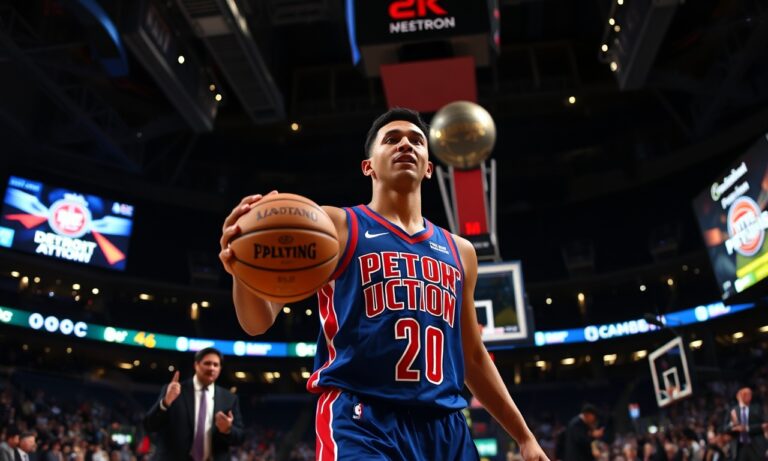
A former Detroit Pistons player is heading into NBA free agency with a potentially significant health concern after reports surfaced that he is dealing with a knee injury that could affect his timetable for workouts and team visits ahead of the summer market. The update arrives as franchises across the league evaluate medicals and contract fits during the early stages of NBA free agency, when availability can be as important as upside.
According to The Athletic, the player’s status is being monitored closely, and teams are expected to weigh the risk of a short-term limitation against the long-term projection. Multiple teams typically prioritize medical clearance and conditioning readiness well before formal negotiations, league sources and basketball analysts have noted, especially for players entering their first meaningful market opportunities.
In Detroit, the development has drawn attention because the player is closely connected to the franchise’s recent roster-building efforts and draft-era expectations. The situation also underscores how quickly a season’s narrative—particularly for a player viewed as a potential first-round pick contributor—can shift when injuries intervene at the wrong time.
Main Section
The timing is especially notable: the NBA free agency period often becomes a sequence of workouts, medical evaluations, and rapid contract decisions. For a former Pistons player, even a modest delay can complicate negotiations because teams may prefer to wait for confirmation of strength, mobility, and return-to-play readiness.
In reported coverage, the injury update centers on a knee issue that has reportedly influenced recent on-court activity and recovery plans. While the player is not described as having a season-ending prognosis in the initial reports, the language has suggested uncertainty about readiness for the earliest dates of team activities, which generally begin well before the signing window fully plays out.
As of this writing, the player and his representatives have not publicly provided a detailed timeline in Detroit-area reporting. However, team decision-making in the NBA often follows a common pattern: clubs request comprehensive medical records, conduct their own assessments, and then connect medical information to role projections—whether a player is being considered for a bench spot, a developmental role, or a higher-usage position.
Impact on Detroit Residents
While the injury news is occurring league-wide, Detroit fans may feel it more sharply than residents in other markets because the Pistons have spent recent years emphasizing development and long-horizon roster building. A player tied to Detroit’s rebuilding efforts represents not just one roster spot, but part of the story the franchise has tried to tell through draft investment, coaching continuity, and player growth.
Detroit has also leaned into the basketball conversation as a civic touchstone: from local watch parties to statewide sports programming, Pistons offseason news tends to function as a proxy for what residents expect from the city’s professional teams. In that sense, an injury update can shift the tone of summer headlines—sometimes prompting skepticism, sometimes inspiring caution, and often increasing attention on training-camp readiness.
For local fans tracking the Detroit basketball news cycle, the key question is how the situation might affect the organization’s broader plans. If the player remains uncertain health-wise, he could sign with a team willing to accept a delayed ramp-up. That, in turn, can influence the Pistons’ competitive landscape—especially if the player becomes a more important rotational piece elsewhere after leaving Detroit.
Beyond fandom, there’s a practical angle. The city’s sports economy—media attention, game-day culture, and local event spending—responds quickly to offseason storylines. Even when the injury involves an individual athlete rather than local business operations, the news can alter the intensity of community engagement around Pistons-related coverage.
Background & Data
In the NBA, free agency is not only about talent; it’s about risk management. Medical evaluations frequently determine whether clubs can justify guaranteeing money and whether they can plan minutes allocations. According to NBA injury-report guidance and team medical protocols commonly referenced by basketball media, teams typically gather injury histories, imaging results, rehabilitation notes, and return-to-play benchmarks before making decisions that affect both the roster and salary structure.
That emphasis on medical readiness connects to how teams view draft investment and early career value. For players drafted with the expectation of becoming long-term contributors, an injury can change how quickly they reach the performance level required to secure meaningful contracts. The market often rewards readiness and role clarity, while punishing uncertainty.
Detroit’s position as a developing roster in recent seasons has made the stakes of player health particularly visible. A player who arrived with high expectations—often including the label of a first-round pick—can quickly see opportunities diminish if his health prevents full participation during crucial periods: workouts, summer leagues, and initial training camp practices.
While this case is being shaped by league-wide mechanics, Detroit residents also understand that the franchise’s short- and medium-term goals depend on how talent assets progress. That is why the intersection of injury updates and the NBA free agency calendar tends to drive immediate attention in local coverage.
What Happens Next
For the player, the immediate next steps are likely to center on clearance milestones: recovery progress, strength testing, and evidence of stable movement under basketball-specific load. If the knee issue continues to affect conditioning or practice availability, it may push potential suitors to structure offers around performance-based guarantees or delayed integration into rotation minutes.
For teams evaluating the player, the approach typically includes a combination of medical review and on-court observation—either from organized workouts or from later practice visibility if timelines allow. According to reporting practices highlighted in major basketball outlets, teams also consider coaching fit and the specific demands of their scheme. A player returning from a knee concern may be evaluated through the lens of mobility needs—cutting, defending at full speed, and absorbing contact in transition.
For Detroit basketball fans, the practical takeaway is to watch for updates tied to two moments: (1) when the player is able to participate fully in workouts, and (2) when reporting clarifies whether the injury will be a short-term limitation or a longer recovery timeline. Those details tend to determine how quickly the market moves and where the player lands.
As the summer signing period advances, more information may emerge from league media, team communications, and medical confirmations. Until then, the current concern may influence how quickly a former Pistons player can convert interest into an agreement—an outcome that reflects the realities of the modern NBA, where availability and health verification can drive the difference between a late contract and a fast one.