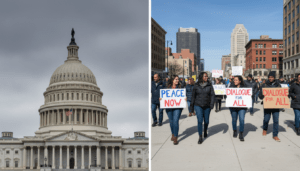
President Donald Trump addressed the nation late last night, declaring that recent U.S. airstrikes against Iranian targets are intended to bring “freedom” to the region, marking a significant escalation as the United States enters direct combat operations. The announcement has sent shockwaves through Metro Detroit, a region deeply connected to the Middle East through its demographics and tied to the global economy through the automotive industry.
While the administration emphasizes the strategic necessity of the strikes to dismantle hostile proxy networks, the reaction in southeast Michigan has been swift and divided. From the coffee shops of Dearborn to the corporate boardrooms of the Big Three automakers, the implications of a prolonged US-Iran conflict are being weighed carefully by residents and local leaders alike.
Impact on Metro Detroit’s Arab American Community
Nowhere in the United States is the tension of Middle Eastern conflict felt more acutely than in Wayne County. According to data from the U.S. Census Bureau, Metro Detroit is home to one of the largest concentrations of Arab Americans in the country. For thousands of families in Dearborn, Dearborn Heights, and Hamtramck, the news of direct combat is not just a geopolitical headline—it is a personal source of anxiety.
Community leaders in Dearborn have expressed skepticism regarding the President’s framing of the strikes as a mission for “freedom.” Many residents have family members living in the region, including in Lebanon, Iraq, and Yemen, where Iranian-backed groups often operate and where conflict spillover is a constant threat.
“The rhetoric of ‘bringing freedom’ is something this community has heard before, often preceding decades of instability,” said a spokesperson for a local Dearborn-based civil rights advocacy group. “Our primary concern right now is the safety of civilians in the region and the potential rise in rhetoric against our communities here at home. We are monitoring the situation closely.”
However, opinions are not monolithic. Some factions within the local Iraqi and Iranian diaspora communities, particularly those who have fled oppressive regimes, have voiced cautious support for actions that might weaken the grip of hardline governments. Yet, the overwhelming sentiment across the metro area remains one of apprehension regarding U.S. soldiers—some of whom hail from Michigan bases—entering direct combat.
Economic Anxiety in the Motor City
Beyond the cultural and humanitarian concerns, the US-Iran conflict poses a direct threat to Detroit’s economy. The automotive industry is notoriously sensitive to global instability, particularly when it involves major oil-producing regions.
Following the President’s announcement, crude oil futures saw an immediate spike. For Detroit, sustained high oil prices translate directly to pain at the pump for commuters and higher logistical costs for manufacturers. Local economic analysts suggest that if gas prices surge past the $4.00 mark, consumer confidence could dip, stalling vehicle sales just as the spring buying season approaches.
“Stability is the currency of the automotive supply chain,” said a supply chain analyst from a Detroit-based consulting firm. “When the U.S. enters direct combat in the Middle East, we almost always see a volatility premium added to energy costs. For Detroit automakers heavily invested in both internal combustion trucks and the transition to EVs, high energy costs complicate the manufacturing landscape.”
Local business owners are also bracing for impact. Logistics companies that rely on trucking goods across the Midwest operate on thin margins; a sharp rise in diesel fuel caused by geopolitical fear could force price hikes on consumer goods across the city.
Political Fallout in a Swing State
The political ramifications of the President’s decision are likely to be felt heavily in Michigan, a crucial swing state. Foreign policy has increasingly become a domestic issue in Michigan, largely due to the uncommitted vote movement seen in recent election cycles regarding Middle East policy.
Political strategists note that the President’s justification of the strikes—framing them as a liberation effort—is a high-stakes gamble with Michigan voters. If the operation is swift and successful, it may bolster support among security-focused voters in Macomb County. However, if the U.S. is drawn into a protracted conflict, the administration risks further alienating younger voters and the Arab American bloc in Wayne County.
“Michigan is a microcosm of the country’s divide on foreign intervention,” noted a political science professor at Wayne State University. “The President’s usage of the word ‘freedom’ is a callback to previous eras of foreign policy that yielded mixed results. How Detroit voters interpret that narrative will depend heavily on what happens on the ground in the coming weeks.”
Local Security and Preparedness
In response to the escalation, local authorities are remaining vigilant. While there is no specific credible threat to the Detroit area, law enforcement agencies often increase visibility around sensitive infrastructure and religious institutions during times of heightened international tension.
The Department of Homeland Security has previously advised major cities to remain aware during the onset of direct combat operations. Detroit Police officials have stated they are in communication with federal partners to ensure the safety of all residents, regardless of the geopolitical climate.
What Happens Next?
As the U.S. enters this new phase of direct combat, Detroiters are left watching the news with a mix of weariness and vigilance. The coming days will likely reveal whether the strikes achieve the administration’s stated goals or if the region is poised for a wider conflict.
For now, the impact is felt in the conversations at local community centers, the fluctuating numbers on the stock market tickers downtown, and the gas stations lining 8 Mile Road. DetroitCityNews.com will continue to provide updates on how this developing story impacts our local neighborhoods and economy.