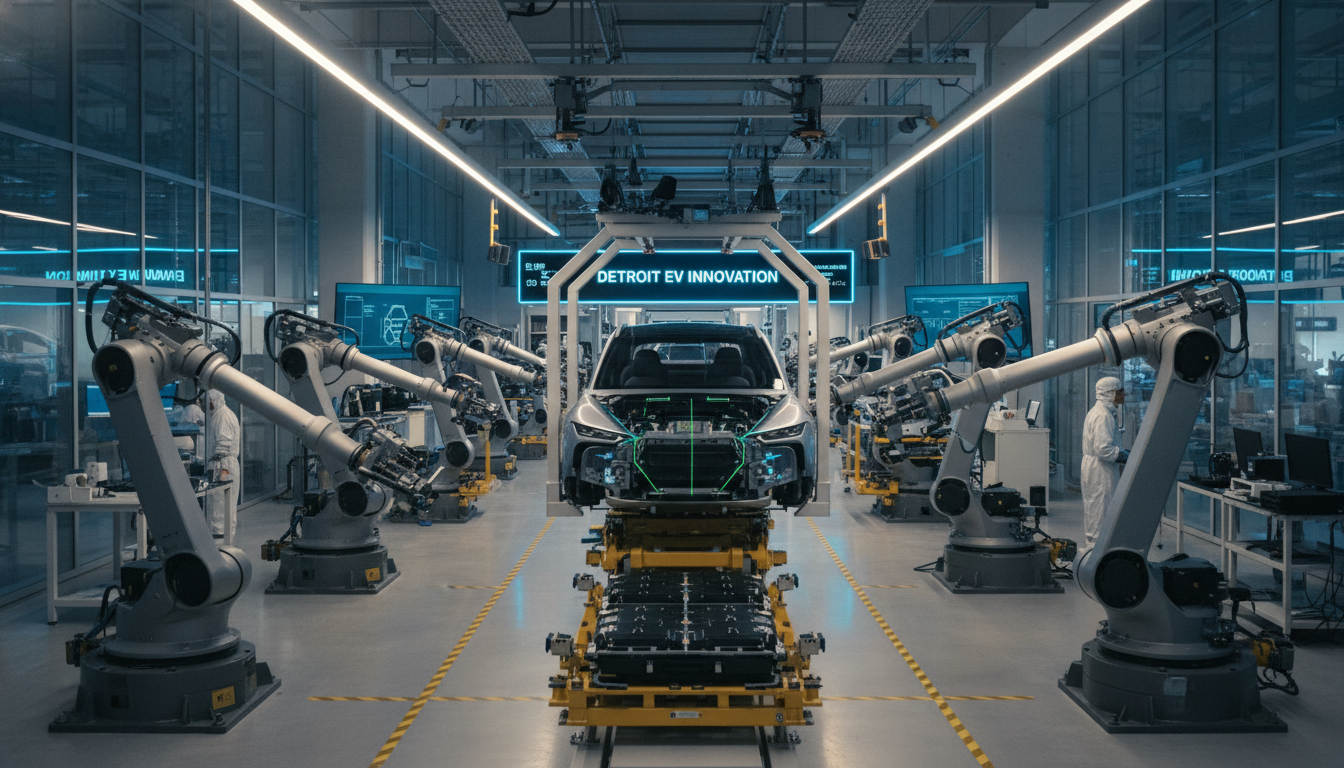
The landscape of the Detroit auto industry is undergoing its most significant transformation since the introduction of the assembly line. As global markets shift toward sustainable transportation, Detroit’s “Big Three” are doubling down on Michigan-based production, funneling billions of dollars into the development of electric vehicles (EVs) and battery manufacturing facilities. This resurgence is not merely a corporate pivot but a fundamental restructuring of the regional economy designed to secure Detroit’s status as the world’s mobility capital for the next century.
Recent data from the Michigan Economic Development Corporation (MEDC) indicates that the state has secured more than $15 billion in electric vehicle and battery-related investments over the last three years. These projects are centered largely within the Detroit metropolitan area, signaling a long-term commitment to the local workforce and industrial infrastructure. As Ford Motor Company and General Motors accelerate their transition away from internal combustion engines, the implications for local suppliers and residents are becoming increasingly clear.
General Motors and the Factory ZERO Transformation
General Motors (GM) has placed Detroit at the heart of its “all-electric future.” The centerpiece of this strategy is Factory ZERO, the Detroit-Hamtramck Assembly Center, which underwent a $2.2 billion renovation to become the company’s flagship EV assembly plant. According to official reports from General Motors, the facility is now capable of producing a variety of all-electric trucks and SUVs, including the GMC HUMMER EV and the Chevrolet Silverado EV.
The investment at Factory ZERO is part of a broader $35 billion global commitment by GM to EV and autonomous vehicle development through 2025. For Detroit, this means the retention of thousands of high-tech manufacturing jobs. Industry analysts note that by repurposing existing footprints rather than building entirely new sites in other states, the Detroit auto industry is effectively bridging the gap between its storied past and a digitized future. The proximity of these plants to GM’s Global Technical Center in Warren ensures a tight feedback loop between engineering and production.
Ford Motor Company Expands Michigan EV Footprint
Ford Motor Company has similarly reinforced its ties to the region. While the company has made headlines with its BlueOval City project in Tennessee, it has simultaneously invested $3.7 billion in its Michigan manufacturing sites. A significant portion of this funding is directed toward the Rouge Electric Vehicle Center in Dearborn, where the F-150 Lightning is produced. This facility represents a new era for the Detroit auto industry, utilizing advanced robotics and sustainable building practices.
Beyond vehicle assembly, Ford’s acquisition and restoration of the Michigan Central Station in Corktown serves as a physical symbol of this evolution. The campus is designed as an innovation hub for electric vehicles and autonomous technology. According to statements from the City of Detroit, this development is expected to attract thousands of tech workers to the city center, further diversifying the local talent pool beyond traditional mechanical engineering.
The Role of Federal Incentives and State Support
The acceleration of these investments is supported by significant public policy shifts. The Inflation Reduction Act (IRA) and the Bipartisan Infrastructure Law have provided a framework of tax credits and grants that make domestic EV production more competitive. According to the U.S. Department of Energy, Michigan is currently ranked among the top states for planned battery manufacturing capacity, with projections suggesting the state will host nearly one-third of the nation’s battery output by 2030.
The MEDC’s Strategic Outreach and Attraction Reserve (SOAR) fund has also played a pivotal role. By providing site-readiness grants and infrastructure support, the state has been able to compete with southern states that have historically used lower labor costs to lure automotive projects. Local officials argue that Detroit’s existing logistical networks and specialized labor force remain its greatest competitive advantages.
Impact on Detroit Residents and Local Workers
For the average resident of Detroit, the influx of capital into EV cars represents both opportunity and uncertainty. The primary benefit is job security; as traditional engine plants phase out, the transition to EV assembly provides a path forward for thousands of United Auto Workers (UAW) members. However, the shift requires a massive retraining effort. Community colleges and vocational schools across Southeast Michigan are currently updating their curricula to include power electronics, battery chemistry, and high-voltage safety.
Economic development in the local infrastructure sector is also anticipated. As more electric vehicles hit the road, the City of Detroit has begun expanding its public charging network. The Detroit Department of Transportation (DDOT) is also exploring the electrification of its bus fleet, which would improve air quality in many of the city’s industrial corridors—a long-standing concern for neighborhood advocates.
Local business owners in the supply chain are also feeling the ripple effects. Small-to-medium-sized tool and die shops that once specialized in transmission parts are now pivoting to produce components for battery enclosures and thermal management systems. While the transition is capital-intensive, the sheer volume of new investments in the Detroit auto industry provides a level of market certainty that has been absent for years.
Challenges and Future Outlook
Despite the momentum, the path to a fully electric Detroit is not without hurdles. Consumer demand for EV cars has shown signs of fluctuation due to high interest rates and concerns over charging infrastructure. Both Ford and GM have adjusted their production timelines in recent months to better align with market realities, emphasizing a hybrid approach in the interim.
Furthermore, the global supply chain for raw materials like lithium and cobalt remains volatile. Detroit’s automakers are increasingly looking to vertical integration—partnering directly with mining companies and battery tech startups—to mitigate these risks. The success of the Detroit auto industry in the coming decade will likely depend on its ability to maintain these complex supply chains while keeping vehicle prices accessible for the average consumer.
Ultimately, the multi-billion dollar investments from Ford Motor Company and General Motors signify a vote of confidence in the city. By anchoring the future of electric vehicles in the very neighborhoods that built the middle class, Detroit is positioning itself to lead the next industrial revolution. As the first wave of these new facilities reaches full capacity, the eyes of the global automotive world remain fixed on the Motor City.