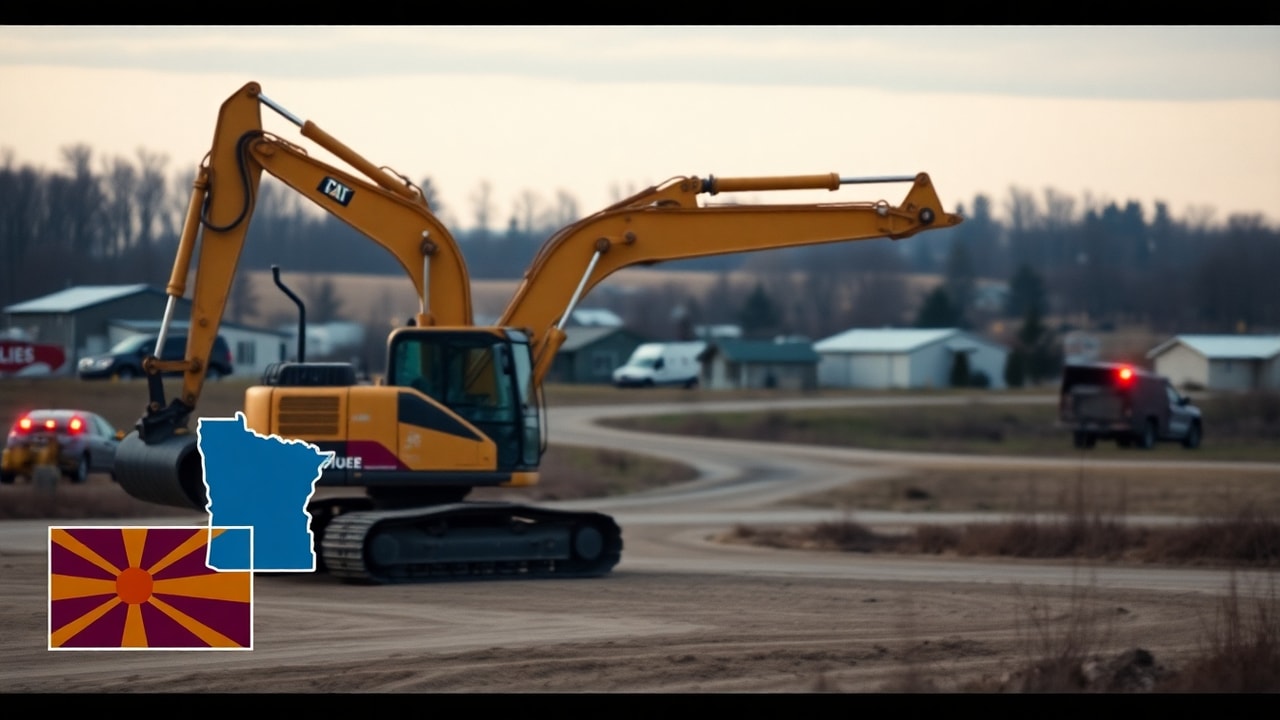
A man from Arizona faces criminal charges after prosecutors allege he led police on a “joyride” in Minnesota using a stolen excavator, an incident that underscores how stolen heavy equipment can be quickly moved across state lines. The case, filed with Detroit Lakes authorities, has drawn attention from law enforcement officials in the region as agencies work to track the vehicle’s route and recover additional equipment.
According to charging documents and reports from local media, Minnesota authorities allege the suspect unlawfully obtained the excavator and then operated it in a way that created a public safety risk during the incident. The matter is now in the hands of prosecutors, with Minnesota authorities coordinating efforts to confirm where the excavator was originally taken and whether other items were involved.
Joyride allegations tied to excavator theft
Prosecutors say the incident began after the excavator was reported missing, leading investigators to pursue leads that ultimately connected the equipment to the suspect identified as an Arizona man in court filings. The allegations describe a brief but chaotic episode in which the equipment was used in a manner police say endangered people and property.
Authorities have not released every detail of the alleged route publicly, but they have indicated the case involves more than a single alleged act. Investigators are looking at how the stolen equipment was handled, who may have assisted with transportation, and whether the excavator could have been moved quickly to avoid detection.
“Cases involving heavy equipment theft require fast coordination because the equipment’s value and mobility can make it difficult to recover once it leaves the area,” a spokesperson for a Minnesota public safety agency said in a statement provided to media. Minnesota authorities have also emphasized that stolen machinery can be repurposed or sold through informal networks before owners realize what’s missing.
Criminal charges and Minnesota authorities’ role
The criminal case proceeds under Minnesota law, with criminal charges stemming from prosecutors’ account of the excavator theft and subsequent operation. While the exact counts vary depending on how the allegations are pleaded, the charges generally reflect both the original allegation of unlawful taking and the later alleged conduct during the incident.
In court and in statements to reporters, Minnesota authorities have framed the matter as a serious public safety issue—not just property damage. Law enforcement officials say excavators and similar machines can cause severe harm if operated improperly or used in unauthorized areas.
Separate guidance from the Federal Bureau of Investigation notes that theft of high-value equipment often involves organized opportunism and rapid movement to reduce the chances of recovery. “Investigators frequently emphasize early reporting and documentation for stolen property,” the FBI notes in materials about property crime prevention and recovery efforts.
Impact on Detroit residents and the broader Michigan- Minnesota connection
Although the incident occurred in Detroit Lakes, the case has relevance for Detroit residents and businesses across the region because Detroit-area contractors and construction supply firms often rely on the same kinds of equipment—sometimes sourced through national dealers or transported across multiple states. Heavy machinery theft isn’t confined by state borders, and recovery can be hindered when stolen equipment is quickly relocated.
For Detroit-area construction companies, the practical impact is typically felt in insurance costs, downtime, and the administrative burden of filing reports and pursuing evidence. When stolen equipment is involved, even businesses that do not own the specific machinery may face increased premiums or tighter scrutiny from insurers and lenders.
Detroit residents also have a civic stake in how public safety agencies respond to equipment-related incidents. Local officials in metropolitan areas often emphasize prevention strategies—such as better access control, GPS tracking, and coordination with state and federal databases—because stolen vehicles and tools can move quickly into or out of the Midwest corridor.
In Detroit and surrounding communities, the construction sector remains a major employer and a central driver of local development. When heavy equipment theft rises, it can contribute to project delays—especially for small contractors who may be forced to rent replacement equipment at higher rates.
Background & data on equipment theft risk
Heavy excavator theft is a recurring challenge nationwide because such machines are both expensive and versatile. Unlike smaller tools that can be concealed more easily, excavators are visible but can still be moved quickly with trailers and trucking logistics. That combination can make them difficult to recover without strong tips, surveillance, or tracking data.
In the wider U.S. context, the U.S. Department of Justice and other federal partners have repeatedly highlighted that property crimes involving high-value items can escalate when theft is followed by additional unlawful conduct. The Detroit Lakes case fits that pattern: investigators allege not only the initial theft but also later actions that they say created further risk.
Public safety experts also note that older machinery and popular models are often targeted. Owners who keep records—such as serial numbers, maintenance history, and photos—can speed up recovery efforts when investigators identify the equipment.
What happens next for the Arizona man
As the case moves forward, prosecutors are expected to test the evidence supporting the allegations and address questions about how the equipment was obtained, operated, and transported. Minnesota authorities may also seek information from witnesses, review surveillance footage from nearby properties, and continue cross-referencing stolen equipment databases.
For the suspect, next steps typically include court proceedings that could involve hearings on bond, pretrial motions, and discovery exchanges between the prosecution and defense. If additional evidence emerges—such as proof of prior ownership documentation or related theft reports—prosecutors could pursue amendments depending on what the facts support.
In parallel, law enforcement agencies often issue reminders to the public and to local businesses on reporting procedures. The FBI has long encouraged owners of valuable property to maintain records and report theft promptly so investigators can act while leads remain fresh.
Local lessons for businesses and residents
For Detroit-area businesses that operate in construction, landscaping, or infrastructure maintenance, the Detroit Lakes incident provides a reminder that stolen equipment can become a multi-jurisdiction problem. Contractors may want to review inventory security measures, confirm that serial numbers and asset tags are recorded, and ensure that GPS tracking—if available—is properly configured.
Residents can also take a practical view: equipment theft affects more than one site. It can threaten neighborhood safety when stolen machines are operated outside permitted areas, and it can complicate repair and rebuilding timelines in communities already dealing with high costs.
While this case is rooted in Detroit Lakes, its implications are regional. As joyride allegations involving stolen heavy machinery continue to develop, Detroit-area stakeholders will be watching how Minnesota authorities handle recovery efforts and whether investigators can link the excavator to a broader pattern of theft.