In a newly resurfaced Detroit history discussion, researchers and historians are tying the legend of “Munitions Mary” to the way General Motors helped shape U.S. wartime production—down to the machinery, materials, and industrial culture that powered the World War effort. The topic has resurfaced after a detailed Starkman interview prompted new questions about how Detroit’s auto industry transitioned from peacetime manufacturing to GM weapons of war during the 1940s.
Although “Munitions Mary” is often recounted in popular memory as a symbol of productivity, workplace power, and wartime urgency, the renewed conversation emphasizes a more specific link: Detroit’s industrial system wasn’t just assembling vehicles and components—it was also enabling the U.S. to produce and sustain World War weapons and related defense output through the expertise of companies and workers tied to the automotive supply chain.
Main Section
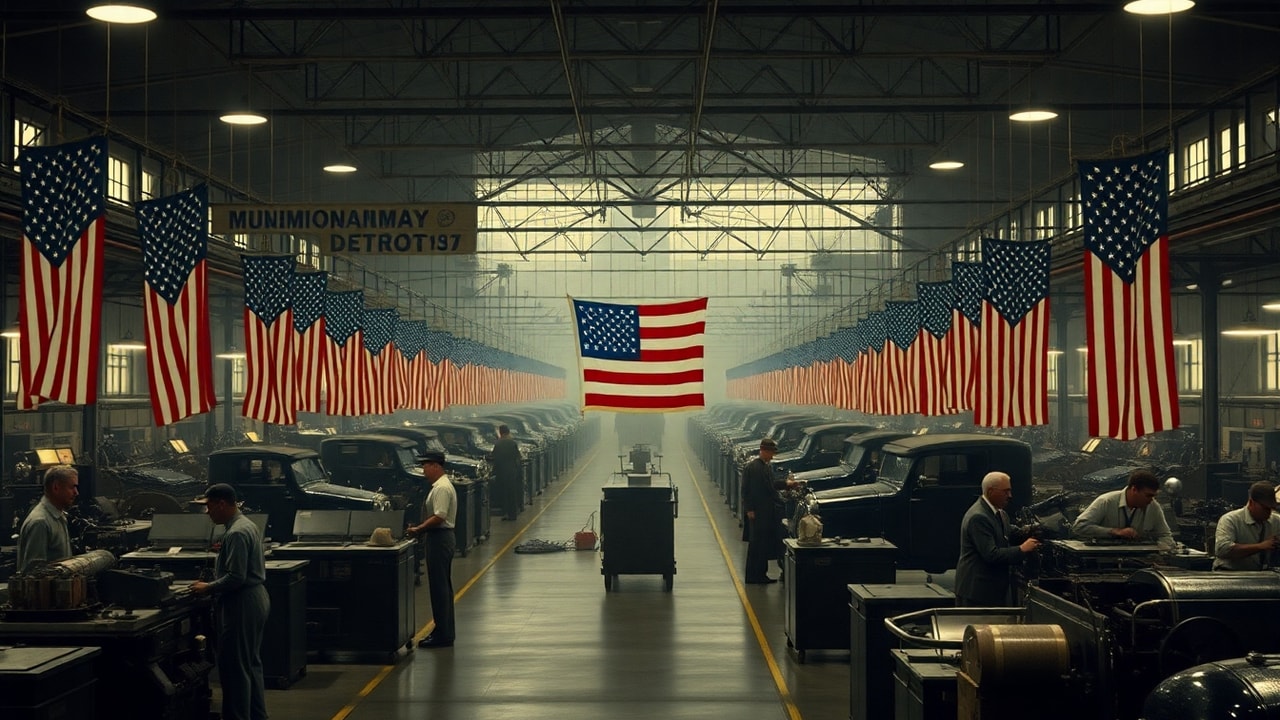
According to Detroit Public Library materials on local wartime industries, Detroit’s factories and skilled labor played a major role in the broader shift to defense manufacturing as the United States moved toward sustained war production. Library curators note that Detroit’s industrial base—deep in machining, tooling, and mass production—was well positioned to convert lines, retrain workers, and scale output quickly.
In the Starkman interview that has circulated among local history groups, historian and author Starkman argues that “Munitions Mary” can be understood not only as a romanticized figure of wartime labor, but also as a shorthand for the industrial network behind the scenes. The discussion frames automotive wartime as a practical transformation: Detroit companies repurposed expertise, reorganized plants, and integrated new defense contracts into existing industrial rhythms.
General Motors did not operate in isolation. Wartime production depended on an ecosystem of government contracting, subcontracting, and standardized manufacturing practices. As a result, “GM weapons of war” is less about one single program and more about a pattern: large manufacturers leveraging Detroit’s industrial capacity to meet military needs.
Why “Munitions Mary” still resonates in Detroit
Part of the enduring relevance is that Detroit residents recognize the era’s fingerprints in the city’s labor stories—especially the way the war years accelerated changes in workforce participation, workplace structure, and local economic priorities. “Munitions Mary” is frequently described as a shorthand image, but the renewed discussion pushes readers to look at the concrete industrial mechanics behind the symbolism: production schedules, factory retooling, and the convergence of civilian and defense manufacturing.
In that context, Detroit’s wartime manufacturing experience is also a foundational part of the city’s broader identity. The same systems of industrial management and mass production that were optimized during the 1940s later influenced postwar consumer manufacturing and, for better or worse, the labor negotiations and economic volatility Detroit would face in later decades.
Impact on Detroit Residents
Revisiting Detroit history is not only about nostalgia; it can affect how communities interpret current industrial and labor dynamics. When residents learn how the city’s manufacturing expertise helped the nation produce defense materials during the World War weapons era, it reframes Detroit’s role from a distant industrial relic to an active historical engine.
Local educators and history organizations say these conversations can also be practical. Workplace history offers lessons for today’s manufacturing workforce development, including how quickly skills can be repurposed when policy and procurement priorities change. Detroit’s ongoing efforts to rebuild and modernize manufacturing capacity make the wartime example particularly salient—especially for residents focused on training pathways, industrial careers, and the long-term relationship between Detroit’s employers and the broader economy.
Local archivists also note that public attention to figures like “Munitions Mary” can encourage more community engagement with primary sources—photographs, plant records, union archives, and government documents—that are sometimes underused outside specialist circles.
Background & Data
To understand the claim that “Munitions Mary” reflects Detroit’s wartime industrial mobilization, it helps to look at the scale of U.S. war production overall. Data from the U.S. Bureau of Labor Statistics has documented how wartime years corresponded with significant shifts in employment patterns, industrial output, and labor participation across the country. For Detroit, those national shifts were amplified by the city’s concentration of major manufacturers and suppliers.
Meanwhile, National Archives records and public documentation on U.S. wartime contracting show that defense production expanded through coordinated government procurement and industrial scaling. Those records also underline why the term “weapons of war” is often discussed in plural terms: wartime output included not only finished systems, but also components, precision parts, and production infrastructure needed to sustain military capabilities.
In Detroit, the automotive sector’s tooling and manufacturing disciplines meant the city’s factories could contribute across multiple categories of defense production. That industrial context is what makes the revived Starkman interview discussion more than a simple retelling of a legend—it situates “Munitions Mary” inside Detroit’s manufacturing transformation.
For example, local history reporting and collections from major Detroit institutions frequently describe how large factories changed roles during the war years, adapting production to meet government demands. While individual stories about specific nicknames or figures can vary in detail, the underlying pattern—Detroit’s industry shifting toward defense output—remains consistently documented across institutional sources.
What Happens Next
As the Detroit history discussion continues to gain traction, residents are likely to see more local programming tied to wartime labor and industrial heritage. History groups are increasingly pushing for careful sourcing—encouraging people to distinguish between widely circulated narratives and verifiable primary documents.
For readers who want to go deeper, experts recommend starting with institutional archives and library collections, then comparing popular accounts like “Munitions Mary” to contemporaneous records. The goal is to connect symbolism to evidence—so Detroit history remains both engaging and accurate.
In the near term, expect additional community talks, educational materials, and archival outreach connected to Detroit’s automotive wartime legacy. And for those following the conversation sparked by the Starkman interview, the focus may shift from the nickname itself to a broader investigation: how Detroit’s industrial capacity translated into tangible defense production, including the systems and parts often summarized under the umbrella term GM weapons of war.
Ultimately, Detroit’s wartime story isn’t only about what happened during the 1940s—it’s about why those choices still shape the city’s identity, its labor memory, and the way residents interpret manufacturing’s role in national priorities.