As Detroit moves toward the middle of the decade, the city is preparing for a transformative year in physical rehabilitation and modernization. The Detroit infrastructure 2026 outlook represents a convergence of federal funding through the Infrastructure Investment and Jobs Act (IIJA) and localized urban planning initiatives aimed at reversing decades of highway-centric design. From the historic transformation of the I-375 corridor to the expansion of the Joe Louis Greenway, the 2026 construction season is expected to be one of the most active in recent history.
The I-375 Reconnection Project Enters Critical Phase
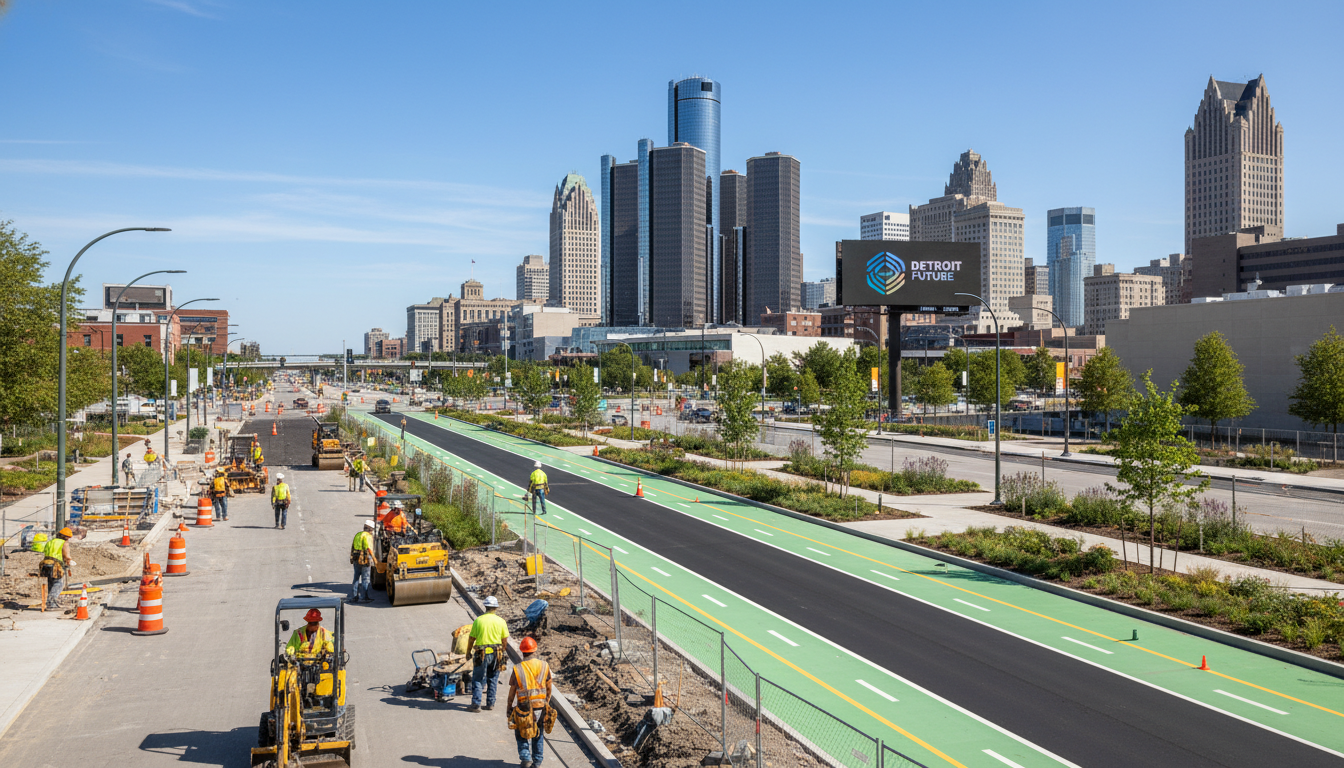
The centerpiece of road projects Detroit residents will watch in 2026 is the ongoing conversion of the I-375 freeway into a street-level boulevard. According to the Michigan Department of Transportation (MDOT), this project aims to remove the sunken barrier that has long separated the downtown core from the historic Eastern Market and Lafayette Park neighborhoods. The 2026 phase of the project is slated to focus on utility relocation and the beginning of the heavy grading required to bring the road to surface level.
City planning Detroit officials note that this project is about more than just traffic flow. By removing the freeway, the city will reclaim approximately 30 acres of land for potential redevelopment. Critics and community members have pushed for this land to be used to honor the history of Black Bottom and Paradise Valley, the vibrant African American neighborhoods destroyed during the highway’s original construction in the 1950s.
Michigan Avenue and Multi-Modal Transit
Another focal point for Detroit infrastructure 2026 is the reconstruction of Michigan Avenue (US-12). Following preliminary work in 2024 and 2025, 2026 will see major progress on the stretch between Cass Avenue and I-96. This project is designed to implement a “complete streets” approach, incorporating dedicated transit lanes, improved pedestrian crossings, and protected bike lanes.
Data from the Michigan Department of Transportation indicates that the redesign will accommodate autonomous vehicle testing and high-capacity transit, aligning with the city’s goals of becoming a global hub for mobility innovation. This aligns with broader Detroit economic development strategies that prioritize tech-ready corridors to attract new businesses.
Bridge Maintenance and Neighborhood Safety
Beyond the high-profile downtown projects, construction Detroit schedules for 2026 include significant investments in neighborhood bridge repairs. According to the Southeast Michigan Council of Governments (SEMCOG), several aging overpasses spanning the I-75 and I-94 corridors are slated for structural reinforcement or replacement. These repairs are critical for maintaining the safety of residential routes that feed into the city’s industrial sectors.
The Detroit Department of Public Works (DPW) has also indicated that 2026 will see the expansion of the “Street Fund” projects, which focus on residential road resurfacing. The city plans to prioritize neighborhoods that have historically seen lower levels of capital investment, utilizing data from the latest neighborhood equity surveys to determine where the need for new pavement and sidewalk repair is most acute.
Impact on Detroit Residents
For the average Detroit resident, the surge in Detroit infrastructure 2026 projects brings a mixture of optimism and logistical challenges. Increased construction will inevitably lead to detours and longer commute times, particularly in the downtown and Corktown areas. However, the long-term benefits include safer pedestrian environments and reduced vehicle speeds in residential zones.
Local business owners in the Eastern Market district have expressed cautious optimism. “The construction is a headache, but the end result—a boulevard that actually connects us to downtown—will change how people shop and visit the market,” said one local vendor. The city planning Detroit team has committed to maintaining access to local businesses throughout the construction cycle, though residents are encouraged to use official city apps to track road closures in real-time.
Urban Planning and the 20-Minute Neighborhood
A driving force behind the city planning Detroit initiatives for 2026 is the concept of the “20-minute neighborhood.” This urban planning philosophy aims to ensure that every resident has access to essential services—such as grocery stores, transit, and healthcare—within a 20-minute walk or bike ride from their home. To support this, the 2026 budget is expected to allocate significant funds toward the Joe Louis Greenway, a 27.5-mile loop that will eventually connect 23 Detroit neighborhoods.
By 2026, several new segments of the Greenway are expected to open, providing safe non-motorized travel options and reducing the reliance on personal vehicles. This shift is seen as a vital component of Detroit’s climate resilience strategy, as green infrastructure along the path will help manage stormwater runoff and reduce the urban heat island effect.
Background and Funding Data
The scale of these road projects Detroit is planning is made possible by a combination of state and federal resources. The MDOT Five-Year Transportation Program highlights that Michigan’s share of federal infrastructure funding has increased significantly since 2021. For 2026, the projected spending on Detroit-area highways and local bridges exceeds $400 million, excluding private-public partnerships for utility upgrades.
Furthermore, the City of Detroit has leveraged American Rescue Plan Act (ARPA) funds to supplement traditional infrastructure spending. This has allowed for a faster rollout of street lighting upgrades and the removal of hazardous lead service lines alongside road reconstruction, minimizing the need to dig up the same streets twice.
What Happens Next
As 2026 approaches, the City Council and MDOT will hold a series of public hearings to finalize the design details for the I-375 and Michigan Avenue projects. Residents are encouraged to participate in these sessions to ensure that community concerns regarding noise mitigation, historical preservation, and local hiring remain at the forefront of the development process.
While the orange barrels will be a common sight throughout 2026, the projects represent a necessary step toward a modernized Detroit. The focus on connectivity, equity, and innovation suggests that the city’s infrastructure is finally catching up to its ambitious economic and social goals.