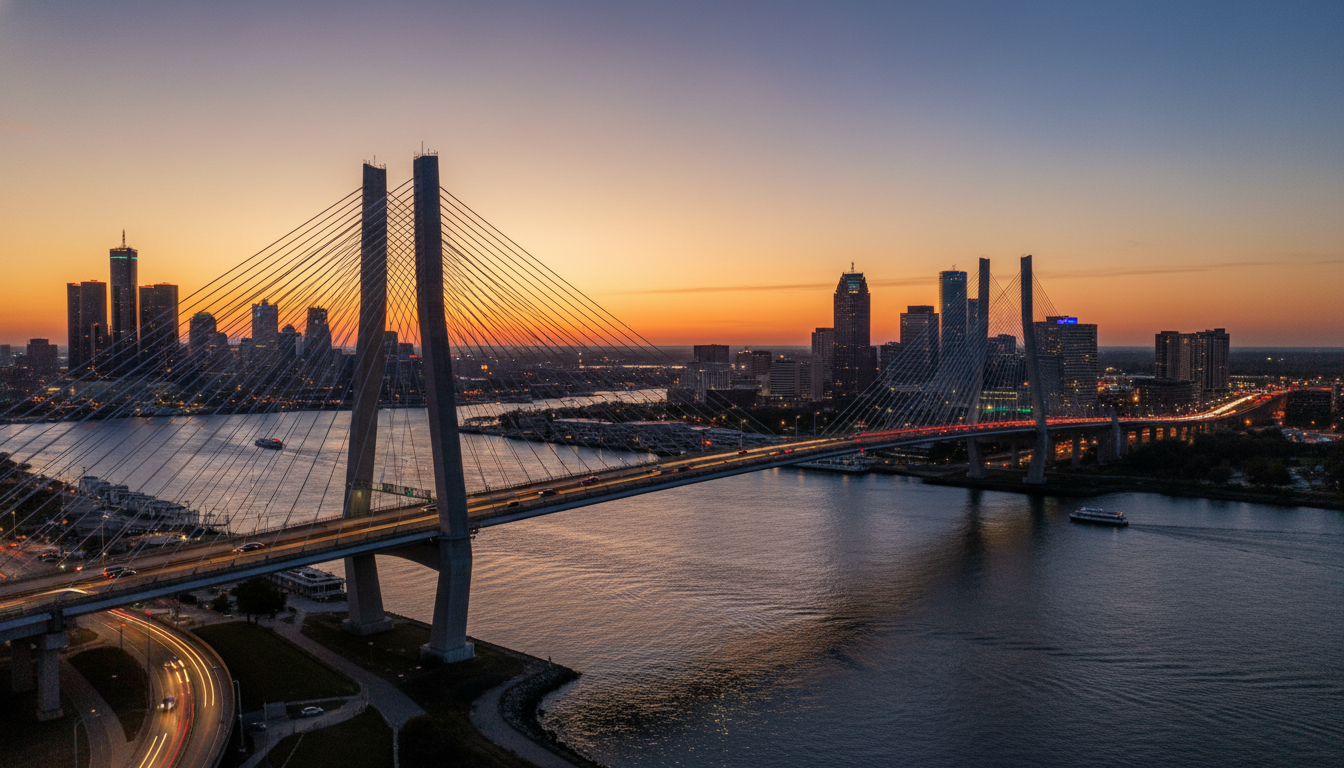
The skyline connecting Detroit, Michigan, and Windsor, Ontario, has officially changed forever. In a historic moment for North American logistics and local infrastructure, the Gordie Howe International Bridge construction reached its most significant milestone to date as the final bridge deck pieces were joined over the Detroit River. This structural union creates the longest cable-stayed bridge in North America and marks the first time the two cities have been physically connected at this location.
The project, overseen by the Windsor-Detroit Bridge Authority (WDBA) and Bridging North America (BNA), represents a multibillion-dollar investment intended to streamline international trade. According to official reports from the WDBA, the bridge deck connection was the result of years of meticulous engineering, involving 216 segments of structural steel and concrete. For Detroit residents, the sight of the completed span serves as a massive symbol of the region’s growing importance in the global supply chain.
The Role of Gordie Howe International Bridge Construction in Global Trade
The Gordie Howe International Bridge construction is not merely an engineering feat; it is an economic necessity. Currently, the aging Ambassador Bridge handles approximately 25% of all surface trade between the United States and Canada. The addition of the Gordie Howe span is expected to provide much-needed redundancy and capacity. Data from the U.S. Department of Transportation suggests that the new crossing will significantly reduce wait times for commercial trucking, which currently faces bottlenecks at the existing border crossings.
Beyond the bridge itself, the project includes massive Ports of Entry (POE) on both sides of the river. The Detroit POE will be one of the largest in North America, spanning 167 acres. This facility will house advanced screening technologies and expansive lanes for commercial and passenger vehicles. This development is a core component of Detroit’s ongoing infrastructure revitalization, aimed at positioning the city as a premier logistics hub for the Midwest.
Impact on Detroit Residents and the Delray Neighborhood
While the economic implications are global, the local effects are deeply felt in Detroit’s Delray neighborhood. For decades, Delray has faced industrial decline and environmental challenges. To address this, the project includes a $120 million (CAD) Community Benefits Plan. According to documentation from the City of Detroit and the WDBA, this plan was developed based on extensive community feedback to ensure that the project benefits those living in the bridge’s shadow.
For local residents, the most immediate benefits have come in the form of the Bridging North America Home Improvement Program. This initiative has provided grants to eligible homeowners for repairs such as window replacements and HVAC upgrades to mitigate noise and dust. Additionally, the project has committed to developing new green spaces and improving pedestrian safety in the surrounding areas. These neighborhood redevelopment initiatives are seen as a critical step in preventing the displacement of long-term residents while welcoming new investment.
Environmental and Social Safeguards
Local advocacy groups have closely monitored the Gordie Howe International Bridge construction to ensure environmental standards are upheld. The project includes permanent air quality monitoring stations in both Delray and Windsor. Reported data from the Michigan Department of Environment, Great Lakes, and Energy (EGLE) indicates that these stations provide real-time transparency regarding particulate matter levels, a major concern for a community already burdened by heavy industrial activity. Furthermore, the bridge features a dedicated multi-use path for pedestrians and cyclists, providing a new recreational link between the two nations that did not exist previously.
Background & Data: Engineering the Longest Span
The technical specifications of the bridge are staggering. The main span stretches 853 meters (roughly 0.53 miles) without any piers in the water, a design choice intended to protect the delicate ecosystem of the Detroit River and ensure safe passage for Great Lakes freighter traffic. According to engineering briefs from the Windsor-Detroit Bridge Authority, the two A-frame towers stand at 220 meters (722 feet), making them some of the tallest structures in the Detroit area.
Employment data shows that the project has created over 3,900 jobs to date, with a significant percentage of the workforce being recruited from local Detroit and Windsor labor unions. The project has also prioritized contracting with Small Business Enterprises (SBE) and Disadvantaged Business Enterprises (DBE), ensuring that the $4.4 billion (USD) fixed-priced contract circulates wealth back into the local economy.
What Happens Next: Testing and Final Opening
While the bridge deck is now connected, the Gordie Howe International Bridge construction is far from finished. The project now enters a rigorous phase of stay cable tensioning, road paving, and the installation of electrical and tolling systems. The WDBA has confirmed that while the structural connection is complete, the bridge is not expected to open to traffic until September 2025.
During this final phase, engineers will conduct extensive stress tests and finalize the integration of customs systems between U.S. Customs and Border Protection (CBP) and the Canada Border Services Agency (CBSA). Local business owners in Southwest Detroit are already preparing for the influx of travelers and workers, hoping that the new crossing will bring increased foot traffic to the vibrant Mexicantown and Delray districts. As the countdown to 2025 begins, the bridge stands as a testament to bilateral cooperation and the enduring resilience of the Detroit spirit.