Detroit’s skyline is often the focus of development news, but the real transformation is happening within its residential corridors. As property values continue to climb across the city, the municipal government has accelerated its efforts in Detroit affordable housing development to ensure that long-term residents are not priced out of their own communities. This movement comes at a critical time as the city experiences a level of investment not seen in decades.
The Scale of Detroit Affordable Housing Development
According to the City of Detroit Housing and Revitalization Department (HRD), the city has set an ambitious goal to preserve or create 20,000 units of affordable housing. This initiative is backed by a combination of federal American Rescue Plan Act (ARPA) funds, state tax credits, and private investment through the Detroit Housing for the Future Fund (DHFF). The DHFF, a private investment fund managed by Local Initiatives Support Corporation (LISC), has already deployed millions of dollars to renovate existing apartment buildings that were at risk of falling into disrepair or converting to market-rate rents.
Data from the U.S. Census Bureau shows that Detroit’s median household income remains significantly lower than the national average, making the availability of rent-restricted units a necessity rather than a luxury. For many residents, housing costs that exceed 30% of their monthly income create a state of “rent burden,” leaving little for healthcare, transportation, and food. To address this, the city’s strategy focuses on residents earning between 30% and 80% of the Area Median Income (AMI).
Impact on Detroit Residents
The impact of these developments on local residents is multi-faceted. For many in neighborhoods like the North End, Jefferson-Chalmers, and Southwest Detroit, the arrival of new construction often sparks fears of displacement. However, the current administration’s focus on preservation—keeping existing units affordable for the next 30 years—is designed to provide a safety net for those who stayed in the city during its most challenging years.
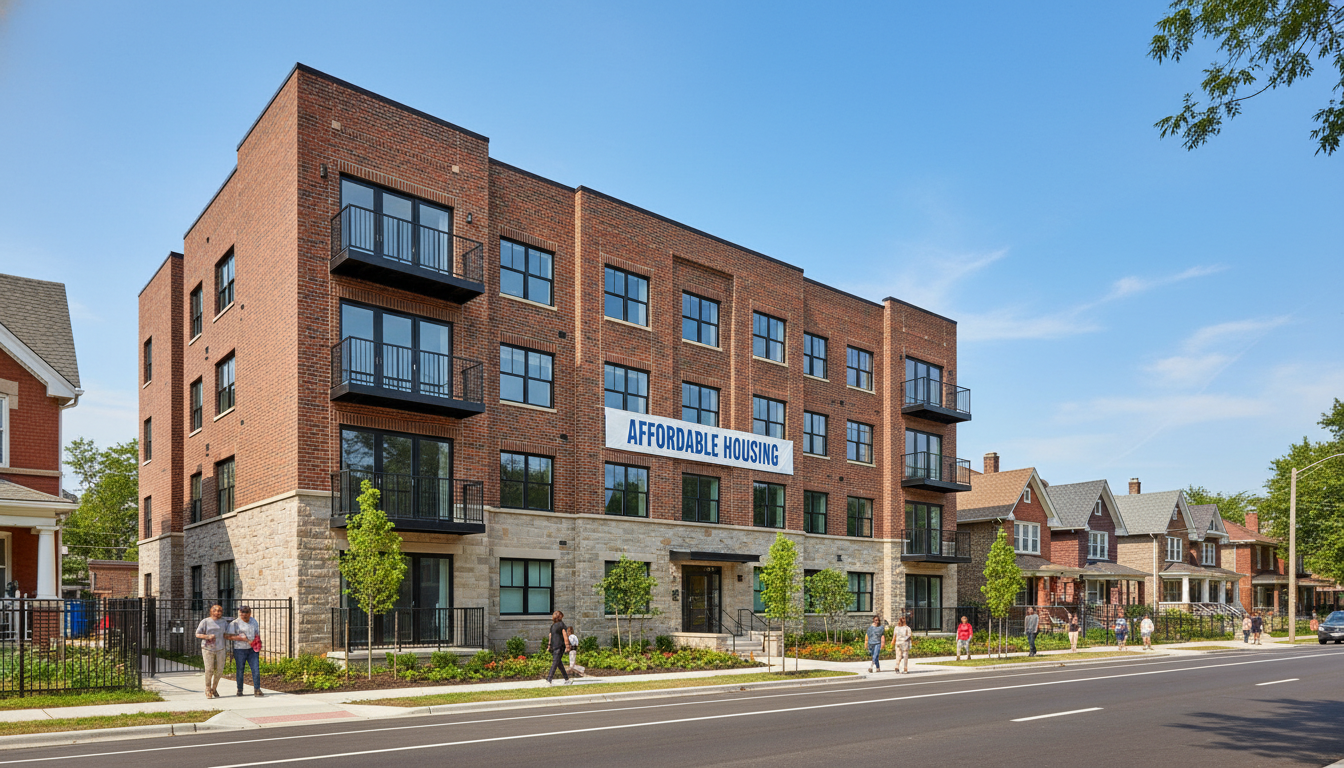
Local advocates note that while new glass towers downtown grab headlines, the stabilization of a 20-unit brick building in a neighborhood like Old Redford can have a more immediate impact on family stability. Residents in these units benefit from updated heating systems, new appliances, and energy-efficient windows, which also help lower utility costs. You can find more information on Detroit neighborhood revitalization efforts in our dedicated local coverage section.
Background & Data: The Economic Reality
The need for Detroit affordable housing development is underscored by shifting market dynamics. While Detroit was once synonymous with low-cost housing, the “renter’s market” has tightened considerably. Reported by the Detroit Free Press and verified by local real estate data, some neighborhoods have seen property values increase by over 20% annually for consecutive years. This appreciation is positive for homeowners but creates a precarious situation for the approximately 50% of Detroiters who rent.
The Strategic Neighborhood Fund (SNF) has been a primary vehicle for this change. By pairing park improvements and streetscape beautification with housing mandates, the SNF ensures that neighborhood improvements do not occur in a vacuum. For example, the redevelopment of the Murray Apartments in Northwest Detroit serves as a template: a historic structure preserved with modern amenities while maintaining rent limits that align with local wages. This aligns with broader Detroit real estate trends that show a growing preference for mixed-use and mixed-income developments.
According to officials at the City of Detroit Housing and Revitalization Department, the city is also leveraging the Detroit Land Bank Authority’s inventory to facilitate small-scale affordable housing. This allows local developers, often Detroit residents themselves, to participate in the city’s growth by rehabilitating duplexes and four-unit buildings.
Challenges in Construction and Funding
Despite the momentum, the path to increasing the housing stock is fraught with economic hurdles. Rising interest rates and the high cost of construction materials have made “pro-formas”—the financial projections for a project—difficult to balance. Many developers find that without significant subsidies, the cost to build a new unit exceeds what a Detroit family can afford to pay in rent.
To bridge this gap, the city has utilized the Neighborhood Enterprise Zone (NEZ) tax abatements and Low-Income Housing Tax Credits (LIHTC). These financial tools are essential for making the numbers work. “The math of affordable housing is complex,” one local developer noted during a recent city planning meeting. “Without the partnership of the city and state, these buildings simply would not be renovated.”
What Happens Next
Looking forward, the focus is shifting toward the Joe Louis Greenway—a 27.5-mile looping path that will connect dozens of Detroit neighborhoods. The city has already begun implementing an “Affordable Housing Equity” strategy along the path’s planned route to prevent the “high-line effect,” where property values skyrocket and displace current residents before the project is even finished.
Several large-scale projects are slated for completion in 2024 and 2025, including the conversion of the historic Fisher Body 21 plant into a massive mixed-use complex that will include a significant portion of affordable units. As these projects come online, the city will continue to monitor the balance between market-rate growth and the preservation of Detroit’s cultural and economic diversity. The long-term success of the Detroit affordable housing development strategy will be measured not just by the number of units built, but by the number of residents who are able to remain in their neighborhoods as the city grows.