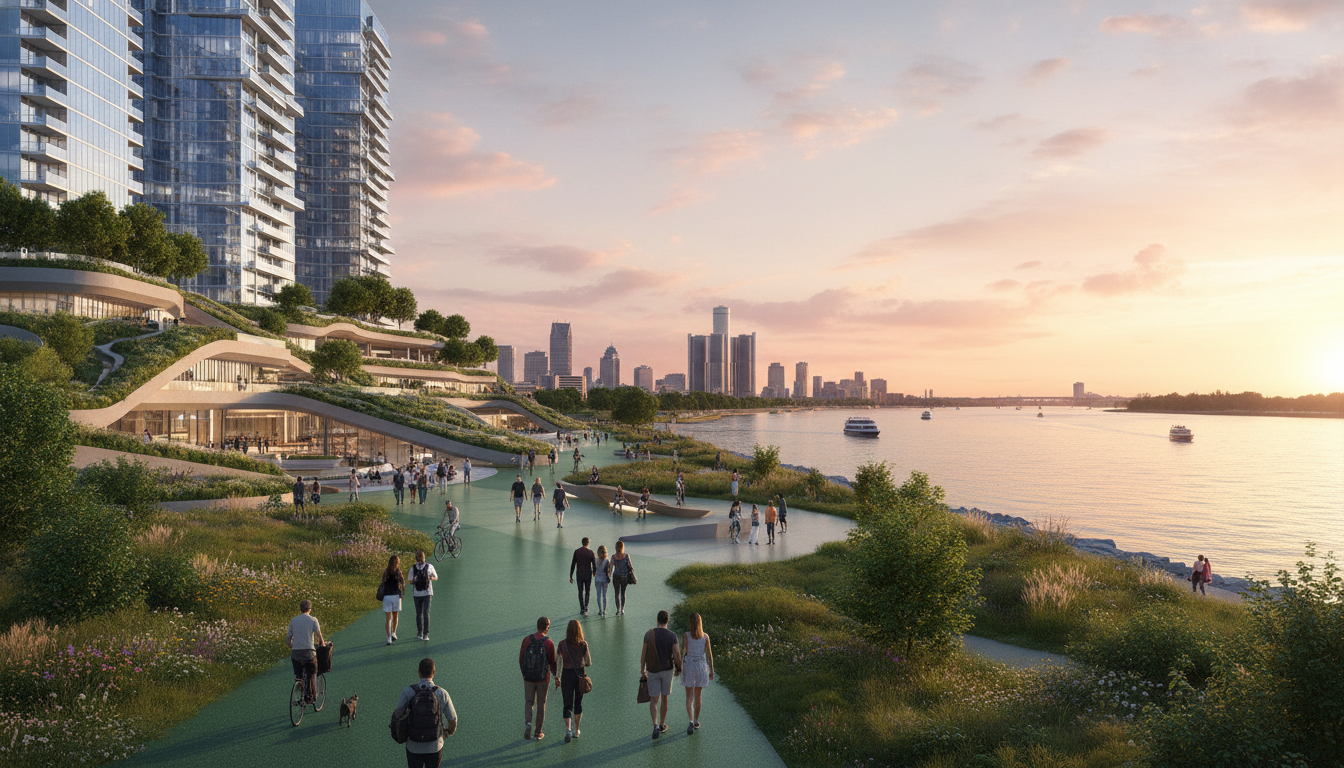
Detroit is currently witnessing one of the most significant architectural and social shifts in its post-industrial history. For decades, the city’s connection to its shoreline was severed by industrial plants and inaccessible private lots. However, as we approach 2026, the ongoing Detroit riverfront development initiative is reaching a fever pitch, with several multi-million dollar projects slated for completion. These developments are not merely aesthetic upgrades; they represent a fundamental change in city development Detroit, prioritizing public access, environmental sustainability, and economic inclusivity.
According to the Detroit Riverfront Conservancy, the nonprofit organization charged with the revitalization of the city’s waterfront, the goal is to create 5.5 miles of revitalized riverfront. This vision, which began over two decades ago, is entering its final, most ambitious phase. The transformation is anchored by the Ralph C. Wilson, Jr. Centennial Park, a 22-acre site on the West Riverfront that is expected to become one of the premier destination parks in the Midwest by 2026. This project alone signifies a massive investment in urban planning Detroit, turning a formerly vacant lot into a vibrant community hub.
The Core Projects Reshaping the Detroit Waterfront
The centerpiece of the 2026 vision is undoubtedly the Ralph C. Wilson, Jr. Centennial Park. Funded through a combination of public grants and a landmark $100 million gift from the Ralph C. Wilson, Jr. Foundation, the park will feature a large-scale water garden, a state-of-the-art playground known as the ‘Delta Dental Play Garden,’ and a massive hill for sledding and community events. Construction data suggests that this park will serve as a western anchor, mirroring the success of the Eastern Market and the existing East Riverfront parks.
Beyond the greenery, the Detroit waterfront is seeing a surge in residential and mixed-use infrastructure. The ‘Water Square’ development, situated on the former site of the Joe Louis Arena, has already begun to change the skyline. By 2026, additional phases of this development are expected to be fully integrated into the riverfront walkway, offering luxury housing and hotel accommodations that cater to a growing demographic of urban professionals and tourists. This influx of capital is a key driver in the broader scope of city development Detroit, bridging the gap between the downtown core and the water.
Crucially, the 2026 timeline also highlights the completion of the Unified Greenway. This project will connect the Detroit Riverwalk with the Joe Louis Greenway, a 27.5-mile loop that circles the city. According to official planning documents from the Detroit Riverfront Conservancy, this connection will allow residents from neighborhoods as far north as McNichols to travel entirely on protected paths down to the riverfront, marking a new era for Detroit transportation and recreation.
The Economic Impact of Detroit Riverfront Development
The financial implications of these projects are staggering. Economic impact studies conducted by the University of Michigan suggest that every dollar invested in the riverfront generates over $10 in private investment. This is evident in the surrounding real estate market, where property values in neighborhoods adjacent to the Riverwalk have seen a steady increase. For those tracking Detroit’s housing market shifts, the riverfront serves as a primary catalyst for new high-density residential construction.
Local business owners are already preparing for the increased foot traffic. In the areas surrounding the East Riverfront, small businesses—ranging from kayak rentals to boutique cafes—have reported a consistent rise in seasonal revenue. The city’s urban planning Detroit strategy has intentionally included provisions for ‘small business corridors’ that ensure local entrepreneurs can benefit from the high-profile development rather than being displaced by national chains.
How This Impacts Detroit Residents
For the average Detroiter, the development of the riverfront is about more than just economics; it is about equity. Historically, many of Detroit’s most beautiful natural assets were walled off from the public. The current phase of Detroit riverfront development specifically addresses this by ensuring that 100% of the riverfront remains open to the public, with no private beaches or gated sections. This commitment to accessibility is a hallmark of modern urban planning Detroit, aiming to rectify the mistakes of the mid-20th century.
Residents in neighborhoods like Southwest Detroit and the Near East Side will have direct non-motorized access to the water for the first time in generations. Public health officials have noted that the expansion of the Greenway system is likely to have a positive impact on local health outcomes by providing safe spaces for exercise and outdoor recreation. Furthermore, the Conservancy has implemented a ‘Community Advisory Team’ to ensure that the design of the new parks reflects the diverse cultural heritage of the city’s residents.
Background and Future Outlook
Data from the U.S. Census Bureau and local planning commissions indicates that Detroit is seeing a slow but steady stabilization of its core population, particularly in areas where infrastructure investment is highest. The Detroit riverfront development is a primary factor in this trend. As we look toward 2026, the focus will shift from heavy construction to long-term maintenance and programming. The City of Detroit has already begun discussing sustainable funding models to ensure that these parks remain clean, safe, and well-maintained for decades to come.
As part of the larger neighborhood revitalization efforts, the riverfront acts as the ‘front porch’ of the city. While there are still challenges—such as ensuring environmental remediation of former industrial sites and managing the rising costs of construction materials—the momentum behind the Detroit waterfront transformation appears unstoppable. By the end of 2026, the city will likely boast one of the most comprehensive and beautiful urban waterfronts in the world, serving as a blueprint for other post-industrial cities across the globe.
What happens next will depend on the continued collaboration between the public sector, private donors, and the residents themselves. With the eyes of the nation on Detroit’s recovery, the riverfront stands as the most visible symbol of a city that is not just surviving, but thriving.