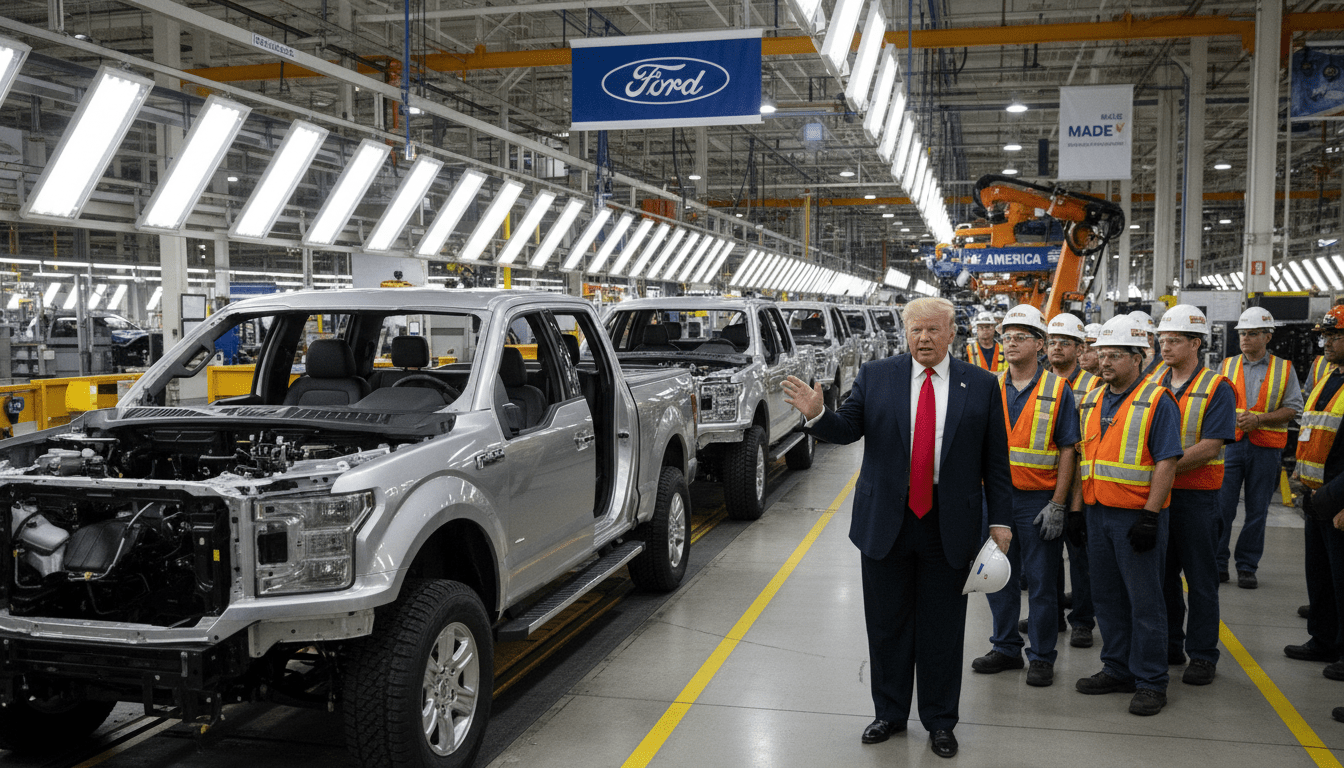
Former President Donald Trump returned to Metro Detroit on Thursday, making a high-profile visit to a manufacturing facility linked to Ford’s truck production before delivering a keynote address focused on the national economy. The visit underscores Michigan’s critical status as a battleground state and highlights the central role the Detroit auto industry plays in the broader national conversation regarding trade, inflation, and manufacturing jobs.
Arriving at the facility early in the afternoon, Trump toured the assembly floor where workers produce components for the Ford F-Series, the best-selling truck in America. The stop served as a visual backdrop for his upcoming remarks at the Detroit Economic Club, where campaign officials stated he would outline a plan to revitalize domestic manufacturing.
Focus on the Auto Industry and Trade
During the tour, the former president stopped to speak with line workers and engineers, inspecting the chassis of a new pickup truck. His interactions focused heavily on the mechanics of the assembly line and the volume of production. While the visit was officially non-political in nature during the plant walk-through, the underlying message was clear: the legacy auto industry remains a priority for his economic platform.
Speaking briefly to reporters on the plant floor, Trump criticized current incentives for electric vehicles (EVs), arguing that the rapid transition mandated by federal regulations threatens traditional automotive jobs in cities like Detroit. "We want to build cars that people want to buy, and we want to build them right here in Michigan, not ship those jobs overseas," Trump remarked, referencing the United States-Mexico-Canada Agreement (USMCA) signed during his tenure.
According to transcripts from his subsequent address scheduled for the Detroit Economic Club, the former president’s platform centers on imposing stricter tariffs on foreign automakers and rolling back Environmental Protection Agency (EPA) emissions standards that push for EV adoption. This approach stands in contrast to the current administration’s heavy investment in battery plants and green energy infrastructure.
Impact on Detroit Residents and Workers
For the residents of Detroit and the surrounding suburbs, the debate over the future of the auto industry is not abstract political theory—it is a matter of livelihood. The transition to electric vehicles has created anxiety among workers in traditional powertrain facilities, who fear their skills may become obsolete or that EV production requires fewer labor hours.
Local labor leaders have expressed mixed reactions to the shifting political landscape. While the United Auto Workers (UAW) leadership has historically aligned with Democratic policies, rank-and-file members in Macomb and Wayne counties often gravitate toward populist economic messages. By visiting a truck plant—a symbol of traditional American manufacturing might—Trump is directly appealing to these voters.
James O’Malley, a shift supervisor at a nearby Tier 1 supplier, noted the uncertainty many workers feel. "We see the headlines about battery plants opening, but we also see layoffs in engine plants. Anyone coming to Detroit needs to explain how we keep our jobs during this transition," O’Malley said. For Detroiters, the visit highlights the high stakes of federal industrial policy: it determines not just the price of cars, but the stability of neighborhoods built on automotive wages.
Background & Data: The State of Manufacturing
Data from the U.S. Bureau of Labor Statistics (BLS) indicates that while manufacturing employment in the Detroit-Warren-Dearborn area has stabilized post-pandemic, it has not returned to the peaks seen two decades ago. The sector remains sensitive to interest rates and consumer demand.
Furthermore, inflation continues to impact the purchasing power of local residents. Recent reports show that the cost of new vehicles has risen significantly, putting new trucks out of reach for many working-class families. This economic pressure point is a key target for the Trump campaign’s messaging in the region.
Automotive analysts suggest that the industry is at a crossroads. "The Detroit Three are balancing massive capital investments in EVs with the need to profit from internal combustion engine trucks," noted a recent market analysis. "Any change in federal regulatory environment will have immediate financial implications for Ford, GM, and Stellantis."
For more on how local businesses are coping with these shifts, read our coverage on Detroit small business manufacturing trends and the impact of industrial development on local neighborhoods.
What Happens Next
Following the plant tour and his speech at the Detroit Economic Club, Trump is expected to hold a rally in the suburbs, further cementing his focus on the "blue wall" states. Political strategists anticipate that Michigan will see frequent visits from both campaigns as the election draws nearer.
For Detroit, the attention brings both opportunity and scrutiny. As the city continues its own economic recovery, the policies debated on the national stage today will shape the region’s industrial footprint for the next decade. Whether through tariffs or tax incentives, the path forward for the Motor City remains a focal point of the national economic debate.