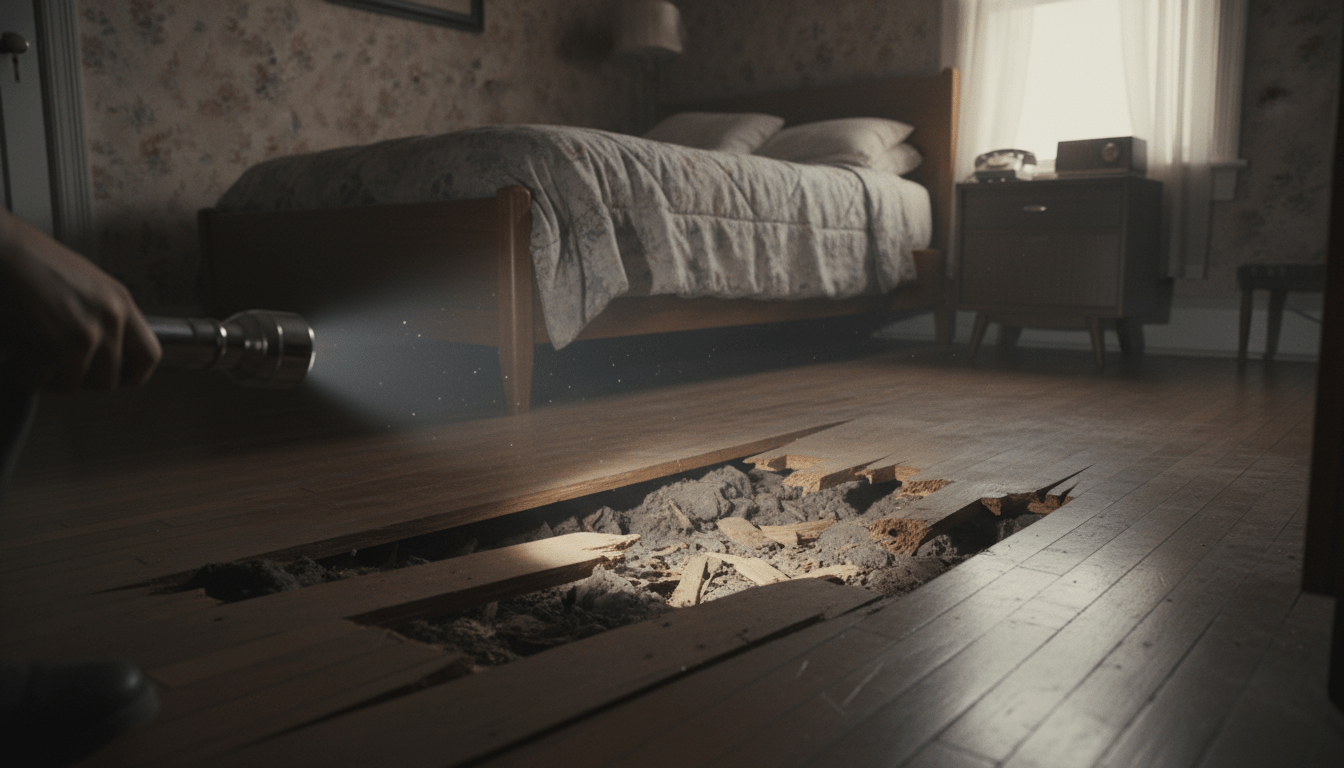
For nearly three weeks, seven-year-old Leo Sanders refused to step foot inside his second-floor bedroom in his family’s historic Green Acres home. Dismissing it initially as a phase of childhood anxiety or night terrors, his parents, Marcus and Elena Sanders, tried everything from nightlights to therapy sessions to coax him back. However, a persistent, faint scratching sound finally prompted the parents to investigate further, leading to a startling discovery that has highlighted a growing issue for owners of Detroit’s aging housing stock.
After moving the furniture and prying up a loose section of the original 1930s hardwood flooring beneath the child’s bed, the couple discovered a massive, active raccoon den nesting within a rotted section of the subfloor, adjacent to exposed wiring. The bedroom mystery, which began as a source of frustration for the family, quickly turned into a significant home safety incident that required immediate intervention from local animal control and structural engineers.
From Child Fear to Home Incident: A Warning for Homeowners
What the Sanders family experienced is becoming an increasingly common scenario in Detroit neighborhoods known for their beautiful but aging architecture. According to data from the City of Detroit Buildings, Safety Engineering, and Environmental Department (BSEED), reports of wildlife intrusion and structural deterioration in residential properties have seen a slight uptick as the city’s housing market continues its rehabilitation boom.
“We thought Leo was just having nightmares or acting out,” said Elena Sanders, a local school teacher. “He kept saying there was a monster scratching under his bed. We feel terrible for not believing him sooner. When we finally looked, we realized the ‘monster’ was a mother raccoon that had entered through a compromised vent in the attic and burrowed down into the floor joists.”
While the incident ended without physical injury to the child, the family discovery revealed significant damage. The animals had chewed through insulation and frayed electrical wiring, creating a severe fire hazard. Local contractors estimate the repairs will cost upwards of $15,000, a burden that many Detroit homeowners face when hidden secrets behind the walls of historic homes come to light.
The Hidden Dangers in Detroit’s Historic Housing
Detroit’s housing stock is among the oldest in the nation, with a significant portion of homes built before 1940. While these structures are prized for their character and craftsmanship, they often harbor deferred maintenance issues that can turn into safety hazards.
Michael Trent, a certified home inspector based in Midtown, explained that what happened to the Sanders family is a textbook example of how small maintenance oversights can spiral.
“In neighborhoods like the University District, Boston-Edison, and Green Acres, you have solid brick homes, but the soffits, fascia boards, and crawl spaces often have decades of wear,” Trent said. “A gap the size of a baseball is enough for a raccoon to enter. Once they are in, they can compromise the structural integrity of a room very quickly. The child’s fear, in this case, was a biological warning system.”
Trent noted that wildlife intrusion is often a symptom of broader structural decay, such as water damage softening the wood, making it easier for animals to claw through.
Impact on Detroit Residents and Families
This home incident serves as a critical reminder for Detroit residents to listen to their home’s cues—and their children. For families renovating older properties, the costs of rectifying these “hidden secrets” can be prohibitive.
According to the Detroit Housing Network, unexpected repair costs are a leading cause of financial strain for first-time homeowners in the city. The Sanders family is now navigating the complex process of insurance claims, as standard homeowner policies often have specific exclusions for damage caused by vermin or pests.
“Many residents don’t realize that standard insurance might cover the fire hazard (the wiring) but not the removal of the animals or the replacement of the rotted wood they chewed through,” explained local insurance adjuster Sarah Jenkins. “It’s a gap in coverage that catches many Detroiters off guard.”
For more on navigating local property issues, readers can view our report on Detroit Property Tax Assessments and Home Value Trends.
Recognizing the Signs
Experts advise Detroit homeowners to perform seasonal inspections of their property’s exterior, looking specifically for:
- Loose or rotting soffit vents.
- Gaps around chimney flashing.
- Overhanging tree branches that provide roof access to wildlife.
- Unusual sounds or smells, particularly in the evening hours.
The Sanders family hopes their story will encourage others to take “irrational” fears seriously. “If we had checked under the bed two weeks earlier, the damage would have been half as bad,” Marcus Sanders admitted.
What Happens Next
The Sanders family has temporarily relocated to a relative’s home in Ferndale while the biohazard cleanup and rewiring take place. The incident has prompted a neighborhood-wide discussion in Green Acres regarding pest control and property maintenance.
The City of Detroit urges residents who suspect code violations or safety hazards in their own homes or rental properties to contact the relevant city departments for guidance on inspections and safety resources.
For further reading on maintaining historic properties in the city, see our feature on Grants Available for Historic Home Restoration in Detroit.