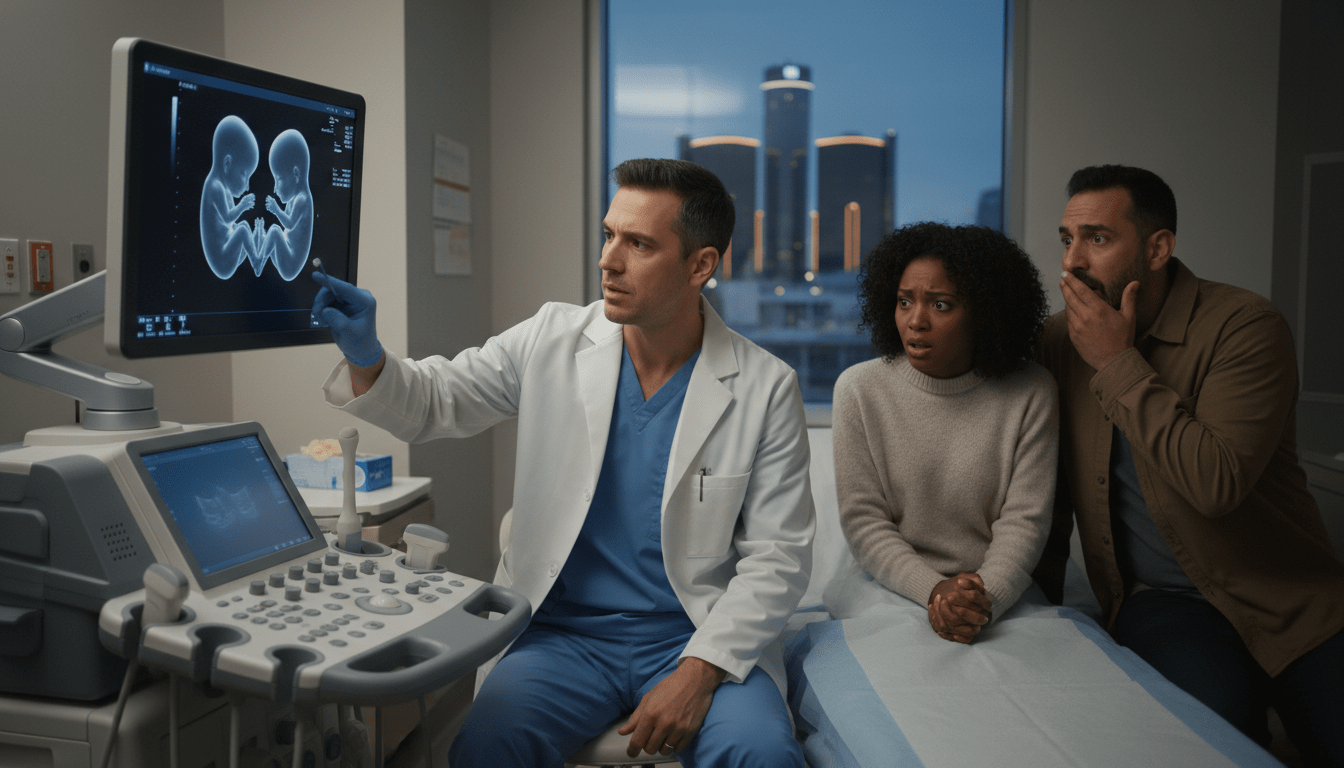
For one Detroit couple, a standard prenatal checkup at the Detroit Medical Center (DMC) turned into a medical drama that highlights both the fragility of life and the advanced capabilities of Detroit’s healthcare system. What began as a routine 20-week anatomy scan quickly escalated when a vigilant sonographer and attending physician noticed something unusual on the monitor—a discrepancy that would leave the expectant family shocked and thrust them into a high-stakes medical journey.
The discovery, identified as a rare presentation of Twin-to-Twin Transfusion Syndrome (TTTS), serves as a potent reminder of the importance of specialized prenatal care in Detroit, a city where maternal and infant health remains a critical priority for local officials and health organizations.
The Ultrasound Discovery That Changed Everything
The incident occurred earlier this month at the DMC Hutzel Women’s Hospital, a facility renowned for handling high-risk pregnancies. According to hospital sources familiar with the case, the ultrasound initially appeared normal. However, the attending maternal-fetal medicine specialist noticed a subtle but strange fluid imbalance between the two amniotic sacs.
“It is a classic case of a medical mystery hiding in plain sight,” explained a specialist in high-risk obstetrics. “On the screen, one twin appeared to be ‘stuck’ against the uterine wall due to low fluid, while the other was overwhelmed with too much fluid. To an untrained eye, it just looks like babies moving, but to a doctor, it signals a life-threatening emergency.”
The condition, known as Twin-to-Twin Transfusion Syndrome, occurs in identical twins who share a placenta. Abnormal blood vessel connections form in the placenta and allow blood to flow unevenly between the babies. One twin donates blood to the other, risking heart failure for one and severe anemia for the other.
The family, residents of Detroit’s Bagley neighborhood, were reportedly left shocked by the sudden diagnosis. Just moments before, they had been debating baby names; suddenly, they were discussing emergency laser surgery to sever the connecting vessels.
Impact on Detroit Residents and Healthcare Access
This story resonates deeply in Detroit, a city that has been battling high infant mortality rates for decades. Access to the kind of advanced ultrasound technology that caught this anomaly is not equitable across all neighborhoods, though strides are being made.
According to the City of Detroit Health Department, early and consistent prenatal care is the single most effective factor in preventing adverse birth outcomes. Stories like this underscore why initiatives like ‘Make Your Date Detroit’—a program designed to reduce preterm birth—are vital for the community. When local hospitals are equipped with top-tier diagnostic tools, anomalies like TTTS can be caught before they become tragedies.
“For Detroit families, knowing that world-class fetal surgery is available right here in the city is a game changer,” said a local community health advocate. “Twenty years ago, a diagnosis like this might have required travel to Cincinnati or Philadelphia. Now, Detroit institutions are performing these life-saving interventions.”
Background: The Science Behind the Shock
Medical mysteries in the womb are becoming less enigmatic thanks to high-resolution ultrasound technology. Data from the National Institutes of Health (NIH) suggests that TTTS affects about 10 to 15 percent of monochorionic (shared placenta) twin pregnancies. Without treatment, the survival rate for both twins is grim—often less than 15 percent.
In this specific Detroit case, the medical team moved quickly. The family underwent a fetoscopic laser photocoagulation procedure, a minimally invasive surgery performed while the babies were still in the womb. Surgeons used a laser to seal the abnormal blood vessels, effectively disconnecting the twins’ shared blood supply and giving each a fighting chance.
Statistics from the Michigan Department of Health and Human Services (MDHHS) show that while Michigan’s infant mortality rate has seen fluctuations, specialized interventions in urban centers like Detroit are crucial for improving numbers. The ability to detect anomalies at the 20-week scan is often the dividing line between life and death.
What Happens Next
Following the successful intervention, the Detroit mother is reportedly in stable condition and is being monitored closely for the remainder of her pregnancy. Doctors expect the twins to be delivered via Caesarean section in the coming weeks, likely premature but with a strong prognosis for survival.
For the broader Detroit community, this event serves as a testament to the critical nature of routine screenings. Local health officials continue to urge expecting mothers to adhere to prenatal schedules, noting that “routine” appointments are often where the most significant discoveries are made.
As medical technology within Detroit’s hospital systems continues to advance, the hope is that more “medical mysteries” will have solutions ready and waiting, turning potential family tragedies into stories of survival.