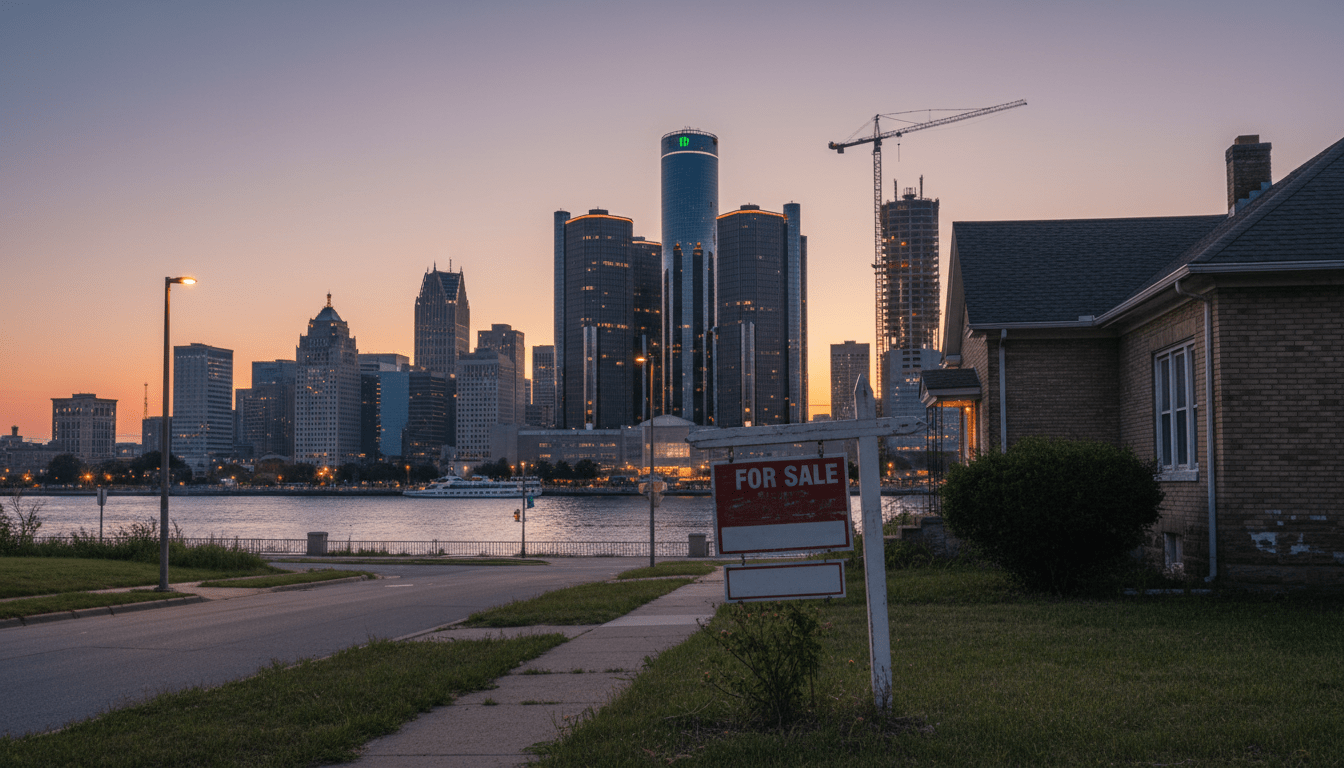
Recent economic data released by the Federal Reserve suggests a prolonged period of high-interest stability, a stance that resonates deeply within the borders of Wayne County. While Wall Street reacts to fluctuations in basis points with high-speed trading, the Michigan impact of federal interest rate shifts is felt most acutely at the closing tables of Detroit bungalows and in the boardroom meetings of developers planning the city’s next skyscraper. For a city in the midst of a fragile but steady economic revitalization, these national monetary policies are more than just statistics—they are the gatekeepers of local growth.
Federal Policy and the Detroit Housing Market
As the Federal Open Market Committee (FOMC) maintains its current stance on the federal funds rate, prospective homebuyers in Detroit neighborhoods like Bagley, East English Village, and Grandmont Rosedale face a dual challenge. According to data from the U.S. Census Bureau, Detroit has seen a notable uptick in homeownership initiatives over the last five years; however, rising borrowing costs are beginning to cool that momentum. The Michigan impact of federal interest rate shifts is particularly visible in the city’s unique real estate landscape, where appraisal gaps have long been a hurdle.
Local real estate analysts suggest that when interest rates remain elevated, the “lock-in effect” takes hold. Current homeowners who secured mortgages at 3% or 4% are hesitant to list their properties, knowing that a new purchase would require a mortgage closer to 7%. This lack of inventory drives up prices even as demand nominally cools, making it increasingly difficult for first-time buyers in the city to enter the market. To understand how these dynamics are playing out locally, residents often look toward the latest Detroit housing market forecast for neighborhood-specific data.
Commercial Development and the Cost of Capital
Beyond residential concerns, Detroit’s skyline is also at the mercy of national monetary policy. The city is currently witnessing several multi-billion dollar projects, including the Hudson’s Site development and the ongoing expansion of the Michigan Central Innovation District. These projects rely on complex financing structures that are highly sensitive to interest rate fluctuations. According to reports from the Detroit Economic Growth Corporation (DEGC), the cost of capital is a primary factor in determining the timeline for secondary phases of neighborhood revitalization.
When interest rates rise, the pro-forma financial statements for new construction often require adjustments. This can lead to delays in groundbreaking or a shift in the scope of projects, moving away from affordable housing units toward high-end luxury spaces to recoup investment costs. The Michigan impact of federal interest rate shifts means that city officials must work harder to provide local incentives, such as tax abatements and brownfield credits, to offset the increased cost of private borrowing.
Data Insights from the University of Michigan
Economic forecasting for the region provides a clearer picture of what to expect in the coming quarters. The Research Seminar in Quantitative Economics (RSQE) at the University of Michigan recently noted that while the state’s economy remains resilient, the manufacturing sector—which is the backbone of the Detroit metro area—is sensitive to the cost of equipment financing. High rates discourage small-to-medium-sized automotive suppliers from investing in new technology or expanding their workforces.
The RSQE analysts pointed out that while inflation has shown signs of cooling, the Federal Reserve’s commitment to its 2% target means that Michigan residents should not expect significant rate cuts in the immediate future. This “higher for longer” environment requires a strategic pivot for Detroit-based businesses, emphasizing operational efficiency over debt-funded expansion.
How This Impacts Local Residents
For the average Detroiter, the Michigan impact of federal interest rate shifts translates to higher monthly payments on everything from car loans to credit card debt. In a city where the median household income is still recovering toward pre-recession levels, even a 1% shift in interest can mean the difference between financial stability and debt accumulation. However, there is a silver lining: higher interest rates have led to increased yields on savings accounts and certificates of deposit (CDs), providing some benefit to residents who have established savings.
Community organizations are stepping in to provide financial literacy and down-payment assistance programs to help bridge the gap created by high rates. These localized efforts are essential for maintaining the momentum of neighborhood investment updates that have been the hallmark of Detroit’s recent progress. By focusing on grant-based funding and community land trusts, local leaders are attempting to insulate Detroiters from the volatility of national fiscal policy.
What Happens Next?
The future of Detroit’s economic landscape will depend heavily on the Federal Reserve’s next moves in late 2024 and early 2025. Economists will be watching the Consumer Price Index (CPI) and employment data closely. If the national economy shows signs of a significant slowdown, the Fed may be forced to lower rates, which would likely spark a surge in Detroit’s real estate activity and commercial construction.
Until then, the city remains in a state of cautious optimization. Local government agencies continue to monitor the Michigan impact of federal interest rate shifts to ensure that development projects remain viable and that housing stays within reach for long-time residents. As the national narrative unfolds, Detroit’s resilience will be tested by its ability to adapt to a high-cost capital environment without sacrificing the social and economic gains of the last decade.