As 2026 begins, the silhouette of Detroit’s skyline remains familiar, yet the industrial pulse beneath it has fundamentally shifted. Long defined by the roar of the internal combustion engine, the “Motor City” is now undergoing its most significant metamorphosis since the introduction of the moving assembly line. The Detroit EV industry is no longer a pilot project or a niche market; it is the primary engine of the city’s economic and structural evolution.
The Manufacturing Resurgence
The transition to electric mobility has necessitated a massive overhaul of Detroit’s industrial footprint. According to reports from the Michigan Economic Development Corporation (MEDC), the state has secured over $15 billion in private investment related to electric vehicle and battery manufacturing over the last few years. In Detroit proper, this is evidenced by the continued expansion of General Motors’ Factory ZERO and Stellantis’ Mack Assembly Plant, which have become benchmarks for high-tech, zero-emission production.
These facilities represent more than just corporate investment; they are the anchors of a new supply chain. Local parts suppliers that once specialized in mufflers and fuel injectors are pivoting toward battery casings, thermal management systems, and power electronics. This shift has stabilized a manufacturing base that many feared would be left behind by the green energy transition. Unlike the automation scares of previous decades, the 2026 landscape shows a high demand for specialized labor, blending traditional mechanical skills with advanced software and electrical engineering.
Impact on Detroit Residents and Workforce
For the average Detroit resident, the rise of the Detroit EV industry is felt most acutely in the job market and the neighborhood environment. The City of Detroit, through its “Detroit at Work” initiative, has partnered with local community colleges to provide certification programs tailored specifically to EV maintenance and battery technology. This focus on workforce development ensures that the residents of legacy neighborhoods are not excluded from the burgeoning neighborhood development occurring across the city.
Beyond employment, the environmental impact is becoming visible. For decades, neighborhoods adjacent to heavy industrial corridors, such as Southwest Detroit and the North End, have dealt with higher-than-average rates of respiratory issues due to vehicle emissions. As the city’s municipal fleet—including DDOT buses and police cruisers—continues its transition to electric power, local air quality metrics have shown a measurable improvement. Data from the Michigan Department of Environment, Great Lakes, and Energy (EGLE) indicates a downward trend in particulate matter concentrations in urban areas heavily trafficked by commercial delivery vans, which are now predominantly electric.
Infrastructure and the Michigan Central Innovation District
The physical landscape of the city is also adapting. The Michigan Central Innovation District in Corktown has fully matured into a global hub for mobility testing. It is here that the intersection of the Detroit EV industry and autonomous technology is most apparent. The project, led by Ford Motor Company in collaboration with the city and state, has turned the surrounding streets into a “living lab” for wireless inductive charging and vehicle-to-infrastructure (V2I) communication.
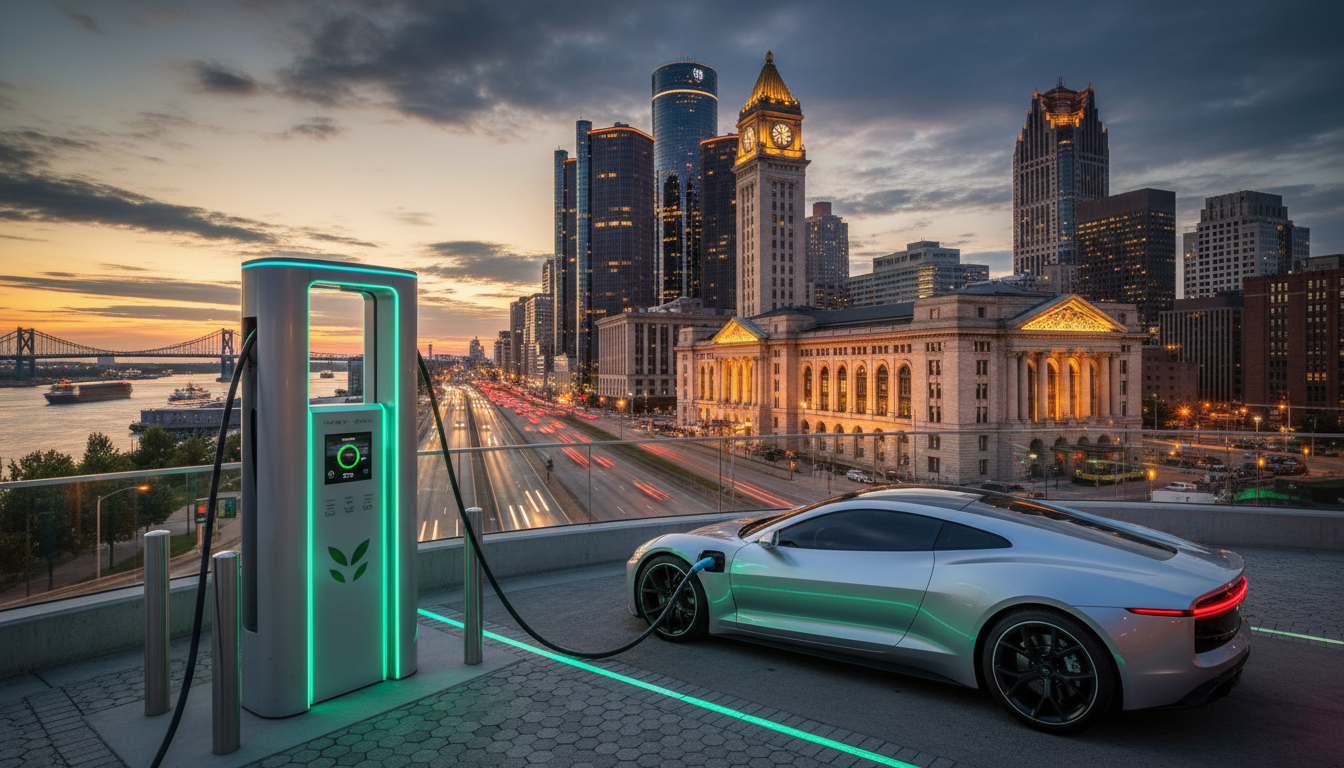
According to the City of Detroit’s Office of Mobility Innovation, the city has successfully installed over 1,200 public charging ports across all seven districts as of early 2026. This expansion was critical in addressing “charging deserts” in lower-income neighborhoods, ensuring that EV ownership is a viable option for all residents, not just those in luxury developments. The city’s strategy has focused on placing chargers in community hubs, such as recreation centers and public libraries, which has fostered a more equitable distribution of technology.
This growth is deeply connected to the broader innovation hub developments that have repurposed historic structures for 21st-century tech needs. The revitalization of these spaces has prevented the urban decay that often followed industrial shifts in the 20th century.
Economic Data and Long-Term Stability
Financial analysts point to the Detroit EV industry as a stabilizing force for the municipal tax base. The shift toward electrification has attracted a new wave of tech-adjacent startups to the city center, diversifying an economy that was once dangerously reliant on a single type of manufacturing. A 2025 study by the University of Michigan’s Economic Forecasting Council noted that for every one direct job created in an EV assembly plant, an estimated 3.8 indirect jobs are supported within the local service and retail sectors.
This economic multiplier is visible in the revitalization of commercial corridors along Woodward and Grand River Avenues, where new small businesses are opening to serve the influx of tech workers and revitalized manufacturing crews. The steady property tax revenue from renovated industrial sites has also allowed the city to maintain a balanced budget while increasing funding for public parks and emergency services.
Challenges and What Happens Next
Despite the progress, challenges remain. The speed of the transition has put immense pressure on the local power grid. DTE Energy has had to accelerate investments in substation upgrades to handle the increased load from residential and commercial charging. Furthermore, while the “green-collar” job market is growing, there is a persistent need for continuous education to prevent a skills gap as battery chemistry and charging protocols evolve.
Looking toward 2030, the city administration remains focused on making Detroit the “Silicon Valley of Mobility.” The goal is to move beyond just assembly and into the research and development of the next generation of solid-state batteries and hydrogen fuel cell integration for heavy trucking. As the world watches the global energy transition, Detroit stands as a case study in how a legacy industrial city can reinvent itself without losing its core identity. The roar of the engine may be fading, but the industrial spirit of Detroit is louder than ever.