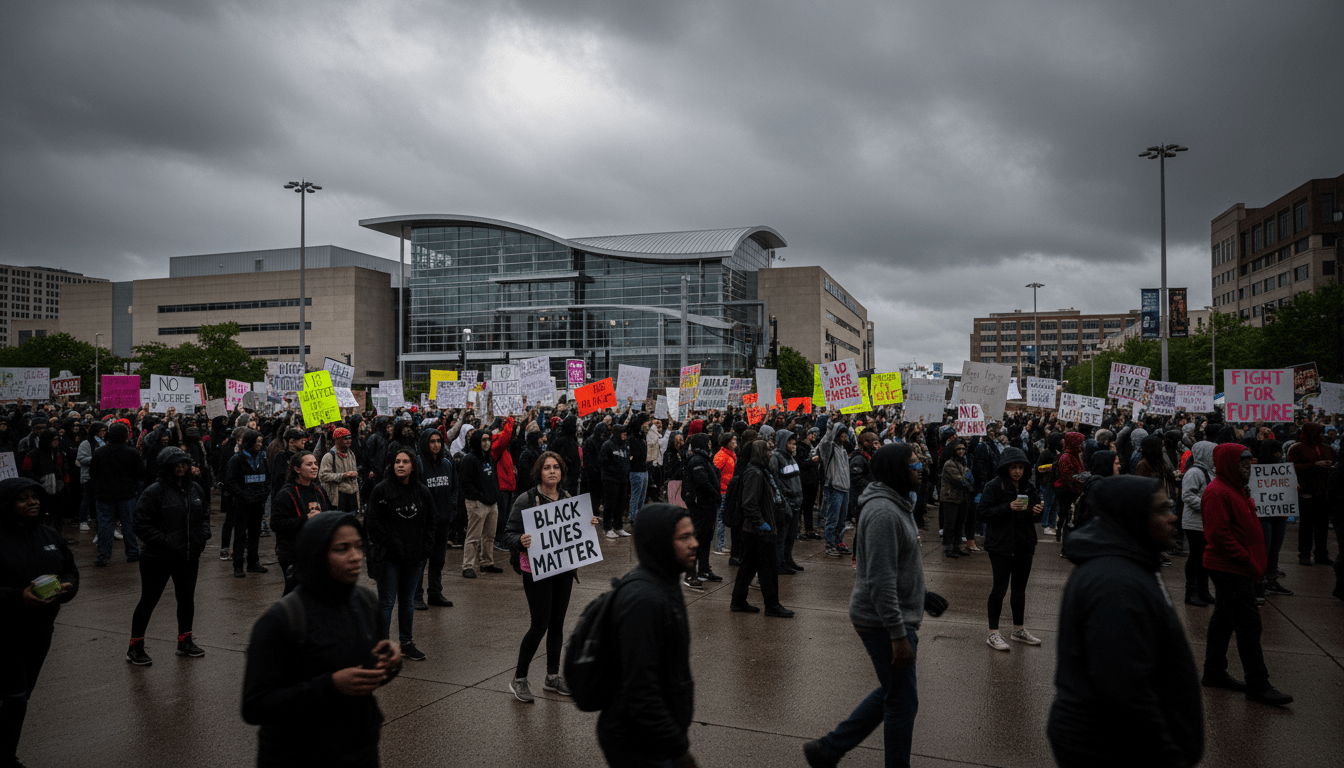
Hundreds of demonstrators filled the streets of downtown Detroit on Thursday, marching in opposition to former President Donald Trump’s campaign visit to the city. The protest, organized by a coalition of local labor unions, civil rights groups, and community activists, highlighted the deep political divide facing the swing state of Michigan ahead of the upcoming election.
While Trump addressed members of the Detroit Economic Club inside the Huntington Place convention center, chants from the street outside echoed off the glass facades of nearby skyscrapers. The demonstrators voiced frustration over the former president’s past rhetoric regarding the city and his economic policies, arguing that his vision for America does not align with the needs of Detroit residents.
The Scene on the Streets
The march began near Grand Circus Park, where a diverse crowd gathered with signs reading “Detroit Against Trump” and “Union Strong.” The atmosphere was tense but peaceful, with a significant law enforcement presence monitoring the situation. According to the Detroit Police Department, officers were deployed to ensure public safety and manage traffic disruptions along the Woodward Avenue corridor.
“We are here to show that Detroit is a city of resilience and inclusion,” said a representative from Michigan Liberation, a local advocacy group involved in the demonstration. “When candidates come here, they need to understand that Detroiters are paying attention to their records, not just their speeches.”
The march proceeded down Washington Boulevard, eventually converging near the entrance of Huntington Place. Participants included auto workers, teachers, and students, reflecting a cross-section of the city’s demographic. The protest coincided with the Detroit Economic Club luncheon, a high-profile event that has historically hosted presidential candidates from both parties.
Political Context and Local Reactions
This Trump visit to Detroit comes at a critical time. Michigan remains a pivotal battleground state, and both parties are aggressively courting voters in Wayne County. However, Trump’s relationship with the city has been complicated. In previous speeches, he has often used Detroit as a cautionary tale of urban decline, a characterization that local leaders and residents have fiercely rejected.
Inside the convention center, Trump focused his remarks on trade policies and manufacturing, attempting to appeal to the region’s blue-collar base. He promised to revitalize the domestic auto industry, a message aimed squarely at voters concerned about the transition to electric vehicles. However, those outside the venue offered a sharp counter-narrative.
“He talks about saving jobs, but his track record says otherwise,” said Marcus Davis, a retired auto worker participating in the march. “We remember the plant closures. We need real support for labor, not just campaign promises made during a quick stopover.”
For more on the city’s political landscape, read our analysis on Detroit voter turnout trends.
Impact on Detroit Residents
For everyday Detroiters, the visit brought logistical challenges customary with high-profile political events. Several major intersections in the downtown core were closed for hours to accommodate the motorcade and security perimeter. The QLINE streetcar service experienced temporary suspensions, affecting commuters relying on public transit to get to work.
Local business owners reported mixed feelings about the event. While some restaurants near the convention center saw a lunchtime bump from attendees, others reported that the road closures and protests kept regular customers away.
“It’s a double-edged sword,” said the manager of a cafe on Congress Street. “You get the excitement and the media attention on Detroit, but you also get the barricades and the gridlock. It disrupts the flow of the workday for locals trying to earn a living.”
Data and Demographics
Understanding the significance of this protest requires looking at the data. According to recent census data, Detroit is overwhelmingly Democratic, yet the margins in the broader state of Michigan are razor-thin. In the 2020 election, high turnout in Detroit was instrumental in flipping the state blue. Consequently, any Trump visit to Detroit is viewed strategically not necessarily to win the city, but to chip away at margins or dampen enthusiasm among opposition voters.
However, recent polling suggests that economic anxiety is high across all demographics. Inflation and housing costs remain top concerns. Protesters argued that the former president’s tax proposals would disproportionately benefit the wealthy rather than the working-class families of Detroit.
For further reading on local economic conditions, see our report on Detroit’s evolving housing market.
What Happens Next
As the election cycle heats up, Detroit can expect more visits from high-profile surrogates and candidates. The Trump visit to Detroit serves as a reminder that the city is ground zero for the national political debate. Organizers of the march have vowed to continue their mobilization efforts, planning further rallies and voter registration drives leading up to November.
Local officials are also preparing for increased activity. The City of Detroit has indicated it is reviewing security protocols to balance the right to protest with the need to maintain public order during future high-stakes visits. As the crowds dispersed late Thursday afternoon, the message left behind was clear: Detroit intends to be heard, not just spoken to.