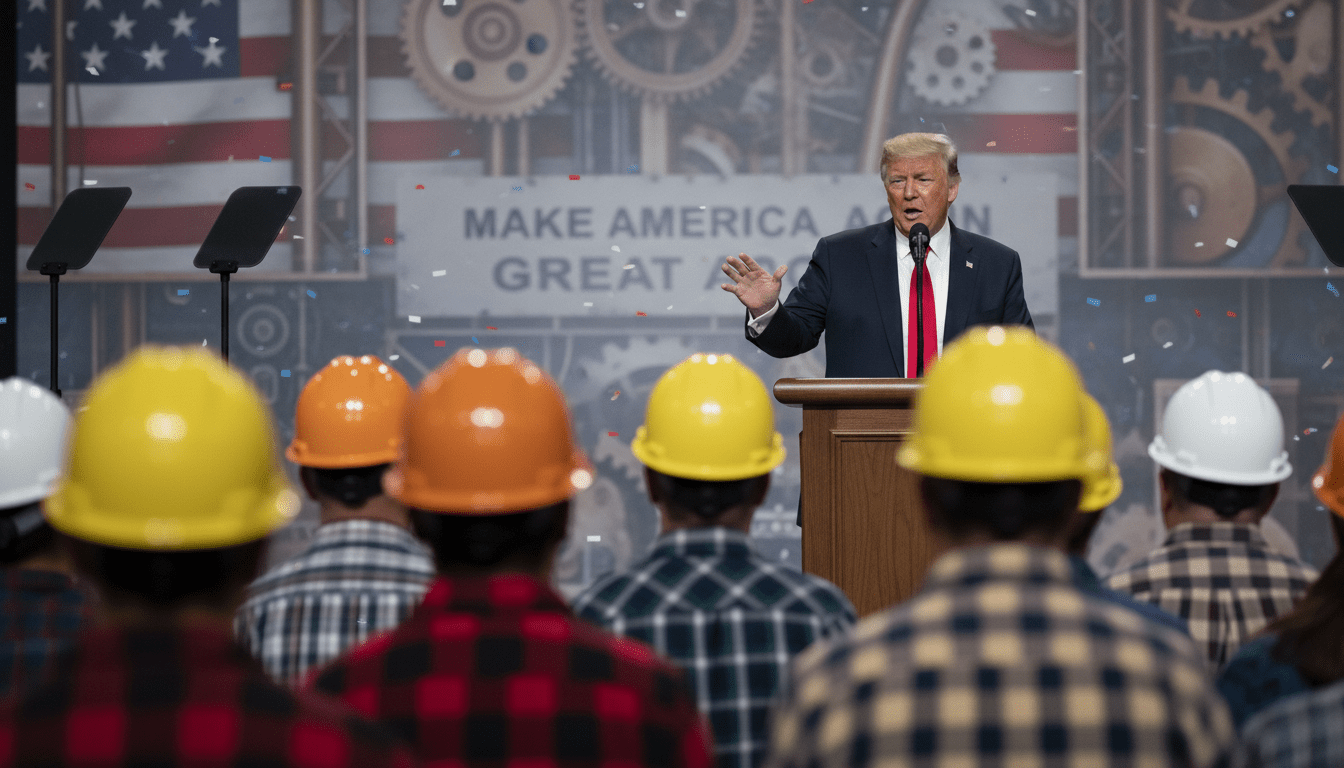
Former President Donald Trump returned to the Motor City this week, delivering a speech centered heavily on the automotive industry, trade protectionism, and what he described as the existential threat posed by the shift toward electric vehicles. Speaking to a crowd that included union members, non-union manufacturing workers, and local business leaders, Trump sought to solidify his standing in Michigan, a critical battleground state for the upcoming election.
The visit comes at a time when Detroit’s economy is navigating complex changes. While the “Big Three” automakers—Ford, General Motors, and Stellantis—continue to invest billions in electric vehicle (EV) infrastructure, anxiety remains high among the workforce regarding job security and wage stability. Trump tapped directly into these fears, arguing that his administration’s policies, specifically the United States-Mexico-Canada Agreement (USMCA), laid the groundwork for manufacturing stability that is now being undermined by current federal mandates.
Focusing on Trade and Tariffs
A central theme of Trump’s address was his track record on trade. He repeatedly reminded the audience of his move to withdraw the United States from the Trans-Pacific Partnership (TPP) and his renegotiation of NAFTA into the USMCA. According to the former president, these moves were essential to stopping the “bleeding” of Detroit jobs to foreign competitors.
“We saved the American auto industry once, and we will do it again,” Trump told the crowd. He claimed that without the protective tariffs he implemented during his term, Chinese automakers would have already flooded the U.S. market with low-cost vehicles, decimating domestic production. He pledged that, if re-elected, he would impose even steeper tariffs on vehicles manufactured in Mexico by Chinese companies, closing what he identified as a backdoor into the American market.
While the USMCA was passed with bipartisan support, its long-term impact is still being debated by economists. However, for many in the audience, the rhetoric resonated. Data from the U.S. Bureau of Labor Statistics indicates that while manufacturing jobs in Michigan have seen fluctuations over the last decade, the sector remains vulnerable to global supply chain shifts.
The EV Mandate Controversy
Perhaps the most charged portion of the event was Trump’s criticism of the Biden administration’s push for electric vehicles. Trump characterized the federal targets for EV adoption not as innovation, but as a “transition to nowhere” that would ultimately cost Michigan workers their livelihoods.
“They want to mandate that you drive cars that don’t work in the cold, don’t go far enough, and are made in China,” Trump asserted, referring to the dominance of China in the global battery supply chain. He argued that electric vehicles require fewer workers to assemble than traditional internal combustion engine vehicles, a point that has been a source of contention in labor negotiations for years.
This messaging aims to drive a wedge between the rank-and-file autoworkers and the United Auto Workers (UAW) leadership. While the UAW leadership has endorsed the current administration, citing pro-labor policies, Trump is betting that individual workers are more concerned with the immediate disruption caused by plant retooling and the phasing out of gas-powered models.
Impact on Detroit Residents
For the average Detroit resident, the stakes of these political battles are personal. The automotive industry is not just a line item in the GDP; it is the lifeblood of the local economy. When auto plants catch a cold, local restaurants, service providers, and Detroit real estate markets get pneumonia.
“It’s confusing for a lot of us,” said Marcus Thorne, a shift leader at a parts supplier in Warren who attended the rally. “We hear from the union that the green transition will bring new jobs, but then we see plants idling. When Trump says he’ll just stop the mandates, it sounds like job security to a lot of guys on the line, even if we don’t agree with everything he says.”
The uncertainty regarding the transition to EVs is palpable in Detroit neighborhoods. Residents are worried that if the domestic automakers fail to compete globally with EVs, Detroit could lose market share. Conversely, if they transition too fast and consumers don’t buy the cars, the result is the same. Trump’s visit highlighted this catch-22, offering a return to traditional manufacturing prioritization as the solution.
Background & Data on Michigan Manufacturing
To understand the weight of Trump’s claims, it is necessary to look at the numbers. Michigan lost approximately 280,000 manufacturing jobs between 2000 and 2010. While there has been a recovery since the Great Recession, the state has never fully returned to its peak employment numbers. During the Trump presidency (pre-pandemic), manufacturing jobs in Michigan grew initially but flattened out by 2019 due to trade wars raising the cost of steel and aluminum.
Current data suggests a mixed picture. Investment in battery plants has brought billions of dollars to the state, yet these facilities often pay lower starting wages than traditional assembly plants, a discrepancy the UAW fought to rectify in their most recent contract negotiations. Furthermore, local infrastructure projects are struggling to keep pace with the energy demands of a fully electrified fleet.
Local policy experts suggest that while tariffs can provide temporary relief, the structural changes in the industry are inevitable. “The global market is moving toward electrification regardless of U.S. policy,” noted Dr. Sarah Jenkins, an economic analyst at a Detroit-based think tank. “The challenge for Detroit is ensuring we lead that innovation rather than trying to hold back the tide. However, the anxiety regarding job losses during the transition is supported by historical data regarding industrial shifts.”
What Happens Next?
As the election cycle heats up, Detroit can expect to remain in the crosshairs of national politics. Trump’s visit signals that his campaign believes the path to the White House runs through Michigan’s factory floors. His strategy relies on convincing voters that the current economic pain—inflation and high interest rates—combined with the uncertainty of the EV transition, warrants a change in leadership.
For Detroiters, the coming months will likely bring more visits, more promises, and more scrutiny of the auto industry. Whether the former president’s message of economic nationalism outweighs the current administration’s investments in future technology remains to be seen at the ballot box. But for now, the debate over the future of the American car—and who builds it—is louder than ever.