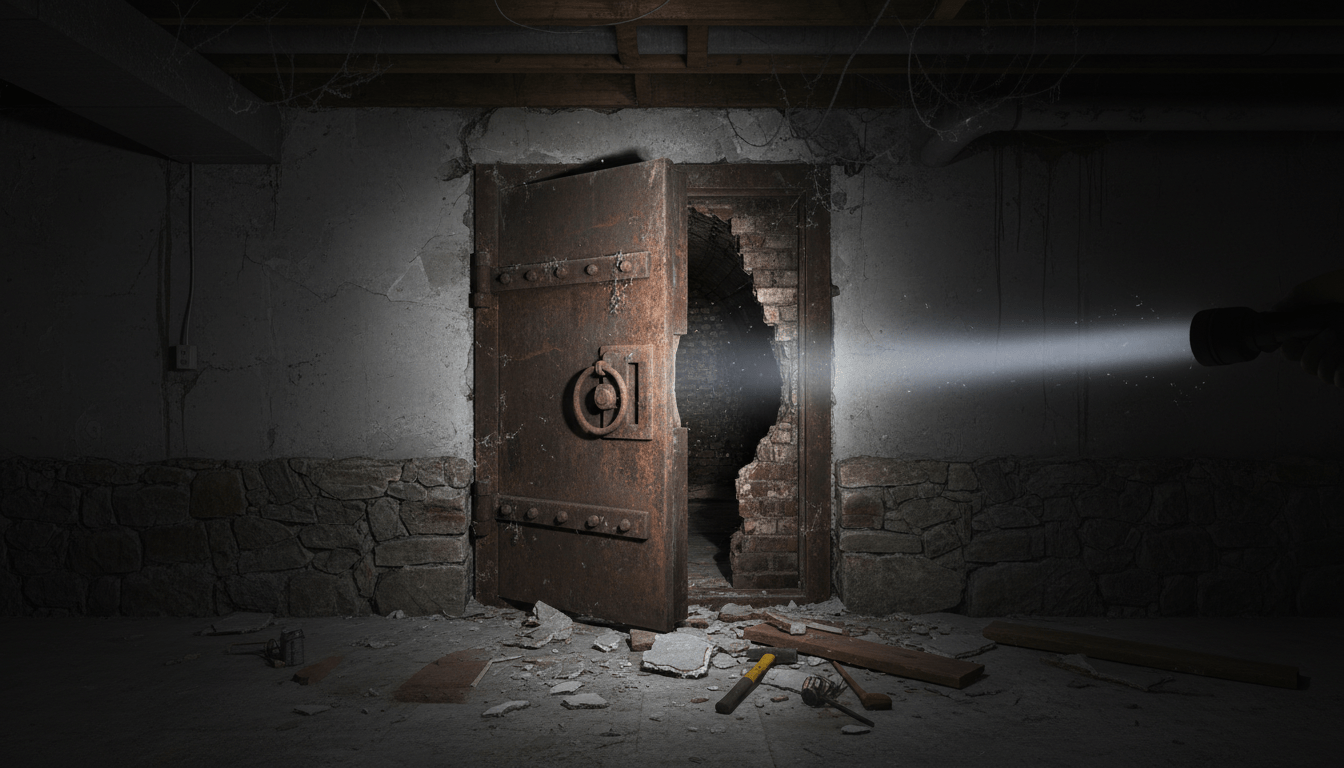
For Mark and Sarah Jennings, the purchase of a dilapidated property on the outskirts of Detroit’s historic Indian Village was meant to be a labor of love. The structure, originally constructed in the late 19th century as a farmhouse before the city expanded around it, required extensive structural work. However, what began as a routine foundation repair last Tuesday evolved into a significant historical find when contractors unearthed a hidden door behind a false wall, revealing a dark secret dating back to Detroit’s Prohibition era.
The basement discovery has since halted construction, drawing attention from local historians and city inspectors who believe the find offers a rare, undisturbed glimpse into the city’s complex past involving the notorious Purple Gang and the rum-running trade.
The Discovery Behind the False Wall
According to the homeowners, the discovery occurred while contractors were attempting to mitigate water damage in the lower level of the home. The house, often described by neighbors as an "old farmhouse" due to its architectural distinction from the surrounding 1920s brick manors, had a basement layout that did not match the original blueprints filed with the city.
"We noticed a discrepancy between the interior measurements and the exterior foundation," said Mark Jennings, a structural engineer. "There was a gap of about four feet unaccounted for. When we removed the rotting wood paneling in the southeast corner, we found a reinforced steel door that had been painted over to match the brickwork."
Upon prying the rusted mechanism open, the couple discovered a windowless, concrete-lined room measuring approximately 6 by 8 feet. Inside, the space contained not only remnants of wooden crates stamped with Canadian distillery markings but also ledgers dating back to 1928. More chillingly, the room featured heavy iron shackles mounted to the wall, suggesting the space was utilized for purposes darker than simple storage.
Historical Context: Detroit’s Dark Secret
To understand the significance of this basement discovery, it is essential to look at Detroit’s history as the epicenter of American alcohol smuggling during the 1920s. According to the Detroit Historical Society, the Detroit River was the conduit for up to 75% of the illegal liquor entering the United States during Prohibition.
Dr. Alan Thorne, a historian specializing in Michigan’s criminal history, visited the site shortly after the discovery was reported. "This isn’t just a root cellar," Thorne explained. "The construction of the hidden door and the reinforcement of the room suggest it was used as a holding cell or a secure drop-point. The presence of restraints indicates that this specific location may have been used by the Purple Gang for kidnapping or extortion, which was a common pivot for the gang when rum-running profits became volatile."
The "old farmhouse" aesthetic of the home likely served as the perfect camouflage. In the 1920s, properties that looked unassuming or agricultural were often used to hide illicit operations from federal agents. The juxtaposition of a quiet family home and a fortified detention room highlights the duality of life in Detroit during the Roaring Twenties.
Impact on Local Real Estate and Preservation
This discovery raises important questions for Detroit’s booming renovation market. As investment pours into neighborhoods like Corktown, Boston-Edison, and the Villages, new homeowners are frequently encountering remnants of the past. However, few finds are as grim or as historically significant as the Jennings’ basement discovery.
According to data from the City of Detroit’s Planning and Development Department, permits for residential renovations have increased by 14% year-over-year. With this surge comes the responsibility of documenting history. The City has specific guidelines regarding the preservation of historical structures, but interiors—specifically basements—are often unregulated zones where history is easily erased by drywall and modern flooring.
"When residents find artifacts or structural anomalies like this, it is crucial they contact the Historic District Commission before demolishing them," said a representative from the City of Detroit. "These elements tell the story of our city just as much as the facades do."
For more on how local zoning affects renovation projects, read our coverage on Detroit zoning law updates and the rising trends in historic home property values.
Community Reaction and Safety Concerns
The revelation of the hidden door and the room’s contents has unsettled some residents in the neighborhood, dispelling the romanticized notion of the "mystery home" often portrayed in fiction. Instead, it serves as a stark reminder of the violence associated with organized crime in the early 20th century.
"It’s fascinating but also deeply disturbing," said Clara Evans, a long-time resident of the neighborhood. "You walk past these houses every day thinking about the architecture, not thinking about what might have happened in the basement eighty years ago."
Local law enforcement was briefly notified to ensure no active threats or human remains were present. Following a preliminary scan, the site was cleared, though the "dark secret" of the room’s function remains a topic of heavy speculation.
What Happens Next for the Homeowners?
The Jennings family now faces a dilemma common to owners of historic properties: preservation versus modernization. While the initial plan was to convert the basement into a modern entertainment space, the couple is now considering preserving the hidden room as a historical feature.
"We can’t just drywall over it now that we know what it is," Sarah Jennings noted. "It’s a part of Detroit’s history, even if it is a dark chapter. We are working with the historical society to see if the ledgers can be archived and preserved."
As Detroit continues its revitalization, stories like this serve as a testament to the layers of history buried beneath the city’s streets. The transformation of an old farmhouse into a crime scene, and finally into a family home, mirrors the resilience and evolution of Detroit itself.