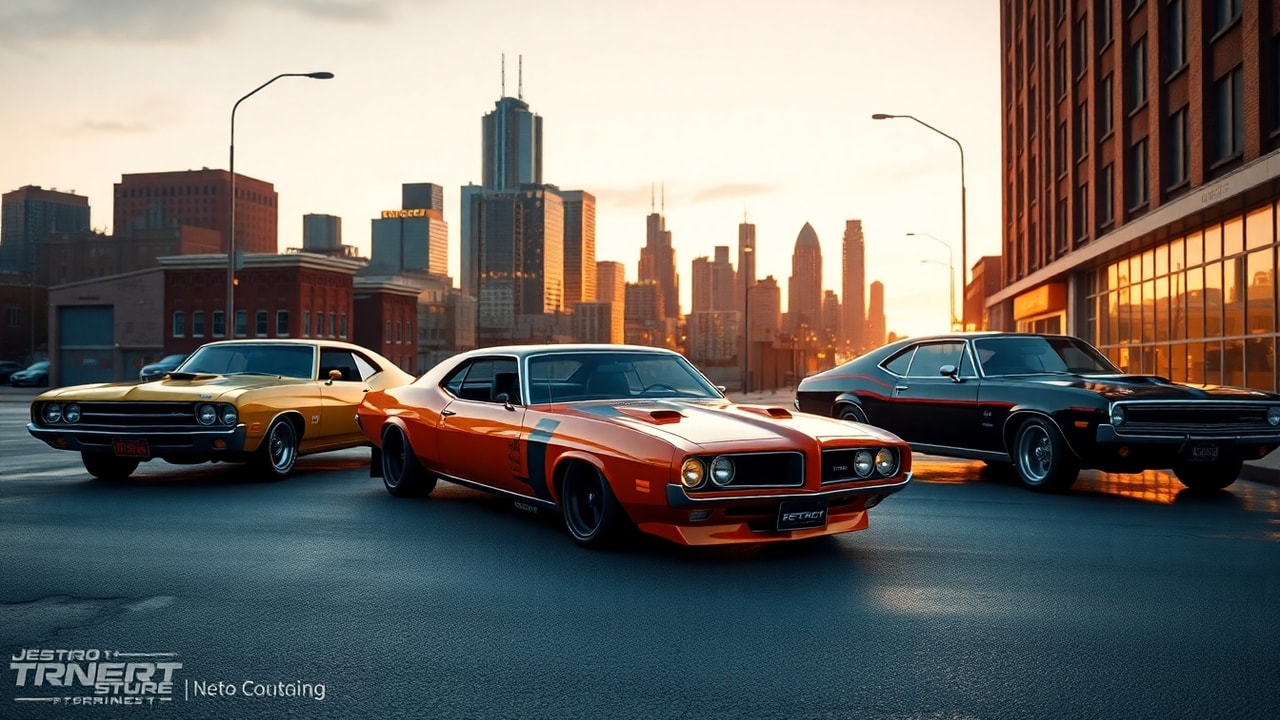
Detroit’s romance with torque has never been just about the chrome. As automakers plan their 2026 lineups, the city’s golden-age muscle cars—and the Detroit identity they helped build—are increasingly showing up in design themes, marketing language, and even enthusiast conversations about what “real” performance should feel like. The question Detroit residents are asking isn’t whether the industry can make fast cars in 2026; it’s whether it can do it with the same emotional punch that once defined Detroit muscle cars.
While the newest vehicles will be judged against the fastest quarter-mile times and the cleanest test-cycle emissions, Detroit’s street-level nostalgia car culture is steering attention toward one constant: the V8 heritage of an era when horsepower felt like a local dialect. That cultural pressure is landing in a surprisingly practical place—how Detroit’s auto supply chain, dealerships, and community events frame the transition to modern powertrains.
When “Classic American horsepower” becomes a design brief
In 2026, the largest automakers are expected to continue rolling out electrification and advanced engine tech while meeting tightening emissions standards. But even amid that pivot, the messaging around performance and heritage remains a major asset. “In Detroit, the story of performance is deeply tied to the sound, the feel, and the identity of V8 muscle,” said Mark Safford, director of communications for the Classic Car Club of America in a recent interview. “Heritage branding doesn’t replace engineering—but it shapes what customers believe the engineering is for.”
Detroit’s own auto-history institutions are also watching how the conversation changes. The Walter P. Chrysler Museum and local car clubs routinely hear the same pattern: younger enthusiasts are drawn to golden-age machines first, then learn the technical details. That means the culture doesn’t just survive—it becomes an on-ramp. When people are willing to travel to shows and spend on parts, it creates momentum that can spill into modern buying decisions, including interest in performance trims and “heritage” packages.
For Detroit-based businesses, that can mean more foot traffic and community engagement. For the automakers, it can mean a clearer understanding of how nostalgia influences demand even in a changing powertrain landscape.
10 golden-age muscle cars that still set the emotional bar
Detroit’s place in the golden age of American performance is widely shared across brands, but many residents associate the era with particular combinations: a big-engine silhouette, hard-edged styling, and an expectation that acceleration should feel effortless. That expectation persists today.
Several golden-age muscle cars remain reference points in Detroit-area shows, wrenching circles, and online discussions:
- 1968 Chevrolet Camaro SS (L-78) — often cited for its balance of aggression and everyday drivability.
- 1969 Chevrolet Chevelle SS 396 — a benchmark for classic American horsepower culture.
- 1970 Plymouth Hemi ‘Cuda — an enduring symbol of V8 heritage cars and high-demand builds.
- 1970 Dodge Challenger R/T — remembered for the theatrical presence and straight-line strength.
- 1971 Oldsmobile 442 — a Detroit-connected nameplate that defined a performance mainstream.
- 1970 Ford Mustang Mach 1 — the bridge between pony-car style and muscle-era expectations.
- 1970 Pontiac GTO Judge — styling cues and engine options that still shape “heritage” designs.
- 1967 Buick GS 400 — a reminder that performance didn’t belong only to the best-known badges.
- 1971 Cadillac Eldorado (performance-focused era memory) — proof that the Detroit performance story included luxury platforms too.
- 1970 Pontiac Firebird Trans Am — a track-to-street link Detroit fans still reference when talking about legitimacy.
These cars don’t compete on the same metrics as modern 2026 builds—weight distribution, transmission logic, tire technology, and software all changed dramatically over decades. But they do compete in one way that matters to Detroit residents: they embody a moment when the idea of classic American horsepower felt personal and local.
Impact on Detroit Residents: parts, jobs, and the “why” behind buying
Detroit’s auto economy isn’t only about assembly lines. A substantial web of small businesses—restoration shops, specialty part dealers, fabrication services, and event organizers—depends on ongoing demand for older vehicles. That demand is sustained by the same nostalgia that brings people to golden-age muscle cars in the first place.
“Local car culture has real economic spillover,” said Gretchen Whitmer, program director at the Michigan Small Business Development Center (SBDC), speaking generally about niche manufacturing and service sectors. “When hobbyists spend on parts, labor, and storage, it supports jobs and helps keep specialized skills alive—especially in cities that have a deep automotive identity.”
That spillover matters as 2026 Detroit automakers move forward with new platforms. If consumers feel disconnected from today’s performance offerings, the cultural base weakens. If they feel continuity—through design nods, sound engineering, performance branding, or heritage trim language—then the transition can feel less abrupt.
Residents also feel a broader effect: when heritage culture stays strong, communities invest more in events that bring visitors downtown and into neighborhoods. Car shows and cruises often act as informal civic infrastructure—turning neutral public spaces into gathering points. In that sense, nostalgia car culture Detroit isn’t only a pastime; it’s a social pattern that supports downtown vitality and neighborhood foot traffic.
Background & Data: Detroit’s automotive identity is persistent, even as vehicles change
Modern Detroit is deeply shaped by the auto industry’s employment cycle and supply-chain structure. Nationally, the U.S. Bureau of Labor Statistics has consistently tracked how auto manufacturing employment and related occupations move with production cycles, though the composition of work has evolved over time toward higher-skilled roles in engineering, software, and logistics. On the policy side, emissions and safety requirements continue to drive powertrain changes that will affect what performance means in 2026.
Separately, Detroit’s broader demographic and business environment reflects a long-term shift: consumers increasingly value technology integration and fuel efficiency, not just acceleration. Data from the U.S. Census Bureau helps explain why local buying patterns are changing as households vary in income, vehicle access, and commuting distance. Even without quoting specific local figures, the agency’s national reporting shows that household mobility trends and vehicle ownership rates remain strongly connected to economic conditions and urban planning decisions.
In other words: Detroit’s golden-age muscle cars aren’t about ignoring change—they’re about what people choose to remember while new powertrains arrive.
Why 2026’s performance narrative can’t ignore the past
Even as automakers emphasize new performance metrics, nostalgia affects how customers interpret those metrics. If a 2026 model can deliver acceleration but lacks the drama—sound profile, tactile feedback, or an obvious link to classic designs—buyers may view it as technically impressive but emotionally flat.
According to the Detroit Auto Dealers Association (in recent industry discussions reported by local trade coverage), dealer feedback frequently highlights that heritage-themed packages and performance branding improve customer confidence when shopping in uncertain times. The logic is straightforward: familiar cues reduce perceived risk, especially for buyers comparing new technology against the well-known benchmarks of earlier eras.
This is where the comparison becomes meaningful. A golden-age car may be slower by modern standards, but it’s remembered because the experience matched the expectation. Detroit’s cultural memory acts like a quality rubric—even for people who may never own the cars they admire.
What happens next: from nostalgia to the next generation of Detroit performance
As 2026 Detroit automakers launch more vehicles under new regulatory and technological constraints, the city’s challenge is to preserve that emotional connection while updating what “performance” means. That can show up in several ways residents will likely notice over the next year:
- Heritage cues in modern trims: interior materials, exterior design languages, and badge recognition that echo earlier eras without pretending physics can rewind.
- Sound and feel engineering: performance calibration that prioritizes throttle response and driver feedback, not just speed.
- Community continuity: more partnerships between dealers, museums, and clubs to keep the V8 heritage cars narrative connected to what’s being built today.
- Local business resilience: ongoing demand for restoration services and performance parts that keep Detroit’s automotive skills network active.
Detroit’s golden age may not return as a production era, but its influence can still show up where it counts: in the way people talk about cars, spend money on them, and decide what future performance should feel like.
For residents watching the rollout of 2026 models, the most practical takeaway is this: the comparison isn’t just about horsepower numbers. It’s about whether Detroit’s performance identity—built over decades of engine noise, mechanical simplicity, and street-level pride—continues to translate into the next generation.