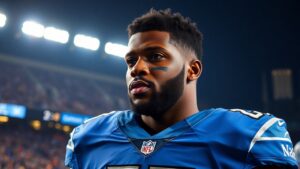
The Detroit Lions have agreed to an NFL draft trade that will send Terrion Arnold to another team in exchange for a Pro Bowl cornerback whose contract is expected to be structured as a $100 million deal, according to league reporting. The move reshapes the Lions’ secondary heading into the offseason and underscores Detroit’s continued focus on upgrading the defense with high-end talent.
The Lions, who have built their roster with an emphasis on speed, coverage versatility and turnover creation, will now pair their defensive backfield around the incoming cornerback’s experience and skill set. Details of the exact pick compensation were not immediately confirmed in a way that can be independently verified from official NFL team announcements, but Detroit’s front office indicated through past offseason messaging that it is willing to make aggressive moves when it identifies a clear positional need.
What the Terrion Arnold trade signals for the Lions
For Lions fans, the headline is straightforward: the Terrion Arnold trade changes the team’s defensive identity in the defensive backfield. Arnold, a young cornerback known for physicality and competitiveness, had been viewed as a developing piece with a long runway. Trading him in a high-value swap suggests the Lions believe the immediate return—top-tier coverage performance at a premium—outweighs the value of continuity at the position.
According to Pro Football Reference, player value and performance often show up most clearly in coverage and snap-based production, and cornerbacks at the Pro Bowl level tend to provide outsized impact in terms of targets allowed and overall defensive efficiency. While those metrics can vary by opponent and scheme, Detroit’s pursuit indicates a desire for a proven presence that can handle increased coverage responsibilities.
Team-building-wise, a Pro Bowl cornerback entering the Lions’ rotation can also affect how the defense is deployed. A high-end outside presence often allows safeties to play with more freedom and can reduce the number of “must-win” situations created by mismatches. For a team seeking to press offenses and limit explosive passing plays, that can translate into more stable second-half defensive stretches—an area teams across the league monitor closely.
Local impact: why a 100 million deal matters in Detroit
While an NFL roster move may feel far removed from everyday life, the financial and operational ripple effects are real in a major sports market like Detroit. Professional teams are major employers and economic drivers, and roster decisions can influence ticket demand, sponsorship value and event-day activity.
According to data from the U.S. Bureau of Economic Analysis (BEA), sports and recreation contribute to broader economic activity through spending on tickets, local hospitality, transportation, and ancillary services. In practice, moves that elevate a team’s perceived competitiveness can shift consumer spending patterns—especially in the weeks surrounding training camp and the season opener.
Detroit also has a history of sports franchises acting as anchors for downtown commerce. Research on how major events affect local spending typically finds increases in visitor traffic and revenue for restaurants and retailers during peak demand periods. A headline signing and a major personnel change can therefore matter for small businesses near event locations, where game-day foot traffic can be substantial.
For residents, the more immediate connection may be how public-facing team activity and fan engagement change. Detroit news NFL coverage frequently shows that roster moves prompt shifts in merchandise demand, watch-party culture and travel plans—particularly for fans coordinating trips from across Michigan and nearby states.
100 million deal context: what’s typical in the modern NFL
To understand the significance of a 100 million deal, it helps to look at how NFL contracts have evolved. In recent years, elite cornerbacks have increasingly been paid at the top end of the market, especially as passing efficiency has become a defining feature of offensive strategy. The NFL also operates under a competitive compensation model shaped by the salary cap, bonus structures and contract timing.
According to analysis from ESPN and contract reporting across the league, large cornerback contracts often include a mix of signing bonuses, guaranteed money and performance-based incentives. Those structures can reduce near-term cap pressure while still locking in long-term roster stability—an approach teams use when they want to secure a cornerstone player without undermining flexibility.
In Detroit’s case, a deal at that scale suggests the incoming cornerback is expected to be a starter from day one, not a developmental project. That, in turn, increases the pressure on the rest of the defensive staff and the secondary rotation to integrate communication and coverage adjustments quickly.
How an NFL draft trade works—and why it’s different from free agency
An NFL draft trade introduces its own strategic trade-offs compared with signing a veteran in free agency. When teams swap draft assets or players for draft rights, the decision carries a longer timeline: it can reflect confidence in both the immediate roster fit and the future pipeline.
In general terms, trades can allow teams to accelerate an upgrade at a premium position by exchanging current talent for additional draft capital—or by acquiring a player they believe is ready now while still preserving some flexibility for later selections. Draft compensation can also be tailored to reflect medical evaluations, contract expectations and the likelihood of a prospect or player being available.
League salary dynamics also make draft timing important. Cornerback values are influenced by age curves and perceived athletic decline risk, and paying for proven play can be a way to avoid volatility inherent in development prospects.
Background: Detroit’s roster direction and the secondary focus
Detroit has spent recent seasons building an identity around athletic defense, coordinated pressure and schemes that aim to create turnovers. In that framework, the secondary is not just a complement—it’s a driver of defensive outcomes. When coverage is tight, pass rush can be more aggressive; when coverage is loose, even elite pressure can struggle to prevent chunk plays.
Former and current coverage evaluations of players like Pro Bowl cornerbacks consistently note how experience affects situational decision-making—late-down matchups, deep-zone spacing and adjustment reads after pre-snap motion. The Lions’ reported pursuit of such a player aligns with the idea that the team wants to reduce defensive “communication failures” and reduce the number of deep completions that can swing game scripts.
For Arnold, the Terrion Arnold trade represents a turning point that will change his role and expectations on his new roster. Moving young talent in an exchange of this magnitude indicates both teams saw value: Detroit for the immediate upgrade and the other team for a player they believe can thrive within their defensive structure.
What happens next for Detroit
In the coming days, Detroit’s focus will likely shift toward finalizing terms and integrating the new cornerback into the offseason program. The team will also monitor how the trade reshapes the depth chart, including who handles outside matchups and how Detroit’s nickel and dime packages evolve.
For fans tracking Detroit news NFL, there are several practical questions that will follow: how the coaching staff adjusts coverage calls, whether the new cornerback’s contract affects future cap flexibility, and how the remaining defensive backs fit into the season’s weekly plan.
Detroit will also use the roster change to evaluate the remaining young talent. Sometimes, trading away a developmental piece opens a clearer pathway for another player to earn snaps—especially if the scheme emphasizes outside leverage responsibilities. That will become clearer once team drills and early practices begin.
Impact beyond the field
For a Detroit audience, major roster moves can also influence local sports culture. Season ticket conversations, jersey sales and community events often intensify when the front office makes a splash. The Lions’ stated goals—building around strengths and aiming for sustained competitiveness—tend to shape the market’s enthusiasm for the season, which in turn affects local businesses operating around stadium schedules.
As the NFL regular season approaches, the key takeaway is that this reported transaction is not just about acquiring a player—it’s about a strategic bet on elite cornerback performance to tighten Detroit’s defense. Whether that bet pays off will show on the field, but the direction is clear: the Lions are pursuing a Pro Bowl cornerback with a contract framed around a $100 million deal, even if it means moving on from Terrion Arnold.