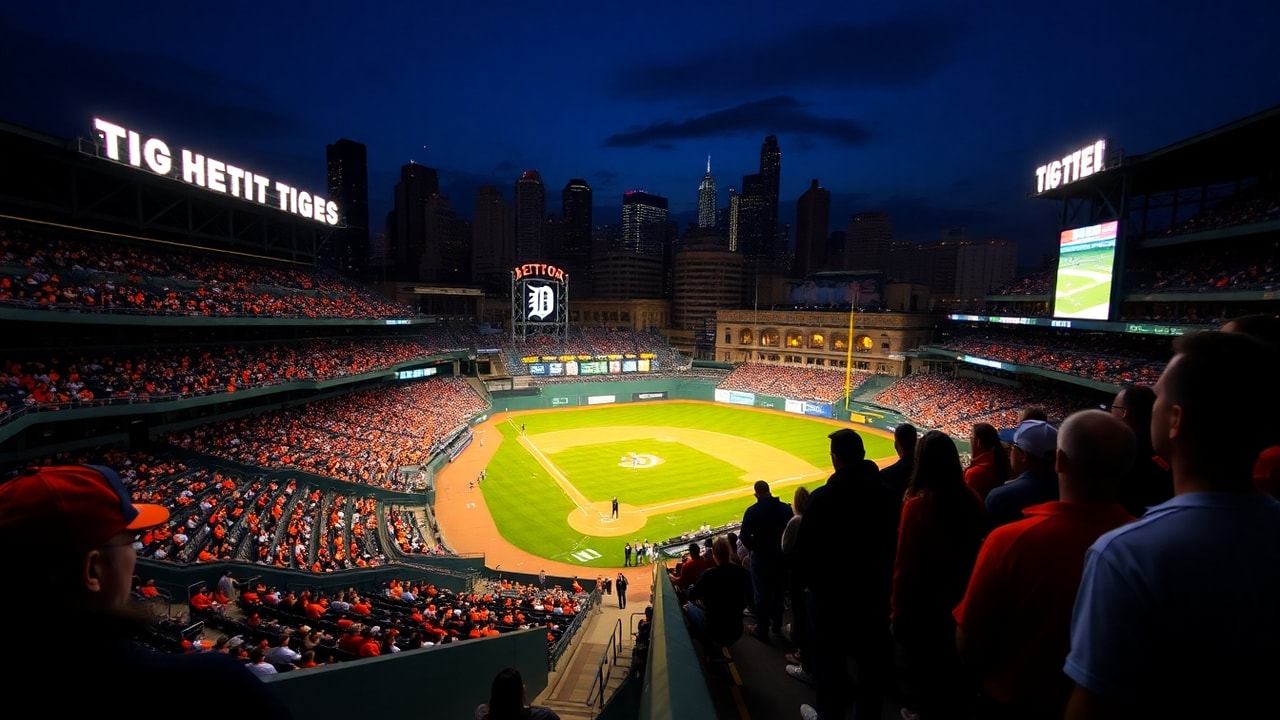
The Detroit Tigers are again being evaluated less on whether they can win today and more on whether they can sustain success over the long haul—an especially sensitive question for fans and local businesses that measure momentum in seasons, not sound bites.
After a series of roster moves and a growing emphasis on player development, the franchise is trying to build something durability-driven: an MLB contender that doesn’t require constant reinvention. For Detroit, the stakes extend beyond the field. Teams can influence downtown foot traffic, regional media engagement and even small-business demand on game days—effects that are hardest to maintain when a team’s performance swings widely from year to year.
Detroit’s edge: talent pipeline meets patience
From an MLB analysis perspective, the Tigers’ most realistic path to sustaining success hinges on two interconnected elements: the quality of prospects moving through the system and the ability to keep core players productive long enough to absorb injuries, slumps and contractual volatility.
“Sustaining success is usually less about one big swing and more about how well you develop talent and manage volatility,” said Garrett Broshar, a baseball writer with Baseball America, noting that depth at multiple positions matters as teams navigate the grind of a 162-game schedule.
That evaluation becomes even sharper in the Tigers’ baseball rivalry ecosystem, where division opponents can also reload quickly. While Detroit’s near-term results get the headlines, long-term planning is tested by how consistently the organization identifies value and retains competitiveness when budgets, roster construction and player development timelines all collide.
Why “over the long haul” matters to fans and the local economy
In Detroit, sports aren’t just entertainment—they’re a recurring public ritual. Game attendance and local spending patterns tend to track team performance, but the relationship is rarely linear. When a team feels stable and credible, fans show up more reliably, media coverage broadens, and sponsors are more willing to commit to longer cycles.
According to the U.S. Census Bureau, the Detroit–Warren–Dearborn area has a large share of residents employed in services and retail, meaning consumer behavior can shift quickly when discretionary spending rises or falls. While the Bureau doesn’t quantify team-to-spending causality, its economic snapshots are frequently used by local analysts to understand how demand moves in consumer-facing sectors.
Local leaders also frame stadium-era sports benefits in terms of consistent engagement. “Repeat attendance is what turns a good season into a broader community habit,” said Donovan Strong, executive director of a Detroit-area nonprofit that supports community programs tied to youth sports. Strong said sustainability—program funding, participation and volunteer energy—often depends on stable local interest rather than short peaks.
That’s where sustaining success over the long haul becomes a practical question: Will the Tigers’ on-field identity translate into predictable off-field engagement, or will Detroit’s sports calendar continue to experience the boom-and-bust cycles common to rebuilding clubs?
Baseball rivalry pressure: Cubs vs Brewers as a mirror
Even beyond Detroit’s division, the Tigers are part of a broader MLB landscape where sustained competitiveness is increasingly about systems—front-office processes, analytics, and a disciplined approach to contracts and player development. Comparisons often come up with teams in other markets that have recently balanced contention windows with longer planning.
In particular, fans sometimes reference Cubs vs Brewers style matchups as shorthand for what it looks like when a franchise tries to keep a roster competitive across multiple roster cycles. The Cubs and Brewers have each leaned on different models—one more acquisition-and-reload focused, the other more development-and-continuity focused—but both illustrate a key lesson: sustaining success requires aligning scouting, coaching, and organizational decision-making year after year.
For Detroit, the key question isn’t whether a single roster move works. It’s whether the organization can create a repeatable engine—finding contributors, keeping them on the field and managing the inevitable transitions when prospects graduate from the minors and roles shift in the majors.
Background & data: what “durability” looks like in MLB
MLB durability is hard to measure with one statistic, but analysts often cluster evidence into three buckets: player availability, performance stability and roster depth.
Player availability matters because injuries can derail even strong projection models. A team that consistently protects innings, workloads and defensive roles often competes longer than teams that rely heavily on fragile, high-variance pieces.
Performance stability reflects whether a team’s batting and pitching outputs resist dramatic swings. Teams with strong plate discipline and adaptable pitching strategies tend to recover faster after rough stretches.
Roster depth is the quiet driver of long-term success. A contender’s advantage doesn’t disappear when one starter is out or when a position player needs a midseason replacement.
These dynamics also connect to Detroit’s broader economic reality. The Tigers play in a city still navigating post-industrial restructuring, which can shape civic expectations around long-term investments. Stable franchise planning can resonate with residents who are accustomed to policy cycles and capital projects that only benefit the community when they’re built to last.
Impact on Detroit Residents: tickets, neighborhoods and local sports culture
Detroit residents often feel team performance indirectly. When the Tigers are competitive, neighborhoods near transit lines and commercial corridors can see increased demand on certain weekends. Restaurants, parking services, and local vendors tied to game-day crowds may benefit, while community youth baseball programs sometimes experience higher participation and renewed interest from sponsors.
But residents also worry about opportunity cost. When a team is rebuilding or inconsistent, civic attention can drift. Local partners may hedge sponsorship commitments, and fans who can’t afford premium ticketing may retreat to cheaper viewing options.
That’s why sustaining success over the long haul is as much about maintaining public trust as it is about avoiding last-place finishes. Over time, a franchise earns confidence by keeping contention within reach, even in years when the path is imperfect.
What happens next for the Detroit Tigers
The Tigers’ near-term challenge is translating organizational progress into consistent results while controlling the roster’s “reset” points. That likely means continuing to develop position players and pitchers with clear roles in mind, not just accumulating prospects. In practical terms, the franchise will be judged on whether it can avoid repeated seasons defined primarily by “potential.”
On the baseball-rivalry front, Detroit will also be competing against teams that may be faster to reload. Divisional matchups tend to magnify momentum. If Detroit can keep winning more than it loses in those stretches, it will strengthen the argument that the franchise is building something that can endure.
For residents, the immediate payoff may show up as more consistent weekend plans—tickets purchased with less hesitation, local business planning for steadier demand, and a broader sense that the Tigers’ future isn’t an open-ended question. The longer payoff is bigger: Detroit’s ability to sustain a shared sports identity that doesn’t vanish when the season turns.
In a league where rebuilding timelines can feel endless, sustaining success over the long haul may be the Tigers’ most decisive move yet—one that will be measured not only in standings, but in how confidently Detroit can look ahead to the next chapter of its baseball rivalry culture.