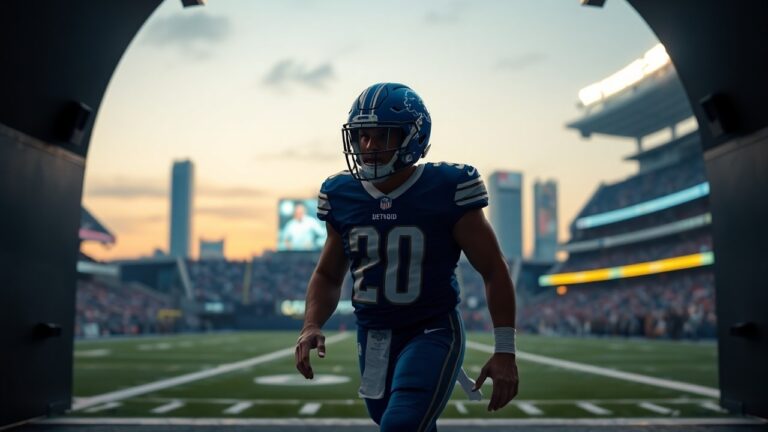
The Detroit Lions entered this summer expecting their run game to be a major strength, but David Montgomery admission from NFL training camp has clarified what the team is prioritizing—and what Lions fans feared might happen if the ground attack doesn’t click quickly.
Speaking during open periods at camp, Montgomery addressed the realities of working through a deeper backfield and the fine margins that determine whether a running back is used as a featured option or rotated more frequently. For a fan base that has been waiting for consistent, physical production in the playoffs and beyond, the message was both candid and instructive.
What Montgomery said during NFL training camp
Montgomery’s comments, reported by The Athletic during Detroit’s training-camp coverage, pointed to a simple truth: workload and rhythm are earned through performance in practice, blocking execution, and health over the course of the preseason. Rather than framing his role as guaranteed, he emphasized that coaches evaluate how each player handles reps and responsibilities, including pass protection and assignment-based runs.
“You can’t just be a running back and think you’re going to get it all the time,” Montgomery said in the account published by The Athletic, highlighting the importance of staying prepared when the scheme calls for a different look. He also discussed how the Lions are working to ensure the run game functions as a system—one that depends on offensive-line consistency, timing, and decision-making on each play.
That admission matters for Detroit football because it confirms what many fans have suspected: even for a proven running back, a team’s usage can change quickly depending on early-season matchups, defensive fronts, and how well the entire offense is operating together.
Why Lions fans worried about the run game—and what the admission signals
For Lions fans, the biggest concern has often been less about talent on paper and more about maintaining momentum. When a run game stalls, it can force the offense into predictable passing situations, reduce third-down efficiency, and increase turnover risk by pressuring quarterbacks into longer, riskier throws.
Montgomery’s camp perspective suggests Detroit is trying to prevent that scenario by building reliability through reps and roles. If the Lions were to keep the run game limited to a narrow set of carries, the offense could become more vulnerable against aggressive defenses that crowd the box.
At the same time, Montgomery’s willingness to emphasize rotation and preparedness is a sign the team is not treating any single back as untouchable. During a typical preseason, even established starters often see their distribution shift depending on health and how quickly players execute the details—particularly those that don’t show up in box scores.
Impact on Detroit Residents: from Sundays to local interest
Detroit sports culture is resilient, but it is also intensely attentive to weekly performance—especially from teams that represent the region’s identity on the national stage. When the Lions’ offense is effective on the ground, the benefits ripple beyond the stadium.
In Detroit-area sports bars and local watch parties, a stronger run game often means longer drives, more clock control, and fewer anxious late-game swings. That translates into a more engaged in-person game-day scene, with fans sticking around for the full broadcast window instead of checking in and out as the offense struggles.
While the NFL is national, the day-to-day economics of game viewing are local. According to Visit Detroit, Greater Detroit entertainment and visitor activity tends to intensify around major sporting events, with restaurants and hospitality partners seeing increased demand during high-interest weekends. If Montgomery and the Lions can establish the kind of physical, sustained offense that leads to competitive games, that increased attention can carry through to Detroit-area businesses that depend on consistent weekend traffic.
Background & Data: running back roles in modern NFL offenses
Montgomery’s comments reflect a broader trend across the league: teams are increasingly optimizing for versatility rather than simply rewarding a single bell-cow style. Workload sharing is now tied to scheme—run plays, third-down packages, and pass protection all require different skill sets.
Data and analysis from organizations such as Football Outsiders have long emphasized that efficiency depends on context: blocking quality, play design, and the defensive pressures facing the offense. Even a talented runner can have reduced impact if the offensive line is inconsistent or if the offense cannot maintain tempo and favorable down-and-distance.
For Detroit, the key is how the coaching staff uses different backs to match personnel and formations. Montgomery’s candid admission is essentially a reminder that the Lions’ approach involves competing for reps inside a defined system. That system is meant to keep the offense predictable in structure but flexible in execution—particularly when games turn into defensive battles.
What happens next for the Detroit Lions and Montgomery
Training camp admissions like Montgomery’s don’t guarantee a specific statistical outcome in the regular season, but they do shape how fans interpret the early depth-chart storyline.
As the Lions move from camp into preseason and then into Week 1 preparation, the most telling indicator will be how often Detroit’s run game produces positive outcomes that extend drives: explosive plays when the defense is expecting runs, consistent gains on early downs, and steady third-down conversions that keep the offense out of obvious passing sequences.
For Montgomery specifically, the next step is the same one he referenced: earning and maintaining a role through execution. That includes fundamentals that scouts often track—assignment accuracy, pass-set timing, and the ability to read blocks and hit the correct cut lanes. If Montgomery can do that consistently, the Lions’ backfield rotation may look less like a concern and more like an advantage.
Bottom line for Detroit football
Montgomery’s camp admission offers a grounded perspective on the reality of NFL roles. For Detroit Lions fans, it confirms that the offense’s success depends on system execution, not just individual carries. If the Lions follow through with consistent line play and smart utilization, Montgomery’s message will read less like a warning—and more like the blueprint for building a durable run game that can travel in October and beyond.